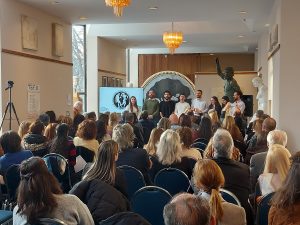
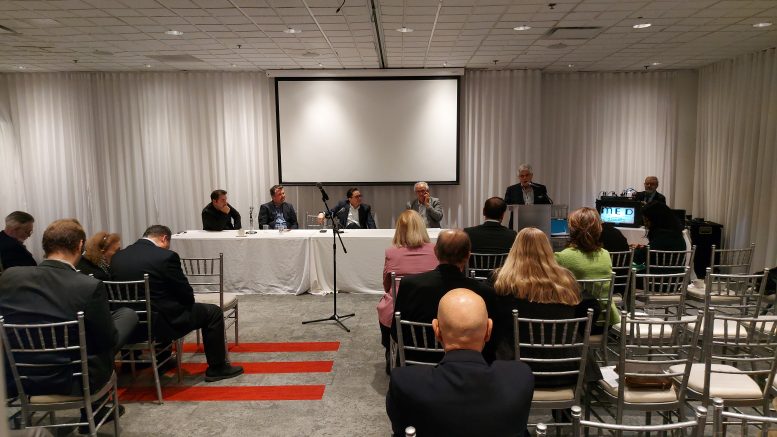
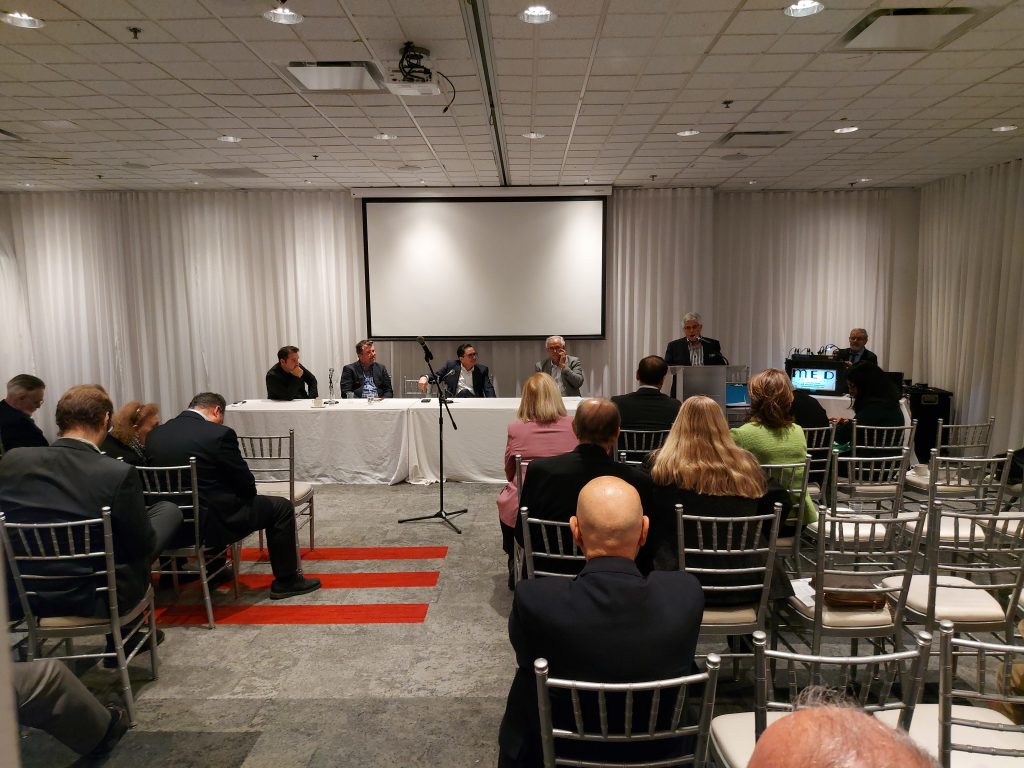

The Centre des Congrès Palace in Laval was bathed in soft light against a backdrop of elegant white drapery, creating a solemn and intimate atmosphere for a gathering that bridged the gap between Montreal’s Hellenic pioneers and its rising political stars. Rows of attentive community members sat facing a dais of distinguished leaders, marking a moment of reflection and mobilization for the Greek diaspora. This visual tableau set the stage for the Hellenic Congress of Quebec’s annual conference, a forum dedicated to examining the vital intersection of Hellenic identity and political influence in Canada under the theme of participation and representation.
The event began with a touch of characteristic cultural humour as John Theodosopoulos, the Vice-President of the Congress, welcomed the attendees by acknowledging the delayed start with a knowing smile. “We’re Greeks, that’s why we announced two and we’re starting with two and a half,” he quipped, instantly establishing a rapport with the room before pivoting to the serious business at hand. This blend of cultural familiarity and formal purpose permeated the opening remarks of President Sotirios Antypas, who addressed the audience in Greek to emphasize the continuity of their heritage. He grounded the day’s discussions in a deep respect for the values passed down through generations, stating, “I think that the commitment that we have in the democratic values which they come from our ancestors that we inherited those values had guided us in order to continue contributing in the political, in the economical, in the cultural life of Quebec and Canada”.
Senator Leo Housakos delivered a keynote address that resonated with ancestral pride and a stark call to action, reminding the audience of the immense sacrifices made by the first generation of immigrants who arrived “with five bucks in their pocket” yet built enduring institutions like the Greek Community of Montreal. He urged the attendees to honour those foundations by actively engaging in the present, warning against the complacency that can accompany success. “Tough times build strong men and comfortable times build weak men,” he cautioned, sharing that he constantly reminds his own children of the “lion in the heart” that drove their grandparents to succeed. His words underscored the central theme that history “can only sustain itself and persevere if you’re ready to defend and fight for it”.
Adding to this call for renewal was Basile Angelopoulos, President of the Hellenic Community of Greater Montreal, who spoke of a transformative energy within the organization. “A new wind has started to blow,” he declared, emphasizing that this momentum must extend to all organizations within the diaspora. He highlighted the critical need for mentorship to engage the youth, noting that the community’s challenges are not merely financial but rooted in participation. “We should all think, and it is good for all of us to think together about how we can create the appropriate conditions to promote the young people,” he urged, framing political engagement as a fundamental act of giving back to the society that allowed them to prosper.
The first panel discussion, moderated by journalist and author Justine Frangouli, brought personal narratives to the forefront and illustrated the diverse pathways to political success. Frangouli opened the session by challenging the traditional gender dynamics of the room, asserting that “the Congress is not a male issue, the Congress is mainly a female issue,” and celebrating the female leaders present.
Member of Parliament Annie Koutrakis highlighted the importance of being informed and analytical, drawing on the Greek concept of “tecton” or builder to describe the “tectonic shifts” currently reshaping global politics. She spoke passionately about her practical achievements, specifically the signing of a Memorandum of Understanding on tourism between Canada and Greece, a milestone that had been missing despite decades of trade relations. “It’s really one of the most proud moments of my political career,” she shared, illustrating how political office can directly strengthen ties with the homeland.
Her colleague, MP Emmanuella Lambropoulos, shared the intimate details of her own political origin story, which began not in a boardroom but in “my grandmother’s living room” where she launched her nomination bid. She recounted the initial scepticism of her father, who worried about her leaving a stable teaching career for the volatility of politics, and the sheer grit required to win. “I was still going to my day job as a teacher from 8 to 4… and going to the doors until 9 p.m., in the dead of winter, in the freezing cold,” she recalled. Her perseverance paid off, allowing her to later champion vital initiatives such as a national school food program and improved access to fertility treatments, issues she noted would not be prioritized without the voices of young women in Parliament.
Local governance was represented by veteran politicians who emphasized service to the citizenry. Mary Deros, a former city councillor with decades of experience, described her entry into politics as a natural extension of her volunteer work as a “soccer mom,” managing teams and serving on the board of the Park Extension Youth Organization. She vividly described her 1998 campaign, where her “volunteers were the kids from soccer,” who stayed up with her “till four in the morning in drizzle rain, putting up my posters” because their parents trusted her implicitly. Aglaia Revelakis, a city councillor for Chomedey, spoke to the resilience required to break away from party machinery. She shared the pivotal moment of her decision to run as an independent, spurred by her husband’s advice that “it’s now or never,” a move that allowed her to continue serving her constituents with integrity.
The conference also tackled serious legislative matters affecting the community. Attorney and former MNA Gerasimos (Gerry) Sklavounos Jr. provided a detailed analysis of Bill 1, the proposed Quebec Constitution Act 2025. He outlined the potential implications for minority institutions, warning that the bill’s provisions could prevent school boards and other bodies from using public funds to legally challenge government actions. He criticized the legislation for seemingly being designed “to protect the government from contestation by citizens” rather than the other way around, urging the community to remain vigilant and informed about legal changes that could reshape the province’s institutional framework.
The afternoon sessions pivoted to the future of the Hellenic Congress of Quebec itself. Moderator Nicholas Katalifos shared a personal anecdote about how he first connected with the Congress as a university student seeking help with a thesis, eventually finding mentorship under Professor Andreas Gerolimatos. He noted the immense potential of the community’s professional network, pointing out that “more than 350 people of Greek origin” currently work just within the English Montreal School Board.
Panelist Dimitri Soudas offered blunt, pragmatic advice on the necessity of unity, recounting his time in the Prime Minister’s office where divided community organizations diluted their own influence. “Unless we present one united front we will never get ministers of Greek origin,” he argued, stressing that internal cohesion is the prerequisite for external power. He also injected levity into the discussion with a story from his youth in the Congress, recalling a parade float project where a budget of $500 ballooned to $2,500, a humorous reminder of the learning curve inherent in youth activism.
During this panel, Gerasimos Antypas offered a historical perspective on the Congress’s evolution, addressing the audience in Greek to reflect on the revitalization of the organization in the late 1990s. He noted that the goal of his cohort was “to pass this flame to others of our generation” and highlighted the deep roots of the community by referencing a “Greek-Canadian guide… published in Montreal in 1921,” proving that their history in the province is foundational. He urged the audience to view the day’s proceedings not as a culmination but as a launchpad for future engagement, asserting, “I think that what is happening now in the Congress is the beginning but today’s discussion must be the beginning of these challenges”.
Following the closing remarks on the road ahead by President Sotirios Antypas, the conference officially concluded its sessions at 5:30 PM. While the schedule originally called for the organization’s General Assembly to follow immediately, the leadership elected to postpone this meeting until January 2026. This decision was made to ensure maximum participation during a quieter week after the holidays, acknowledging the high volume of competing community events taking place throughout the city on December 7 2025.