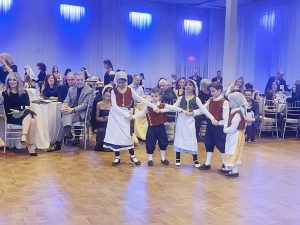
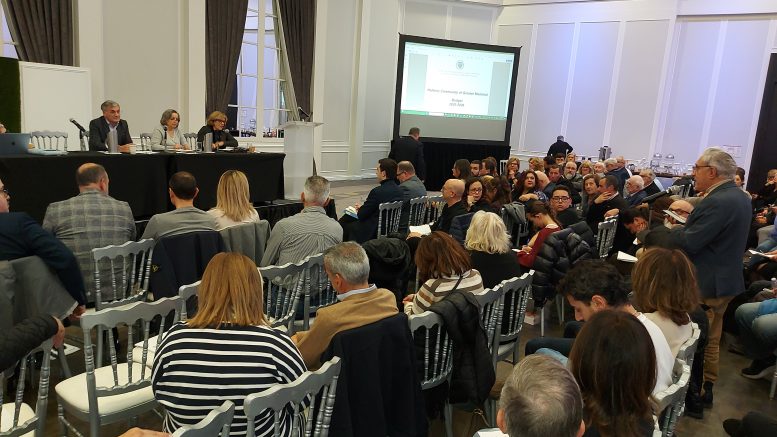
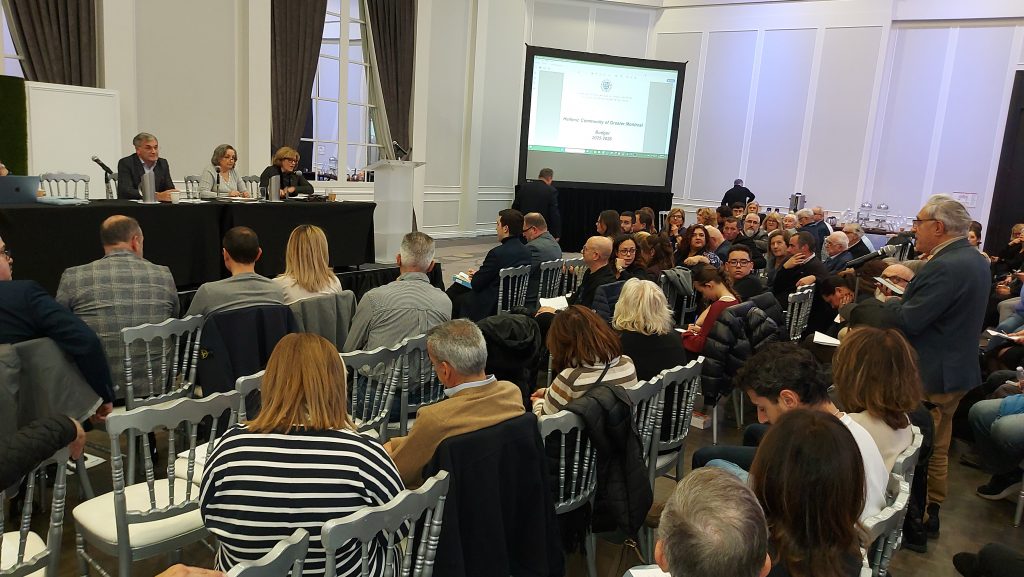

Under the crystal chandeliers of the Château Royal in Laval, a venue whose elegance stood in sharp contrast to the weathered, unusable halls of the Montreal community center, the Hellenic Community of Greater Montreal (HCGM) gathered for a defining moment of transition. President Basile Angelopoulos stood before the assembly, his voice carrying the weight of a century of history as he opened the meeting by acknowledging the resilient spirit of the local Hellenism that had necessitated this temporary relocation to the North Shore. The atmosphere was one of quiet intensity, a room filled with 196 stakeholders who had come to witness the unfolding of a new administrative era while grappling with the structural and financial burdens of the old. This gathering was more than a procedural requirement; it was a collective reckoning with the physical reality of a community whose primary Montreal hall remains shuttered by roof failures, and whose future now rests on a delicate balance of ambitious growth and rigorous fiscal discipline.
The meeting began with a poignant reminder of the community’s reach and the mechanical necessity of its governance. A live screen at the front of the hall illuminated the current membership statistics, showing 4339 registered members across the Greater Montreal Area. As the clock ticked past the scheduled start, the counter for those present climbed steadily until it reached 101, just one soul over the 100-person requirement for a quorum. President Angelopoulos took the microphone with a sense of relief and purpose, thanking the attendees for their presence and emphasizing that their participation would be critical for the future of Hellenism in the region. He spoke of the need for unity, weaving a narrative of a community that is not merely a collection of buildings or balance sheets, but a living, breathing entity that must evolve to survive. This vision of evolution was underscored by the presence of the Board of Directors and regional council members who stood individually to be recognized, a gesture intended to humanize the leadership and bridge the gap between the executive and the membership.
This human context, however, was immediately anchored by the sobering reality of the Auditor’s Report for the fiscal year ending June 30, 2025. The numbers presented by the Treasurer and confirmed by Richter LLP painted a picture of a community at a financial crossroads. The financial statements revealed a significant deficiency of revenues over operating expenses, totalling a net operating loss of 2,504,547 dollars for the year. This figure, coupled with a cash deficit of 2,787,032 dollars, underscored the urgency of the Board’s plea for communal support. The community’s total debt has reached 11,922,607 dollars, a staggering sum that includes a 1.5 million dollar line of credit with the Bank of Montreal that has been fully utilized. These figures were not presented as a cause for despair but as a baseline for the accountability that the current administration has promised to uphold. The auditors issued a qualified opinion, a standard but serious notation for non-profit organizations where certain donation records are inherently difficult to verify, yet they reported no instances of fraud or significant irregularities, providing a foundation of trust for the path forward.
The Board’s narrative shifted from these hard truths to a vision of revitalization, highlighting the successes of the Socrates-Demosthenes schools and the Cultural Institute. The President spoke with pride about the “I Support” campaign, an ambitious initiative designed to ensure the vibrancy of the Greek Orthodox churches and the educational institutions that serve as the backbone of the community. He noted that despite the financial headwinds, the schools continue to provide an exemplary trilingual education to hundreds of students, acting as the primary vehicle for preserving the Greek language and heritage. The proposed budget for 2025-2026, which the assembly eventually passed, projects a total regional revenue of 1,814,000 dollars, with the Cultural Institute aiming for 184,000 dollars through dances, fundraising, and registration fees. The Board framed these goals not as mere projections but as a patriotic duty, calling on every member to see themselves as an investor in a heritage that has thrived in Montreal since 1906.
Moments of scrutiny emerged as the floor was opened to questions, with former Treasurer Nick Fudas raising critical concerns regarding the management of the bank covenants. Fudas, drawing on his experience from the previous administration, questioned the sustainability of the current debt servicing strategies and the long-term implications of the fully drawn line of credit. His interventions served as a necessary counterpoint to the official optimism, forcing a detailed discussion on the liquidity risks that the organization faces. Similarly, Mrs. Christine Vathis pressed the Board on the transparency of the Audit Committee’s findings, suggesting that the report’s focus on past administrative decisions felt more like a political settling of scores than a neutral financial analysis. These exchanges, while heated, provided the assembly with a rare look at the internal friction that often defines large communal organizations, yet they also demonstrated a healthy, democratic engagement where dissent is not silenced but debated.
The legacy of the previous administration was also a point of discussion, with Dr. George Tsoukas and his son,Dr. Orestis Tsoukas, participating in the dialogue. Dr. Orestis Tsoukas, a former secretary for athletics, provided insightful remarks regarding the need for better integration of youth programs and sports into the community’s long-term strategic plan. His contributions were met with respect, reflecting a shared desire among all factions to see the younger generation take a more active role in the community’s life. The Board responded to these critiques by reiterating their commitment to transparency and by promising that future decisions, including the potential referral of governance issues to legal authorities, would only be made by the Board as a whole after thorough evaluation by the Audit Committee. This commitment to procedural rigour was a central theme of the Audit Committee’s own recommendations, which urged the organization to maintain internal resolution of disputes whenever possible to protect the community’s reputation and dignity.
Throughout the five-hour proceedings, the narrative arc of the meeting remained focused on the precarious but hopeful transition toward modernization. The President’s report touched upon the eventual repair of the Montreal Community Center’s roof, a project that symbolizes the broader effort to rebuild the community’s infrastructure both physically and financially. He spoke of the “bird that has flown” in reference to past missed opportunities, but urged the members to focus on the “new themes” and the “significant words” that would define the next three years. This call to action was supported by the approval of the consolidated budget, which seeks to balance the books through a combination of increased registration fees, targeted fundraising, and more efficient management of real estate assets. The Board’s message was clear: while the financial burden is heavy, the collective will of the 4339 members is a resource that has yet to be fully tapped.
As the meeting progressed into the evening, the technicalities of the HCGM’s governance were further dissected through the lens of the Audit Committee’s analysis. The committee highlighted the need for broadened liability insurance for regional council members and targeted governance training for all leaders, suggesting that the community’s future success depends as much on the quality of its management as on the generosity of its donors. The financial statements for June 30, 2025, showed that while the organization has faced a significant deficiency of revenues, it still maintains assets totalling 21,348,779 dollars, primarily in land and buildings. This underlying asset value provides a safety net, but as the Treasurer noted, it is a net that cannot be relied upon forever without a fundamental shift in how the community generates and manages its operational cash flow.
The assembly concluded with a final members’ question period that touched on everything from the status of the supplemental Greek schools to the logistics of church maintenance. The dialogue remained civil, though the underlying tensions between different historical factions of the community were occasionally visible. President Angelopoulos closed the session by thanking the members for their patience and their passion, noting that the sheer length of the meeting was a testament to how much everyone cared about the organization’s survival. He reminded the audience that the Hellenic Community of Greater Montreal is more than a non-profit; it is a sacred trust passed down through generations. The 2025 Annual General Assembly of the Hellenic Community of Greater Montreal was officially adjourned at 7:05 p.m. following a motion by the assembly that was seconded and passed by a majority of the members present.