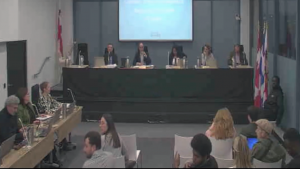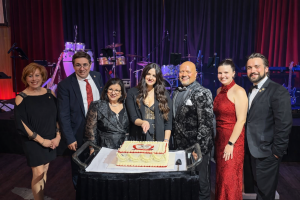
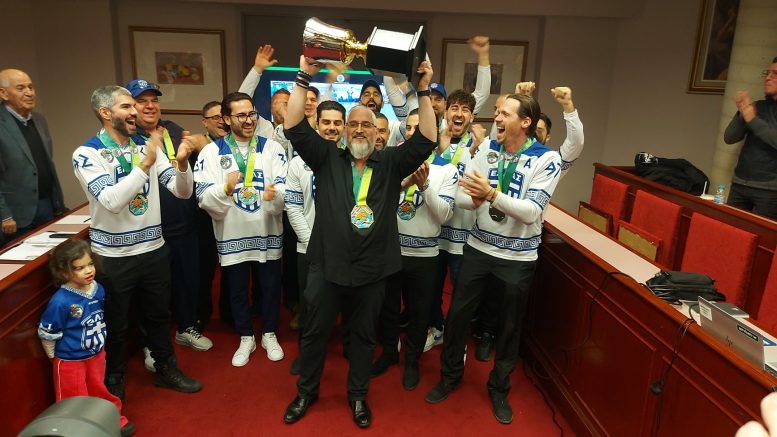
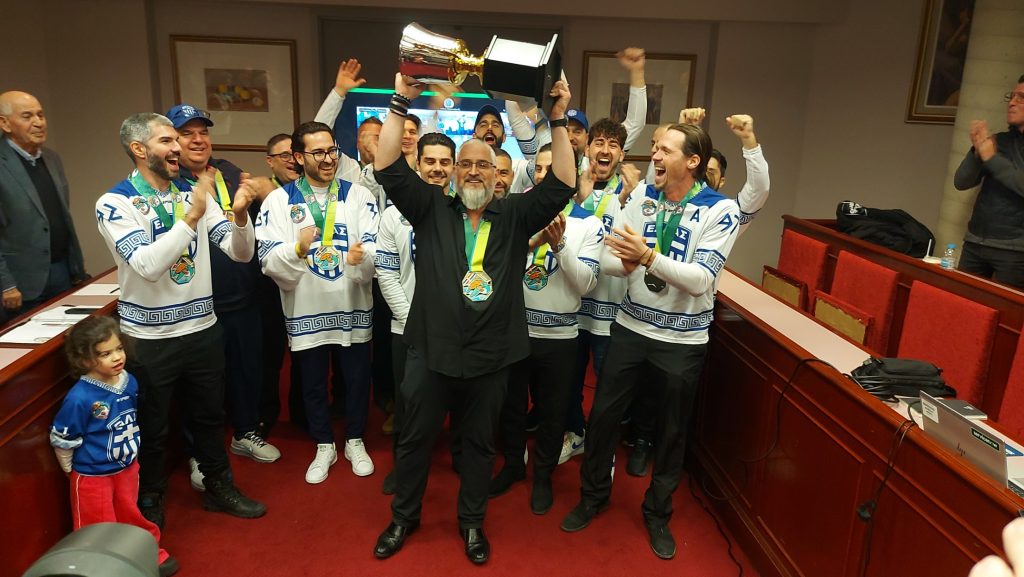

The atmosphere inside the boardroom of the Hellenic Community of Greater Montreal on the evening of December 2, 2025, was one of barely contained jubilation. Board members, accustomed to deliberations on budgets and community programming, found themselves on their feet, applauding as a group of young men in white jerseys trimmed with the ancient Greek meander pattern filed into the chamber. At the head of the procession stood Peter Chiotis, a member of the Regional Board of Directors Council of Laval and the coach of Team Hellas, hoisting above his head a gleaming silver trophy. Gold medals hung from the necks of the athletes behind him. These were not professional players from Athens or Thessaloniki, but Hellenes and Philhellenes from the neighbourhoods of Montereal, Laval, Chomedey, Park Ex and the West Island, and they had just accomplished what many in the international ball hockey community considered impossible: defeating Canada on its own turf, in its own sport, to claim the gold medal at the 2025 World Ball and Dek Hockey Federation World 4vs4 Championships in Puerto Plata, Dominican Republic.
The victory, achieved on November 29, 2025, sent ripples through the Greek diaspora in Montreal and beyond. Local radio personality Vinny Barrucco of 95.9 Virgin Radio offered his congratulations on air, praising the team for their determination. “I want to say a big, huge congratulations to the Greek Montreal ball hockey team,” Vinny announced to his listeners. “They just won the world’s biggest and most prestigious ball hockey tournament. That is incredible. So nice to see a group of about 20 Montrealers come together. They travel together. They put their heart and soul into it. And they won.” The sentiment captured the essence of what Team Hellas had achieved: a triumph forged not in elite training academies, but in the recreational rinks and community leagues of Greater Montreal.
Coach Peter Chiotis, addressing the Board of Directors at the HCGM headquarters, offered his gratitude in characteristically spiritual terms. “I would like to first thank Jesus Christ and the Virgin Mary, because only a miracle made this happen,” Chiotis declared, his voice thick with emotion. “I want to introduce to you all these players who made our nation proud, showing courage, determination, and love for one another.” The roster he then called forward, one by one, represented a cross-section of Montreal’s Greek community: twin goalkeepers Christos and Angelos Ekonomakis, captain and leading scorer Panagiotis Karvouniaris, team president Manny Mavroudis, and the clutch shootout specialist Carl Gingras, among others. Several players were connected to Greek heritage through marriage or family ties, reflecting the inclusive definition of Hellenic identity that has long characterized Montreal’s diaspora.
The tournament itself, sanctioned by the World Ball and Dek Hockey Federation, brought together national teams from Canada, Quebec, the United States, Slovakia, Czechia, and a combined North American squad. Unlike the traditional 5vs5 format played on ice hockey arena floors, the 4vs4 game is contested on plastic tile surfaces, emphasizing speed, skill, and rapid transitions. Slovakia and Czechia, nations where ball hockey enjoys semi-professional status with state support, arrived as favourites. Team Quebec, drawn from the province that serves as the global heartland of ball hockey, was considered a powerhouse. Team Canada, perennial champions, featured players with NHL experience. Against this backdrop, Team Hellas entered as heavy underdogs, a self-funded squad of local league veterans who trained together at the PTM facility in Laval.
“It simply started as an idea to join the world stage and be part of a huge 4×4 tournament representing Greece,” Chiotis explained in an interview with The Montreal Greek Times. “We are a bunch of friends with great talent who wanted to try it out. We knew we had a huge and difficult task playing the best programs of the world as a whole.” The coach, a veteran of Montreal’s ball hockey scene with 17 local championships to his name and previous international experience leading the Hellenic Ball Hockey Association Masters team to a World Championship in Bermuda, assembled his roster without formal tryouts. He selected players he trusted, men who had competed against one another for years in different leagues but had never played together under a single banner.
The tournament’s opening match set the tone for what would become a remarkable run. Facing Slovakia, a team whose players receive compensation for their efforts, Greece produced a shock 4-3 victory. “We beat programs that picked best players of their countries,” Chiotis later reflected. “We were just a bunch of local friends. This is huge.” The following day brought a brutal encounter with Czechia, a 5-2 loss that was less about the scoreline than about the physical toll exacted. Tournament officials reportedly informed team presidents that officiating standards would be adjusted due to the intensity of the match. Greece emerged battered but unbroken.
The psychological low point came in the third group-stage game against Team Quebec. Leading for much of the contest, Greece allowed the match to slip away, eventually falling 4-2. That evening, Chiotis withdrew from the team’s social activities, retreating to his hotel room to contemplate tactical adjustments. “That night I locked myself in the room and needed to make a few changes,” he recalled. “The team was shocked that I didn’t join them.” What emerged from that solitary deliberation was a renewed sense of purpose, distilled into a slogan coined by captain Karvouniaris: “Be honest about every shift.”
The following morning, as the team bus carried the players toward their match against North America, Chiotis gathered his squad for a speech that would become the stuff of community legend. “Today we’re playing two monsters,” he told them. “You guys have some kind of a following in Montreal that they’re there and they’re watching us play. Some of them are very proud for us and some of them are going to be mocking us. I’m a very proud guy and I know in this bus right now we have a couple of players that are simply winners. They don’t like losing.” The coach challenged his players to decide their own fate. “If you guys want to go back to Montreal and be a laughingstock to certain individuals, then let’s make the best out of it. Let’s go there, make a fool out of ourselves, and we call it a day. Or let’s do what I think you guys are capable of doing.”
The response was emphatic. Greece dispatched North America 4-0, then delivered the result that announced their credentials as genuine contenders: a 2-0 shutout of Team Canada. Goalkeepers Christos and Angelos Ekonomakis were imperious, and November 26 was thereafter designated by the team as “National Shutout Day.” A 6-2 rout of the United States completed the group stage, sending Greece into the knockout rounds with a 4-2 record and second place overall, trailing only Czechia.
Michael Tzouvadakis, who served as assistant coach, trainer, medical staff, and equipment manager, offered his own perspective on the team’s transformation. “We were a bunch of friends who joined this tournament thinking of having fun, while on vacation in a sunny destination,” Tzouvadakis wrote in a statement to The Montreal Greek Times. The reality proved far more demanding. “Did whatever was needed to get the boys to be successful,” he noted, summarizing his multifaceted role.
The quarter-final brought a rematch with the United States, dispatched 8-1 in what amounted to a formality. The semi-final, however, offered a chance at redemption against Team Quebec. Trailing 2-0 and facing elimination, Greece mounted a furious comeback. Marino Destounis scored with eight minutes remaining to cut the deficit. With one minute left, Quebec committed a tripping penalty on Karvouniaris. Off the ensuing faceoff, Konstantinos Kakivelis fed Carl Gingras for a one-timer that tied the match. The game proceeded to a shootout, where Gingras again proved decisive, scoring the winner while Christos Ekonomakis turned aside every Quebec attempt.
The gold medal final, contested on November 29, pitted Greece against Canada in a rematch of their group-stage encounter. Tim Langiano opened the scoring for Greece, assisted by team president Mavroudis. Canada equalized immediately and took the lead early in the second period. With two minutes remaining and their championship dreams fading, Greece found an answer. Konstantinos Fragkioudakis pinched forward and found captain Karvouniaris, who buried the tying goal. The shootout that followed became an exercise in nerve and precision. After regulation attempts left the teams deadlocked, Gingras stepped forward once more. His goal secured the championship, triggering scenes of unbridled celebration.
“Only with God we were able to accomplish what we did, cause it wasn’t luck, it was divine intervention,” Chiotis maintained. The coach’s spiritual interpretation found resonance with the community. At the December 2 Board of Directors meeting, the Secretary of Athletics for the HCGM read a formal letter of congratulations, describing the victory as “a remarkable achievement for all Greeks in Montreal and abroad” and noting that it marked “the first time that Greece participates in a 4×4 Open Category tournament.” The letter invited the team to consider the community’s sports centre as their home.
HCGM President Basile Angelopoulos placed the achievement in historical context. “I cannot help but remember some wonderful successes which Greece had,” he told the assembled gathering. “There was a remarkable success, if you remember, in 2004. And it started, if I am not mistaken, with the European Cup, which the Greek team shocked everyone. During that magical period of 2004, when we were all so proud, the second, of course, was the Olympic success, and the third, even in music, was the year we won the Eurovision.” Angelopoulos drew a line connecting those triumphs to the present. “I see this as an interesting symbol, that as we begin our 120th anniversary, this will be the beginning of many such successes.”
The final standings of the Men’s Open division told the story of an upset for the ages: Greece claimed gold, Canada silver, Quebec bronze, followed by Czechia, Slovakia, North America, and the United States. For the players who wore the blue and white of Hellas in Puerto Plata, the victory represented something beyond athletic achievement. It affirmed the capacity of a diaspora community, bound by heritage and friendship rather than professional contracts, to compete at the highest level of their sport. The team departed the HCGM boardroom that December evening to the applause of Board members and the cheers of families who had gathered outside, the trophy they carried a tangible symbol of what faith, family, and country could accomplish when channelled through collective effort.
The 2025 WBDHF World 4vs4 Championships concluded on November 29, 2025, in Puerto Plata, Dominican Republic, with Greece defeating Canada 3-2 in a shootout to claim the gold medal.