
Local Journalism Initiative Reporter
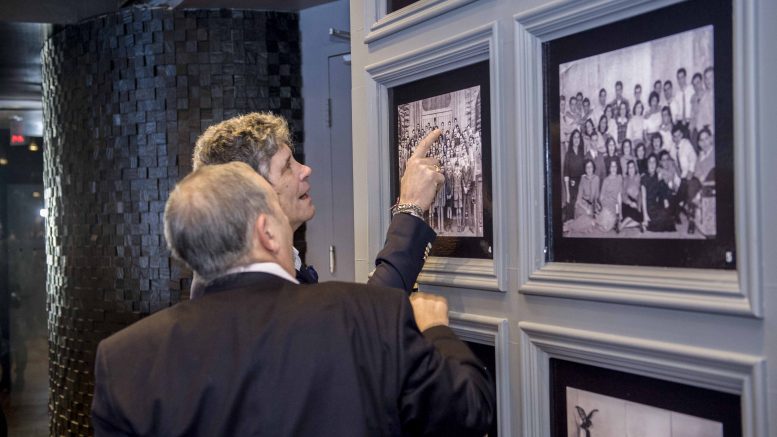
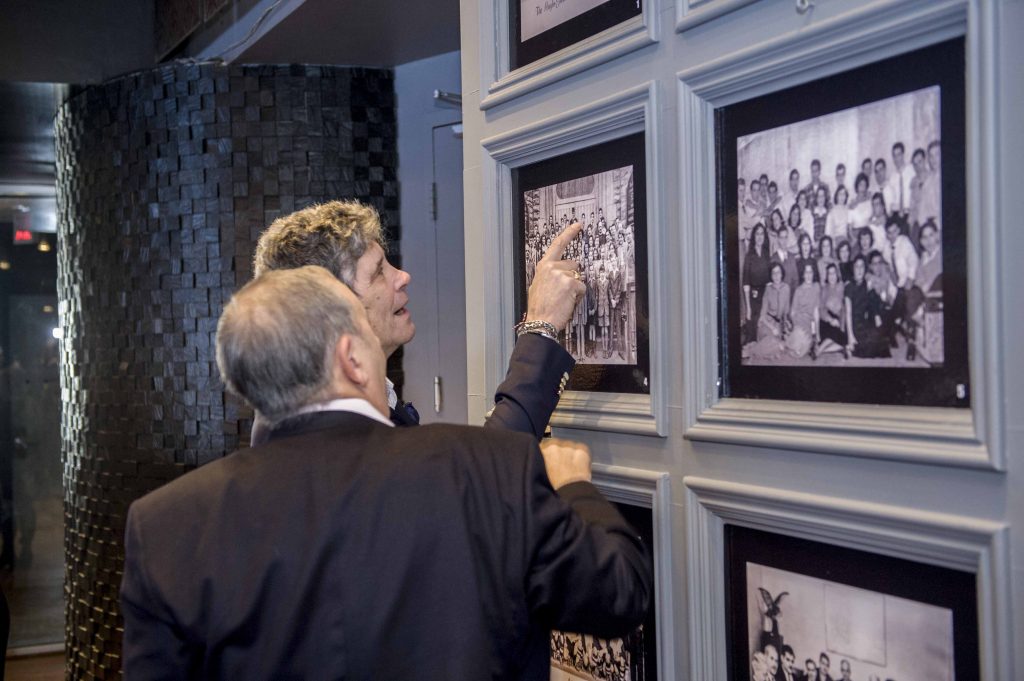
At the entrance of the Hotel10 restaurant, framed black-and-white photographs of early Greek families lined the walls, drawing guests into a shared moment of recognition and quiet reflection. Faces from another era looked out from carefully preserved images, many of them taken on the same grounds where the Greek Community of Montreal first organized itself more than a century ago. Two men in dark suits stood shoulder to shoulder, pointing at a grid of group portraits and searching for familiar names. Around them, other guests did the same, leaning in close, murmuring dates, some tracing fingers across the glass. Conversations slowed as attendees paused and lingered, while the setting itself carried the weight of memory. From this intimate threshold, the evening unfolded into a broader meditation on migration, faith, language and the enduring institutions that shaped Hellenic life in Montreal.
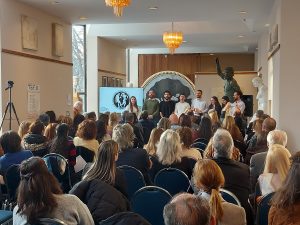
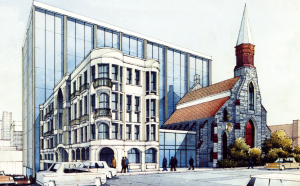
The sold-out event, titled Our Roots, Our Journey, took place on Feb. 8 at Hotel10, at 10 Sherbrooke St. W., built on the historic site of the Holy Trinity Greek Orthodox Church, a cornerstone of the community until it was destroyed by fire more than 40 years ago. The location was not incidental. Holy Trinity had once stood as the spiritual and social centre of Greek Montreal, a place where worship, education and communal decision-making converged under one roof. On Jan. 16, 1986, the church was consumed by flames in what the Journal de Montréal described at the time as the loss of “one of the most beautiful churches in the city.” Before its destruction, Holy Trinity had housed Sunday liturgies, Greek-language classrooms, youth clubs, community meetings and the very institutions that would grow into the HCGM as it exists today. The building was eventually converted into a commercial structure and later, alongside the adjacent Art Nouveau Godin building dating from 1915, became the hotel that now occupies the address. The community still owns the land. Hosting the event there restored the continuity between past and present, grounding the anniversary celebrations in physical history.
Like many started sharing throughout the evening, this historic ground holds deep personal meaning. For me, it embodies the culture and unified identity I proudly carry as a Greek-Canadian. It was the church where my parents were married in 1977, where my siblings were baptized, and the very street where my family has lived since the 1950s—where I grew up into adulthood. This neighbourhood is where my father arrived by boat at just five years old in 1959, and where my mother came at eighteen to visit her aunt, only to meet my father and choose to build her life here. What began as the dream of our parents and grandparents became our reality. It represents the opportunities we hold today and our responsibility to honour that legacy—preserving our heritage, language, and culture while leading future generations forward. It is this sense of gratitude and duty that motivates me to give back and proudly serve my community as Youth Secretary of the HCGM Board and other organizations that strengthen and inspire the next generation of our community across Quebec and Canada.
Guests were welcomed into a room filled with archival material drawn from the Hellenic Community of Greater Montreal’s library, alongside contributions from Jim Tselios, Jim Lekas and other private fami-lies. Photographs displayed at the entrance and on easels throughout the venue documented weddings, school classes, community councils and youth groups that once gathered at Holy Trinity. Numbered cards and pens were placed on each table so that attendees could help identify the figures in the pictures. Several guests recognized parents and grandparents in the images, often sharing stories across tables. The atmosphere was formal yet deeply personal, combining the dignity of commemoration with the warmth of reunion.
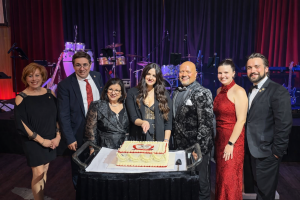
The evening was the first official event marking the HCGM’s 120th anniversary. It was organized by Kostia Pantazis, chair of the Personalities Subcommittee of the 120th anniversary committee, and em-ceed by Christina Georgiou-Laliberte, a graduate of École Socrates-Démosthènes and a current student at the Aristotle secondary program. In her opening remarks, Georgiou-Laliberte framed the theme of the night as both historical and forward-looking. “Our roots keep us stable while our journey shows our growth and our dreams,” she said. “Today, as we reflect on our roots and our journey, I am especially excited to learn more about the history of our community as we recognize and honour the builders of the Hellenic Community of Greater Montreal.” She delivered her remarks in fluent Greek, French and English, a trilingual performance that would resonate throughout the afternoon as a living testament to everything the founding families had set in motion.
Central to the programme was a video presentation produced by Peri Creticos. The short film drew on interviews with descendants of the founding families, including Christos Goulakos, Jim Tselios, Aristia Skodras, Ernie Grevakis and Jim Lekas, who shared accounts of their forebears’ arrival in Canada, their early struggles and the businesses they built from nothing. Lekas, a former vice-president of the National Bank of Greece (Canada) in Montreal and past president of the Hellenic Board of Trade, told THE MONTREAL GREEK TIMES his great-great-uncle Theodore Lekas was documented as the first recorded Greek in Montreal in the 1840s, and possibly the first in all of Canada. “Imagine getting off a ship, landing in a strange place, not knowing any language, and having $10 in your pocket,” he said. “That is how my father-in-law came over here, and he built an empire. He built the best Greek restaurant in Montreal, which everybody knew of.” Jim Tselios recounted how his grandfather George Tselios, a Macedonomachos who had fought against the Bulgarians, fled the Ottoman authorities, sailed to Montreal in 1907 and found work stoking furnaces at the CPR Angus Shops. Within two years, he had brought over his sons, aged 14 and 12, and put them to work.
George Tsitouras, the newly appointed president of the Fundraising Committee, described the gathering as a moment of gratitude and renewal. “We are very happy to be here for the first families that built our community,” he said. “We wish to honour them today and to find the energy to do our best for the community, to bring it back to where it was many years ago.” He thanked the broader community for its support during the recent Radio Marathon and announced efforts for the coming year’s fundraising initiatives to support the Socrates schools.
HCGM president Basile Angelopoulos delivered the evening’s keynote, situating the celebration within a historical arc that began with Greek settlers arriving in the 1840s, long before any organized community existed. Those first arrivals landed in a harsh climate with no infrastructure to welcome them. They borrowed priests when they could find them and held makeshift liturgies wherever space allowed. It was only in 1906, when the Greek government and the Ecumenical Patriarchate agreed to send clergy to the New World, that the community formally incorporated and established its first church, Evangelismos, on a nearby street. By 1925, political divisions imported from Greece, between monarchists and supporters of Eleftherios Venizelos, had split the parish in two. The Venizelists purchased a Methodist church on Sherbrooke Street for $50,000, the equivalent of more than one million dollars today, and renamed it Holy Trinity. The Great Depression forced reconciliation: the community sold Evangelismos and unified under one roof.
Angelopoulos then recounted a passage from the memoirs of Judge Dimitri Hadjis, the first Greek judge appointed in Quebec, who recalled walking through the church hall in the early 1980s and hearing, in memory, the voice of community leader Frixos Papachristidis rallying his compatriots to purchase the land for the future St. George Church and community centre in 1954. The price was $290,000, roughly $3.4 million in today’s currency. “Do not fear, my Greek friends,” Papachristidis told the room. “We will find the money. We will buy the lot. The church no longer fits us. New blood has come from Greece. We must accommodate the newcomers.” He then called on each family by name, Spiliotopoulos, Gavris, Grevakis, Kolivas, Florakas, Sklavounakis, and others, until the sum was pledged. “And if there is anything missing, take this blank cheque, Father Salamis, and fill in the missing amount from me,” Papachristidis said. The $3.4 million, in today’s terms, was collected on the spot.
“That was our history,” Angelopoulos told the crowd. “That was the way things were done then. That is the way our forefathers took care of things so that we can inherit them and celebrate them today.” He added: “Honouring the people who built our institutions is not only an act of gratitude, it is a commitment. We inherited something extraordinary. It is now our duty to preserve it, strengthen it and ensure its excellence for generations to come.”
One of the afternoon’s most affecting moments came when nine-year-old Tommy Macrisopoulos, a fourth-year student at Socrates school in Roxboro, took the microphone. Speaking clearly and confidently, he recounted how his grandfather Tom Macrisopoulos attended Greek school in the basement of Holy Trinity Church, on the same ground where they stood that day. He told the room that his great-grandfather Nikos Kalivrousis left the island of Andros at 14 to work on ships, jumped ship in Saint John, N.B., in 1934 because he was perpetually seasick, and made his way to Montreal. His other great-grandfather, Paul Pantazos, arrived from Nafpaktos in 1947 at the age of 17 and was introduced by his cousin Jimmy Asimakopoulos to the Holy Trinity Youth Club, where he met the woman who would become Tommy’s great-grandmother. “When I hear these stories, I feel proud and grateful,” the boy said. “These are my roots, and this is my family’s journey.” His remarks drew sustained applause and reflected the generational continuity the event sought to highlight.
Nikolaos Karalekas, Greece’s consul general in Montreal, who was attending such a community gather-ing for the first time, congratulated the HCGM. “We had the joy and the honour to witness a tribute to the first Greeks who arrived in Montreal, in Quebec, more than 120 years ago,” he said. “Hellenism is a value, it is our homeland, and we have a duty and a joy, above all, to continue it into the future.”
HCGM vice-president Michalis Patsatzis described the evening as deeply moving, pointing to the pres-ence of second, third and fourth generations seated together. “Families came with very few things and many difficulties, because they did not speak the language and financially did not have the means, but because they were united, because they believed in the Greek language, in the culture, in the religion, they built what we have today,” he said. He noted that the event marked the formal beginning of a year-long series of educational, cultural and religious activities commemorating the 120th anniversary, including an upcoming observance for World Greek Language Day and commemorations for the national holiday on March 25.
George Goulakos whose family is among those honoured as early established families, spoke about the obligation to project Greek identity beyond the community itself. “We have a beautiful culture and a beautiful history, and we as Greeks and as Hellenes have got to start spreading the word amongst other people,” he said. “Let us stand up and show people who and what we are as people, as a community and as citizens of the world.” He recalled that his uncles had been present on these grounds as early as 1910.
George Maris and his son Adrian, representing the family of past HCGM president Adrian Maris, re-counted how the elder Maris rallied the general assembly in the basement of St. George’s
Church to vote for the construction of the community centre, and how former prime minister Konstantinos Kara-manlis and Melina Mercouri, then minister of culture, marvelled at the speed of its completion. Adrian Maris, the grandson, spoke of the privilege of growing up trilingual in Montreal. “To be able to have that honour, that privilege here in this very great city of ours, so far away from Greece, yet so well educated and always looking towards the future,” he said. “It is really great to be a part of that.”
Kostas Milonopoulos, former president of the Greek Orthodox Community of Laval, who arrived in Montreal in 1955 and served at Holy Trinity under Father Salamis, recalled the church hall’s library of Greek-Christian culture, youth sports played at the adjacent Mont Saint-Louis, and friendships that evolved into families over five decades of volleyball matches. “Many of my friends found wives here, got married,” he said, tracing a line from those early gatherings to the broader institutional expansion that followed.
Jimmy Zoubris, a longtime community member visiting the building for the first time in approximately 20 years, said entering it brought back vivid memories of the former church and its offices. “It brings me back to a time when we were all here,” he said. “Behind you I see the staircase that used to lead up to the offices of the community. It is good that the history of Hellenism in Montreal still lives in the heart of Montreal.”
Aglaia Revelakis, the municipal councillor for Chomedey Laval, praised the organizing committee. “When we walked in and saw the old photographs of people who sacrificed everything to work hard, without the language, to build what we have today, we must be very proud,” she said. “This is our history, and these are the customs we must pass on to our children.”
The evening concluded with a formal blessing and dinner, after which guests continued to circulate among the photographs, contributing names and details to help identify figures from the past. The program ended as scheduled, marking the official launch of the Hellenic Community of Greater Montreal’s 120th anniversary celebrations at the historic site of the former Holy Trinity Church.