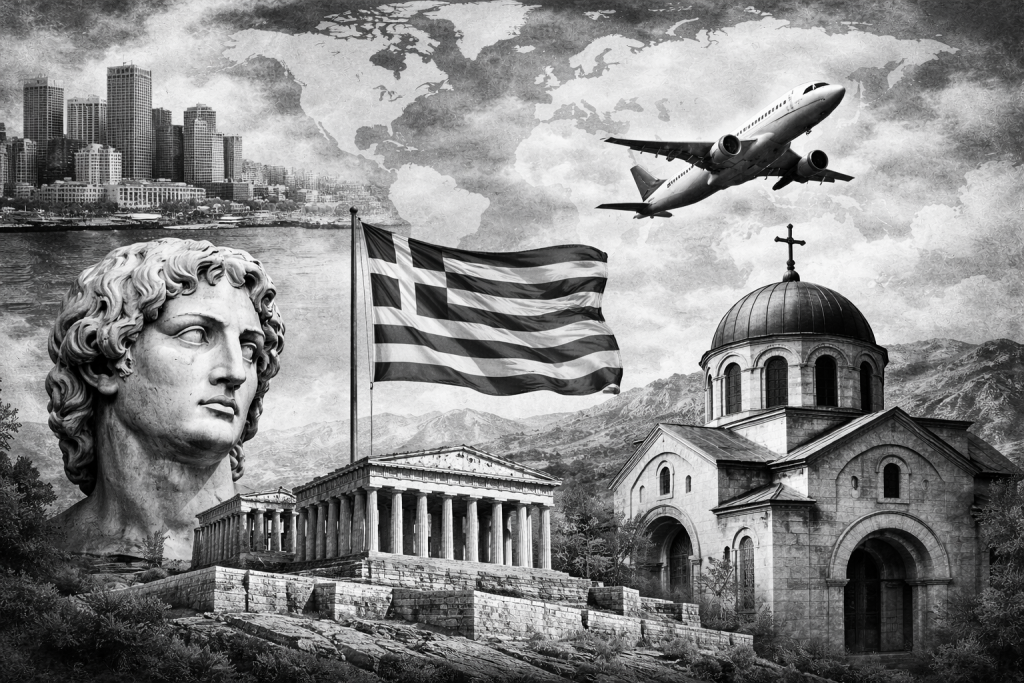
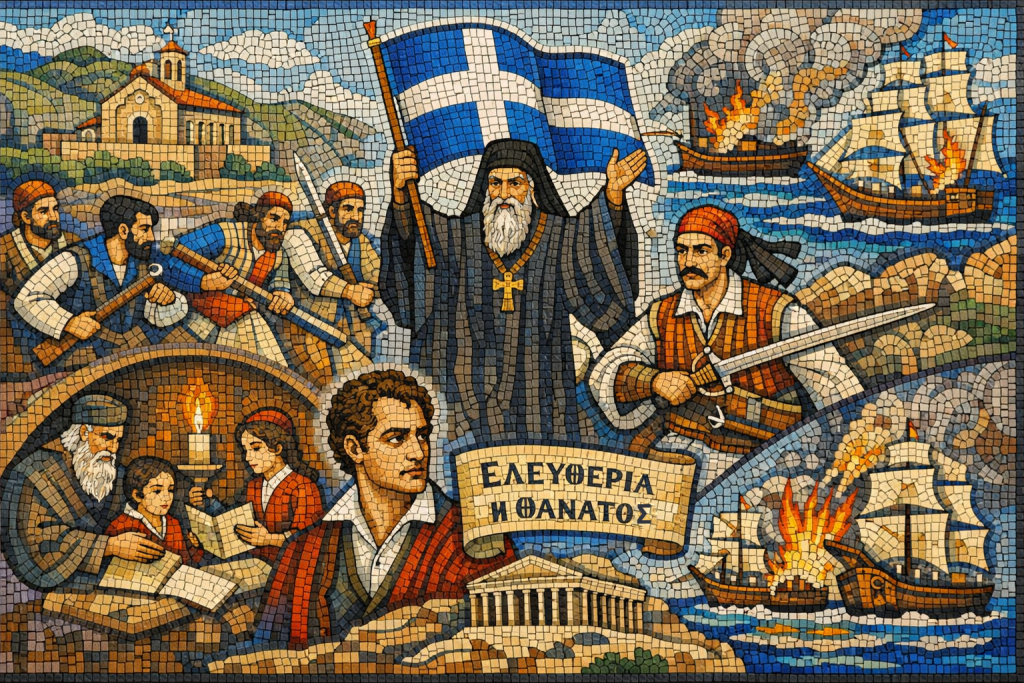

On the 25th of March each year, Greeks around the world observe the anniversary of the 1821 Revolution, the armed uprising that launched the Greek War of Independence against nearly four centuries of Ottoman rule. For millions of Hellenes and philhellenes, the date carries profound national and cultural significance. For Greek-Canadians, and especially for the younger generation who look forward each year to the grand parade on Jean-Talon Street, it is worth understanding the history behind the celebration.
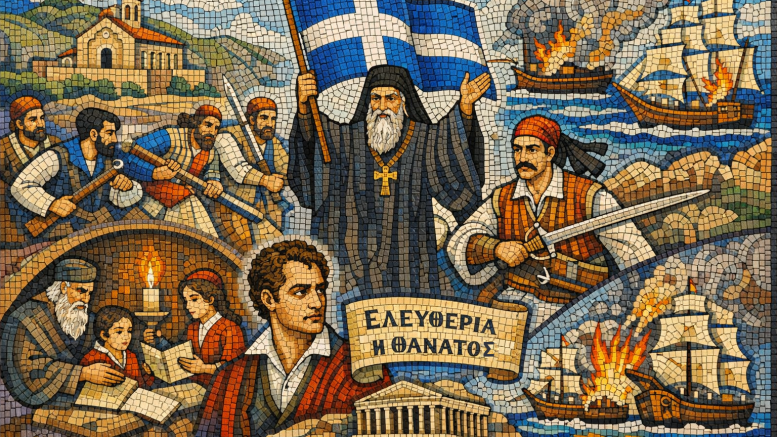
By the early 19th century, the Greek people had lived under Ottoman occupation since the fall of Constantinople in 1453. For roughly 400 years, Greeks were denied political self-determination, subjected to heavy taxation and forced conscription, and relegated to the status of second-class subjects within the Ottoman Empire. Throughout those centuries, the Greek Orthodox Church played a central role in preserving the Greek language, faith and national identity. Secret schools, known in Greek tradition as “kryfò scholiò,” are remembered as places where children learned to read and write Greek in defiance of restrictions imposed by Ottoman authorities.
By the late 1700s and early 1800s, a growing movement for independence had taken root among Greek intellectuals, merchants and military leaders both within Ottoman-held territories and in the Greek diaspora across Europe. A secret revolutionary organization called the Filikì Eterìa, founded in 1814 in Odessa, worked to coordinate an organized revolt. Its members recruited supporters across the Greek world and laid the groundwork for a national uprising.
On the 25th of March 1821, the revolution began. Tradition holds that Bishop Germanos of Patras raised the flag of revolt at the Monastery of Agia Lavra in the Peloponnese, blessing the struggle and calling Greeks to arms. Fighting erupted across the Peloponnese, on the islands of the Aegean and in mainland Greece. Greek revolutionaries won early victories against Ottoman garrisons, and on the first day of January 1822, the First National Assembly at Epidaurus adopted a constitution and formally declared Greek independence.
The war that followed was long and brutal, lasting nearly a decade. Greek fighters endured sieges, massacres and internal divisions. The struggle captured the imagination of people across Europe and North America, giving rise to the philhellenic movement. Volunteers, intellectuals and political figures from Britain, France, the United States and other nations lent their support to the Greek cause. Among them was the English poet Lord Byron, who traveled to Greece and died at Missolonghi in 1824.
International intervention proved decisive. In 1827, the combined naval forces of Britain, France and Russia destroyed the Ottoman-Egyptian fleet at the Battle of Navarino, a turning point that effectively secured Greek independence on the battlefield. Diplomatic negotiations followed, and in 1830 the London Protocol, signed by the three allied powers, formally recognized Greece as a sovereign and independent state.
The Treaty of Constantinople, signed on the 21st of July 1832 between the Great Powers and the Ottoman Empire, established the final boundaries of the new Kingdom of Greece and confirmed its full sovereignty.
Here in Montreal, the Greek community marks this anniversary each year on the last weekend of March with a parade along Jean-Talon Street that draws thousands of participants and spectators from across the city. It is one of the largest public expressions of Hellenic identity in Canada.