
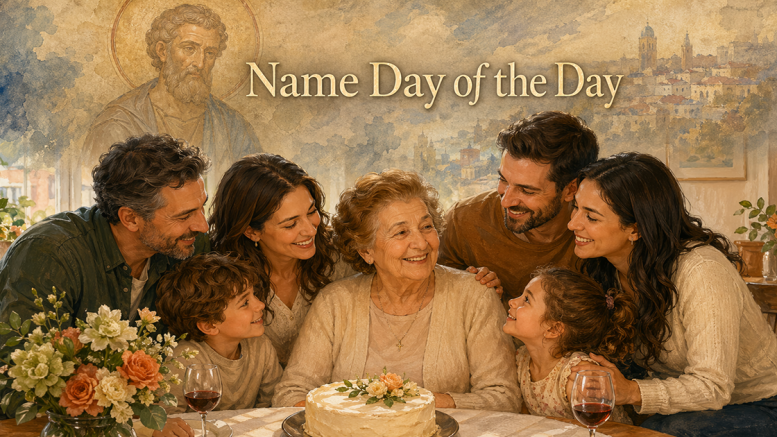
Today’s name day is one of those distinctly Greek ones that can still travel easily beyond family. If you know a Glykeria, whether she is your aunt, your co-worker, your music-loving neighbour or the cousin everyone calls Glykeri at home, today is her day to hear from you.
Glykeria comes from the Greek Γλυκερία, built on the adjective γλυκερός, meaning sweet. The word goes deep into Greek, from ancient γλυκύς for sweet, pleasant or gentle, a root that also passed into scientific and literary English through forms like glucose and glyc- words connected with sweetness. It is a name whose sound and sense have stayed close to Greek across the centuries, which is why it still feels so recognizably Greek today.
In the Eastern Orthodox Christian tradition, a person’s name day is the feast day of the saint after whom they were named at baptism.
Glykeria is one of those names that already carries its own atmosphere. It suits the theia who never arrives empty-handed, the hairdresser who remembers every customer’s family news, or the university friend whose voice softens a room the minute she walks in. For many Greek Canadians, it also has a familiar cultural echo through the singer Glykeria, a name that feels warm, melodic and immediately lived-in.
So if there is a Glykeria in your contacts today, send the message. A simple happy name day can open the door to a conversation with a classmate, colleague or old friend who may never have heard of the custom before. Chronia Polla! to every Glykeria, Glykeri, Glykero and Glykeritsa celebrating today, and to anyone lucky enough to share the wish with them.