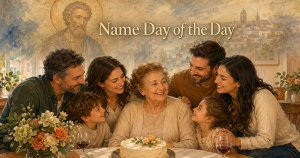
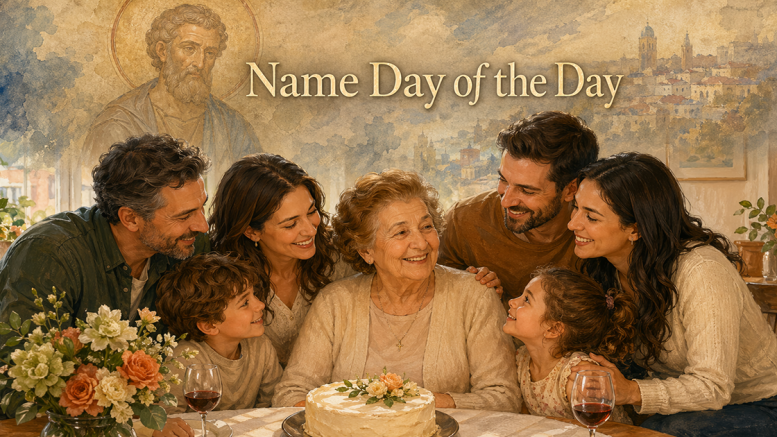
Today, every Athena you know shares a name day with the Greek tradition, and so does every Simeon, Simon and Shimon in a wider name family that crosses languages with ease. It is the kind of day that can start with a text to a cousin named Athina and end with a cheerful “happy name day” to a co-worker named Simon who has never heard of the custom before.
Athena comes straight from ancient Greek Ἀθηνᾶ, the name bound to the city of Athens and one of the most enduring names from classical antiquity. Its modern Greek form Αθηνά stays very close to the ancient one, while English keeps the Latinized Athena. Simeon follows a different path: Greek Συμεών came through biblical Greek from Hebrew Shim’on, usually understood as “he has heard,” and sits beside related forms such as Simon, Siméon and Szymon across Europe.
In Eastern Orthodox Christianity, a person’s name day is the feast day of the saint after whom they were named at baptism.
That is why the custom often spills beyond one household and into the whole city. Athena has a clear classical poise to it, easy to picture in the university friend who always sounds prepared before anyone else has opened the notes, or the teacher whose calm intelligence holds a room together. And Simeon has one of those old, travelled names that can belong just as naturally to a papou, a barber on the next block, or a colleague named Simon who wears it in an entirely Canadian way without knowing its Greek calendar moment has arrived.
September 1 also brings a long circle of other names into the day, including Antigone, Aspasia, Aphrodite, Thalia, Penelope, Pandora, Cleopatra, Sappho, Ourania, Margarita, Adamantios and many more, each carrying its own layer of Greek language, literature, history or family memory. Some are ancient and mythic, some are learned and literary, and some remain rare but instantly recognizable in Greek life.
Chronia Polla! to everyone celebrating today, in Greek and non-Greek circles alike. If you know an Athena, a Simon, a Simeon, or another September 1 name, send the wish along and share the tradition. It is one of the easiest ways to let a small piece of Greek culture land warmly in someone else’s day.