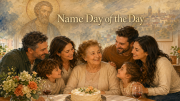
Today, every Michael, Mike and Mikey you know shares a name day with the Greek tradition. It is the kind of celebration that slips easily into Canadian life: a quick text to a classmate named Mike, a warm wish to your co-worker Michael, or a note to the across-the-street neighbour who has never heard of a name day but will probably love the idea.
Michael comes into Greek as Michail, from the Hebrew Mikha’el, a name built from the elements mi “who,” kha “like,” and El, “God,” giving the sense “Who is like God?” From Hebrew it passed into Greek, then Latin as Michael, and from there into the major languages of Europe, including English and French, which is why the name feels equally at home in a Montreal office, classroom, or family table. It is one of those names whose path through languages makes it both ancient and immediately familiar.
The name day tradition originates in Eastern Orthodox Christianity: a person’s name day is the feast day of the saint after whom they were named at baptism.
For Greek families, that means today may belong to a Papou Michalis or a godfather named Michail, but it also naturally extends outward to the Michael at your dentist’s office or the Mike who has been your university friend for years. Even when the person celebrating has no Greek connection at all, the name itself creates the bridge.
Today’s calendar also includes Myrofora, a distinctly Greek name formed from myron, meaning “perfumed oil” or “myrrh,” and phoreo, “to bear” or “to carry,” literally “myrrh-bearer.” It is less likely to appear in English-speaking daily life, which makes Michael the name most readers will recognize instantly beyond the family circle.
Chronia Polla! to everyone celebrating today, in Greek and non-Greek circles alike. If you know a Michael, Mike or Mikey, this is a lovely day to send a message, say happy name day, and share a small Greek custom with someone who may not even know they are being celebrated.