
This page documents how to access the Montreal Greek Times Unicorn (MGT Unicorn), a non-mainstream, parallel infrastructure operated by THE MONTREAL GREEK TIMES.
MGT Unicorn is an Origin Polyprotocol Publishing System (OPPS) that distributes current journalism, radio programming, and emergency alerts across legacy, alternative, and privacy-oriented network environments. It extends the live output of THE MONTREAL GREEK TIMES beyond contemporary web and app ecosystems into historically significant protocols and specialized access paths, while preserving the character of each medium.
Rooted in our 1994 online broadcasting history, Unicorn functions both as a heritage publishing environment and as a live operational distribution system. It is intended for technically proficient users, retro-computing enthusiasts, researchers, archivists, privacy-conscious readers, and others who value standards-based or non-mainstream access methods. Users are expected to configure and operate compatible software independently.
Depending on the access point used, readers and listeners can follow current headlines, open full articles, search the live article corpus, retrieve terminal-ready bulletins, browse archives, download print replica PDFs, podcasts, and software, subscribe through feed and newsreader technologies, listen to live radio, and access official emergency alerts through alternative delivery paths.
This is not our primary publishing platform. Our modern website, mobile applications, connected TV apps, and contemporary streaming services remain the recommended access points for the general public.
PDF compatibility note: The MGT Unicorn print replica PDFs are produced as PDF 1.3 and are compatible with Adobe Acrobat Reader 4.0 on Windows 95 or higher, as well as many legacy PDF viewers on classic operating systems.
Web 1.0 mirror
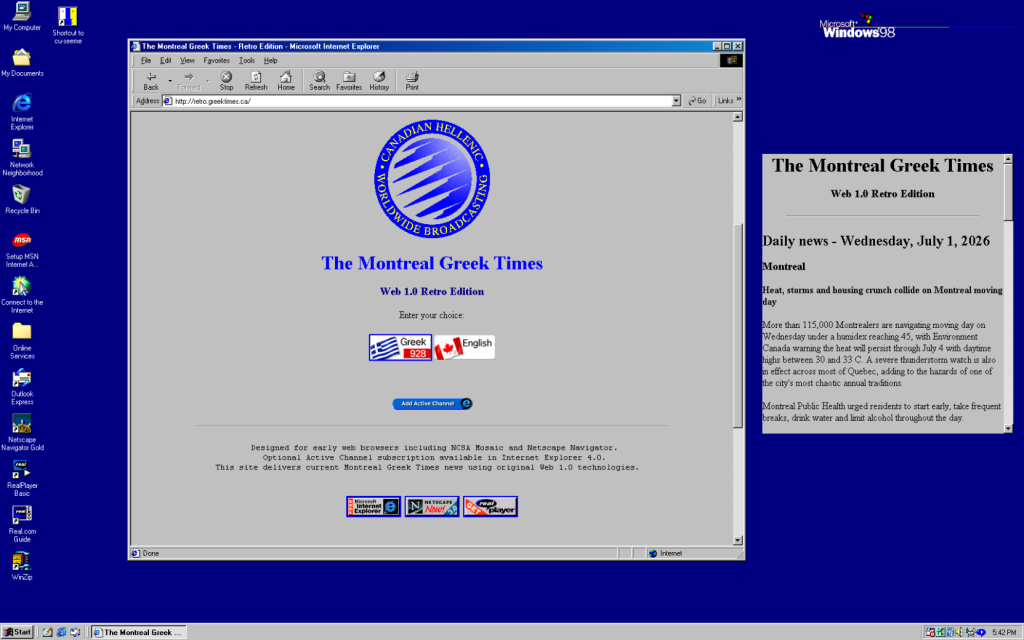
A lightweight, text-first web environment designed for early browsers and low-resource systems.
What you will find:
Current Montreal Greek Times headlines, full articles, and active emergency alert notices presented in a classic Web 1.0 layout compatible with early graphical browsers.
How to access:
Designed for early web browsers including NCSA Mosaic and Netscape Navigator. Modern browsers can also access it normally.
Windows users may also access both the Retro Web mirror and the Active Desktop channel through The Montreal Greek Times Unicorn Suite for Windows, our native Windows application for MGT Unicorn.
Windows app download:
Download The Montreal Greek Times Unicorn Suite for Windows (ZIP)
URL:
http://retro.greektimes.ca

An optional Active Channel subscription is available for Internet Explorer 4.0 through 6.0, preserving the late-1990s “push-style” content model associated with Windows 98, Active Desktop, and Microsoft’s Channel Definition Format. It represents an early precursor to modern RSS syndication. To our knowledge, only three Internet Explorer Active Channels are currently known to remain in operation worldwide.
RSS
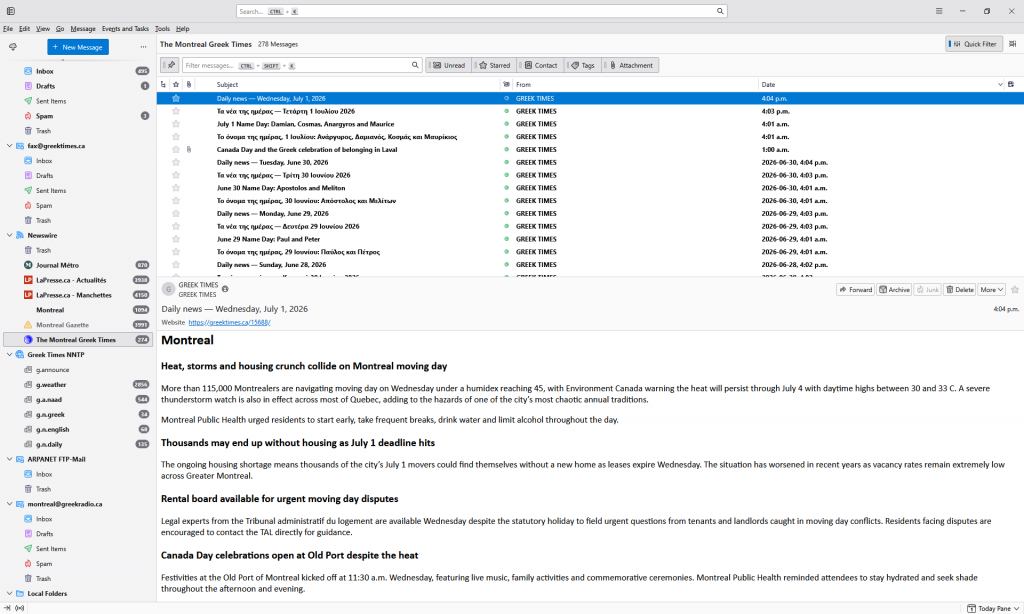
RSS, or Really Simple Syndication, is a widely used web feed format that allows users to receive updates from websites automatically without visiting them directly. It became a standard method of content distribution in the early 2000s and remains one of the most efficient ways to follow news in a structured, application-driven environment.
What you will find:
A continuously updated feed of current Montreal Greek Times headlines and full articles, allowing readers to subscribe and receive new content automatically as it is published.
How to access:
Use any RSS-compatible reader or feed aggregator. On legacy systems, older desktop feed readers may be used where supported. On modern systems, RSS can be accessed through dedicated applications, email clients, browser extensions, or web-based readers.
URL:
http://rss.greektimes.ca
https://rss.greektimes.ca
Gopher
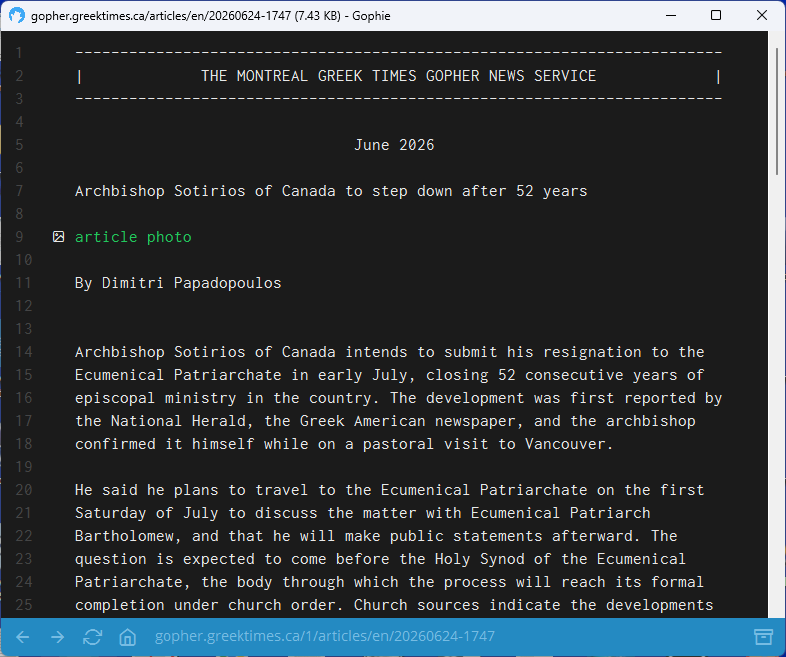
Gopher is a small, quiet corner of the Internet and a predecessor of the World Wide Web. It provides structured, menu-driven navigation without scripts, advertising, or client-side complexity. Before the web became dominant, Gopher served as one of the Internet’s first practical public news racks: a menu-based way to browse current articles, magazine issues, academic newspapers, government bulletins, economic releases, public documents, and archive material.
Gopher played an important role in early online news dissemination because it gave readers a structured path into published information before modern websites became the standard. During the early 1990s, users could browse online magazines, political commentary, public-affairs material, institutional bulletins, government documents, and newspaper-like services through simple menus. In public debates such as NAFTA, Gopher helped connect readers to current commentary and related documents at a time when online news publishing was still experimental. For researchers, journalists, students, and technically proficient readers, it functioned as a searchable public newsstand and document shelf distributed across universities, media services, libraries, and public institutions.
Within MGT Unicorn, THE MONTREAL GREEK TIMES uses Gopher in that same publishing tradition: as a menu-based public news rack for headlines, full articles, archives, emergency alerts, public notices, media files, print replicas, and editorial material. Today, roughly 200 or so Gopher servers are estimated to remain active worldwide, and THE MONTREAL GREEK TIMES operates one of them as part of a live newsroom-linked publishing system.
What you will find:
A fast, hierarchical directory of current headlines, full articles, archives, active emergency alerts, downloadable alert audio where available, news sound clips where available, and access to the print replica edition of THE MONTREAL GREEK TIMES in PDF. Images and sound clips made available through our Gopher service use the historically native .gif image and .au audio formats associated with the Gopher era, preserving period-correct image and audio delivery for compatible clients and systems.
How to access:
On retro systems (Windows 3.x and Windows 9x), Netscape Navigator 3.0 Gold provides native Gopher support.
On modern systems, a dedicated client is recommended. Lagrange is available for Windows, Linux, macOS, iOS and Android, and supports both Gopher and Gemini.
Windows users may also browse the MGT Unicorn Gopher service through The Montreal Greek Times Unicorn Suite for Windows.
Windows app download:
Download The Montreal Greek Times Unicorn Suite for Windows (ZIP)
URL:
gopher://gopher.greektimes.ca
Gemini
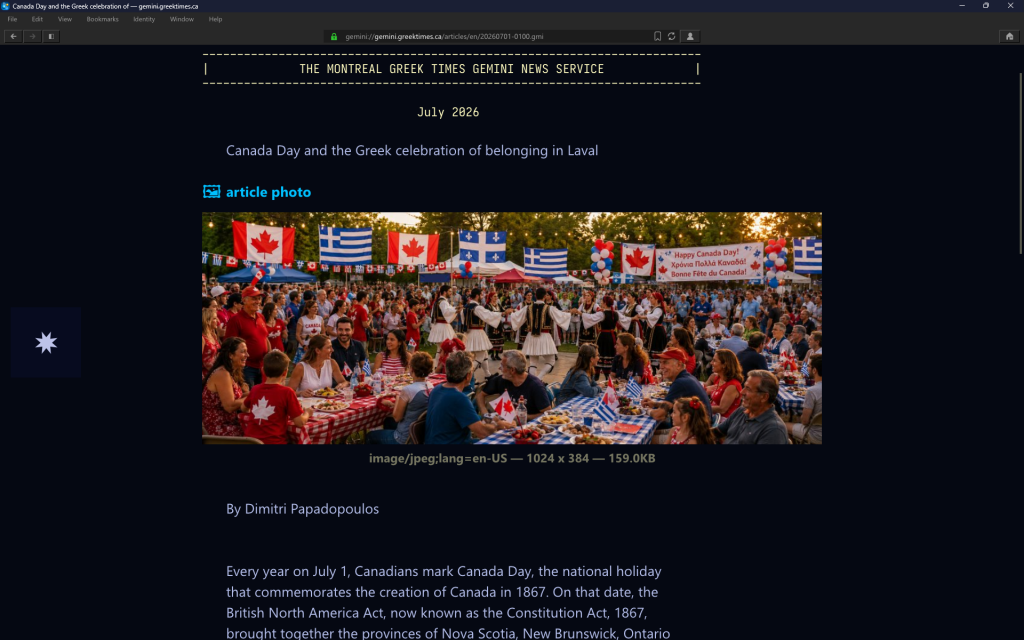
Gemini is a modern, minimalist protocol introduced in 2019 within the small internet movement. Although recent in age, it is intentionally modeled on early internet philosophies, prioritizing simplicity, text-first content, and the absence of advertising and scripting. Inspired by Gopher-era design, Gemini continues the architectural lineage that MGT Unicorn preserves.
What you will find:
A clean, low-overhead capsule featuring current Montreal Greek Times headlines, article access, active emergency alerts, and Greek-language alert pages in a reading-focused format.
How to access:
Gemini requires a dedicated client. Lagrange is available for Windows, Linux, macOS, iOS and Android smartphones and tablets.
URL:
gemini://gemini.greektimes.ca
Telnet
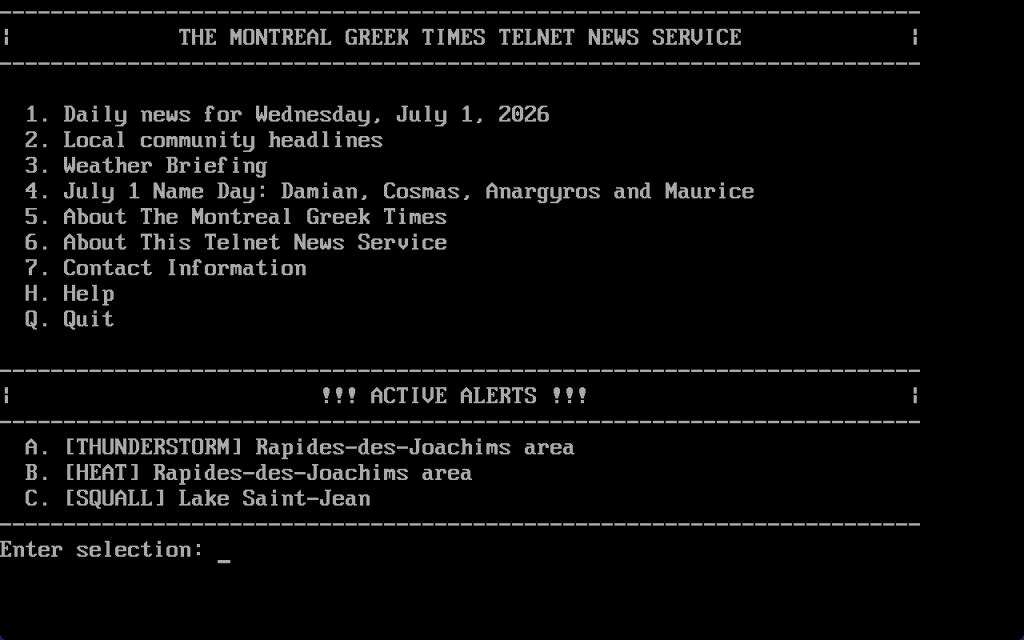
Telnet is one of the original Internet remote terminal protocols, designed to let a user connect to a remote text-based service over a network. As part of MGT Unicorn, THE MONTREAL GREEK TIMES operates a dedicated Telnet news service intended for fast, menu-driven access to current information. Public-facing information Telnet endpoints of this type appear to be extremely rare, likely numbering only in the dozens worldwide.
What you will find:
A lightweight interactive news service featuring the latest English-language headlines, full article text, Montreal weather briefings, contact information, service information, and active NAAD emergency alert notices in a streamlined terminal interface. The service is designed as a quick-access text endpoint rather than a social or messaging system.
How to access:
Use any Telnet-capable client and connect to the dedicated Telnet hostname on port 23.
On retro systems, use Telix, Procomm Plus, Qmodem or similar Telnet software where supported.
On modern systems, standard terminal Telnet clients may be used, along with dedicated retro-oriented clients where appropriate.
Windows users may also access the Telnet News service through the built-in terminal in The Montreal Greek Times Unicorn Suite for Windows.
Windows app download:
Download The Montreal Greek Times Unicorn Suite for Windows (ZIP)
Connection command:
telnet telnet.greektimes.ca
Finger services
Finger is one of the earliest Internet protocols, originally developed in the late 1970s to retrieve human-readable user and status information from remote systems.
Because Finger returns flexible plain text, it also became a small but historically important bulletin mechanism. Early Internet users adapted it to publish public information beyond personal status, including headline-style notices, sports scores, music charts, weather information, storm updates, science bulletins, NASA headline news, launch schedules, mission updates, and service-status messages. Its role was narrow and direct: a single command could retrieve a fresh public bulletin from a remote system.
Finger later declined because it could expose personal or system information and raised legitimate privacy and security concerns. The MGT Unicorn Finger service is therefore intentionally limited to public newsroom output. It does not provide personal lookup information. It preserves the historical form of Finger while applying it only to editorial, weather, alert, and service bulletin material.
Within MGT Unicorn, THE MONTREAL GREEK TIMES uses Finger in that same bulletin tradition. It is a command-line newsroom dispatch and article lookup service for headlines, full article retrieval by “User ID”, emergency alerts, Montreal weather, service notices, and short public information updates. In newsroom terms, it functions like a wire-service stub, designed for fast retrieval from a command line with very little overhead.
What you will find:
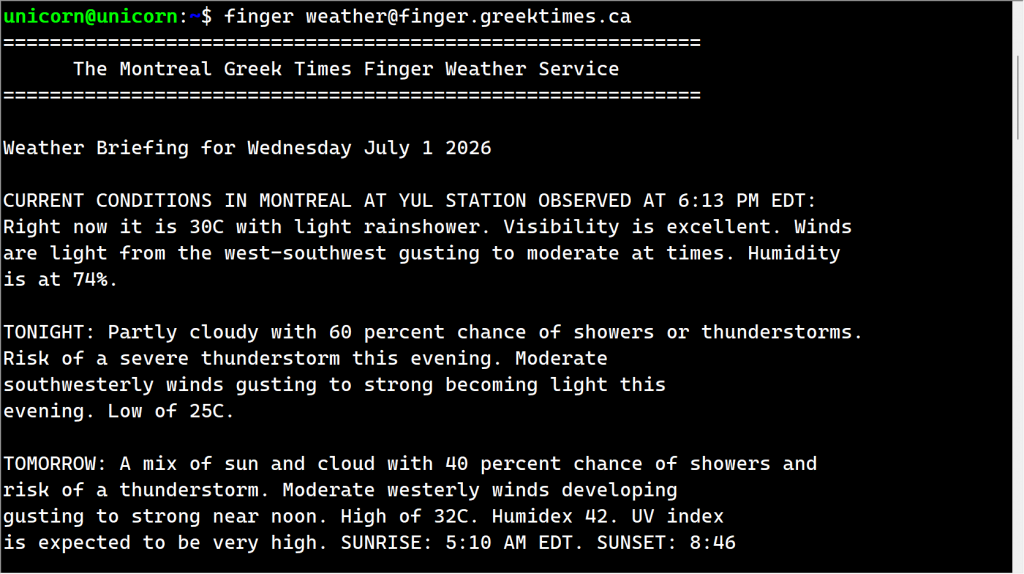
Text-based access to current Greek community headlines, full articles retrievable by ID, active emergency alert notices, and a custom-generated Montreal weather briefing. Rather than mirroring a website, the forecast is built from raw ECCC data and interpreted into a clean, terminal-ready bulletin by THE MONTREAL GREEK TIMES. Optimized for command-line systems, low bandwidth and clarity.
How to access:
Finger can be accessed from most UNIX-like systems and from Windows NT-based systems, including Windows 2000, XP, 7, 10 and 11, which include the built-in finger command. Simply open a terminal or Command Prompt and type:
For news:
finger news@finger.greektimes.ca
For weather:
finger weather@finger.greektimes.ca
Finger services can also be accessed through the Lagrange small-web browser.
Windows users may also access the News and Weather Finger services through the built-in terminal in The Montreal Greek Times Unicorn Suite for Windows.
Windows app download:
Download The Montreal Greek Times Unicorn Suite for Windows (ZIP)
To access our Finger services via Lagrange, enter the following URLs:
Weather:
finger://finger.greektimes.ca/weather
News:
finger://finger.greektimes.ca/news
NNTP
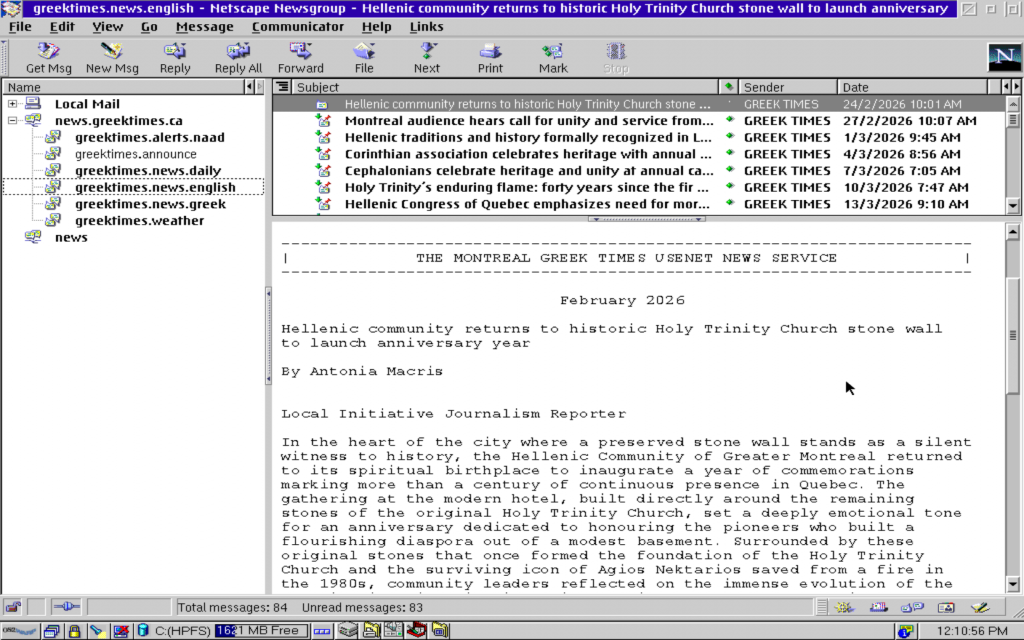
NNTP, the Network News Transfer Protocol, was one of the defining technologies of online news distribution before the modern web. For years, Usenet and traditional newsreader software formed a primary way that users read, followed and archived network-published information. As part of MGT Unicorn, THE MONTREAL GREEK TIMES operates its own full-stack NNTP server, extending current journalism, weather bulletins, and emergency alerts into another historically significant protocol environment.
What you will find:
A standards-based NNTP news server carrying current Montreal Greek Times articles, weather briefings, system notices, and official emergency alerts through dedicated newsgroups:
greektimes.news.englishfor English-language news articlesgreektimes.news.greekfor Greek-language news articlesgreektimes.weatherfor Montreal weather briefings in English and Greekgreektimes.announcefor system announcements and editorial notesgreektimes.alerts.naadfor official emergency alerts distributed through our NAAD integration
Unlike a minimal feed mirror or hobby stub, this is a full operational NNTP service with native reader access, local article injection, automated publishing, authenticated posting capability. Publicly reachable independent NNTP servers of this type appear to number only in the tens worldwide.
How to access:
Use any compatible newsreader. On retro and legacy Windows systems, clients such as Outlook Express or Forte Agent may be used where supported. On modern systems, users may connect with software such as Mozilla Thunderbird, tin, slrn or other NNTP-capable clients.
Anonymous users may read all greektimes.* groups without authentication. Secure access is available on both standard and TLS-wrapped ports.
Server:
news.greektimes.ca
Ports:
119  - NNTP with STARTTLS
563  - NNTPS (direct TLS)
WAIS
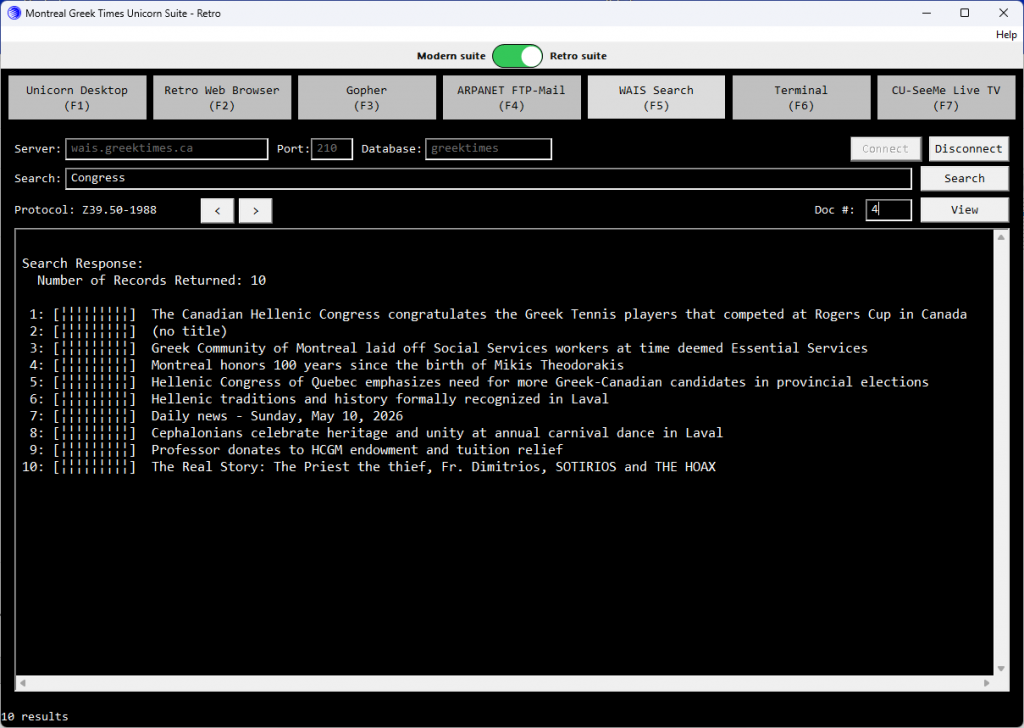
WAIS, or Wide Area Information Server, was one of the earliest distributed search and information retrieval systems on the Internet, emphasizing query-based access to indexed document collections rather than menu browsing. As part of MGT Unicorn, THE MONTREAL GREEK TIMES operates a live WAIS search server, extending current journalism into another historically significant protocol environment. To our knowledge, THE MONTREAL GREEK TIMES maintains the only publicly accessible production WAIS server using the original WAIS protocol derived from Z39.50-1988 currently in operation worldwide.
What you will find:
A searchable index of current Montreal Greek Times content, allowing readers to perform ranked full-text searches across indexed articles through a protocol originally associated with early Internet research and information discovery. We brought back a forgotten search engine that predates the web, and it now serves real news in 2026.
This is anomaly-level rare even within the already unusual ecosystem of legacy internet services. In practical terms, it is not simply a preserved protocol endpoint, but a live production search service attached to a working newsroom.
How to access:
The recommended contemporary access method is The Montreal Greek Times Unicorn Suite for Windows, which includes a native WAIS client configured for the MGT Unicorn server. Legacy UNIX command-line examples are omitted here because the traditional waissearch client is obsolete and no longer included in contemporary Linux systems.
A standalone Windows WAIS client developed specifically for this server also remains available.
Windows app download:
Download The Montreal Greek Times Unicorn Suite for Windows (ZIP)
Standalone WAIS client download:
Download the standalone MGT WAIS client (ZIP)
Server:
wais.greektimes.ca
Port:
210
Database:
greektimes
FTP
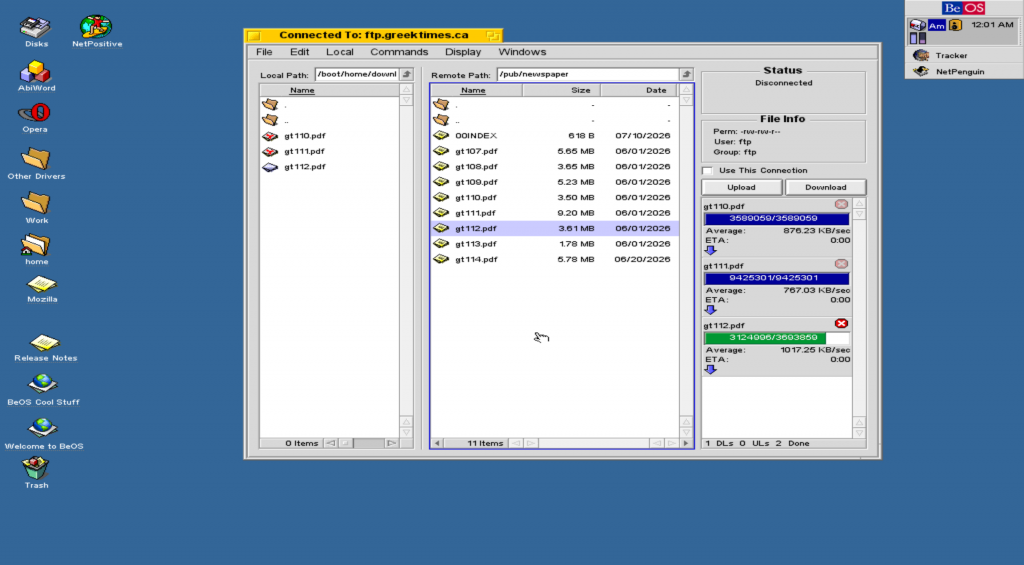
FTP, the File Transfer Protocol, was one of the foundational services of the early Internet and remains one of the simplest ways to distribute downloadable files across a wide range of operating systems and client environments. In the news context, anonymous FTP became the Internet’s early file counter: a direct retrieval point for documents, reports, datasets, images, audio, software, public records, archives, and source material behind the daily flow of published information.
FTP played an important role in news dissemination during major public events because it gave readers and journalists access to the underlying material. During the NAFTA debate of the early 1990s, anonymous FTP made it possible to retrieve treaty text, chapters, appendixes, and related public documents directly from Internet file archives. During the Bosnia conflict in the mid-1990s, anonymous FTP sites were used to gather and distribute news-related information, documents, images, reports, and archive material connected to the war. In this role, FTP was not the headline ticker. It was the document room behind the newsroom.
Within MGT Unicorn, THE MONTREAL GREEK TIMES uses FTP in that same archival and documentary tradition. It is the file depot of the system: the place for print replica editions, podcasts, software, media, public files, and selected downloadable material intended for direct retrieval rather than browser-based access.
What you will find:
Anonymous access to the print replica editions of THE MONTREAL GREEK TIMES in PDF, audio and video podcasts, downloadable software by Greek Times, and other selected files intended for direct retrieval rather than browser-based access.
How to access:
On retro and legacy systems, use any standard FTP client or command-line FTP utility. On modern systems, users may connect with software such as FileZilla, WinSCP, built-in command-line FTP tools where available, or direct FTP support in compatible file managers.
Anonymous login is enabled.
URL:
ftp://ftp.greektimes.ca
Port:
21
Login:
anonymous
Archie
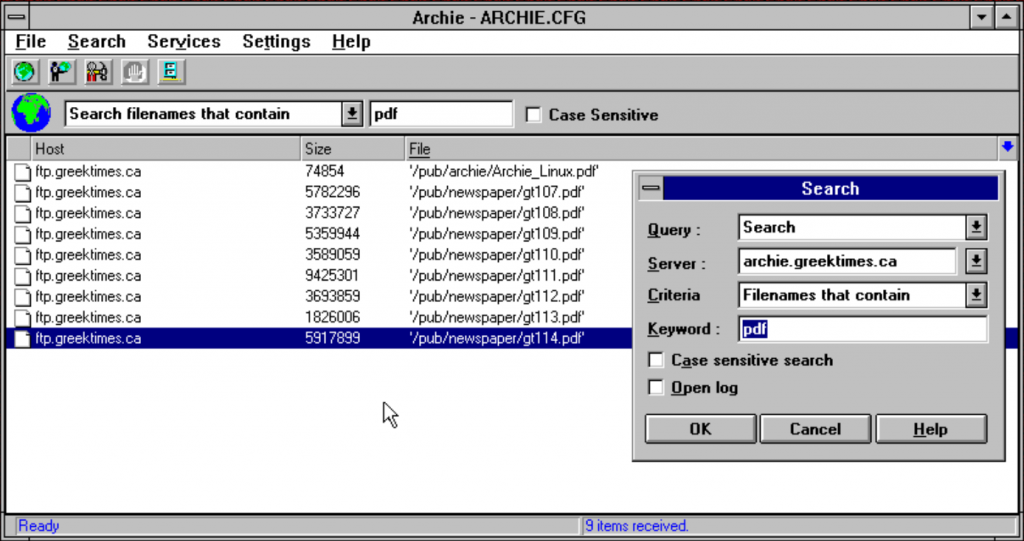
Archie was the Internet’s first search engine, created at McGill University in Montreal in 1989 by Alan Emtage, with Peter Deutsch and Bill Heelan. Before the World Wide Web, public anonymous FTP servers held an enormous and growing collection of software, documents, reports, datasets, images, audio, public records, and news-related material. The problem was finding those files. Archie solved it by collecting directory listings from FTP servers and building a searchable index of filenames, directory paths, and host locations.
Archie also became an important discovery tool for early online journalism and research. Reporters, librarians, researchers, and technically proficient readers used it to locate source documents, public records, news archives, press material, and files connected with developing stories. During the public debate surrounding the North American Free Trade Agreement, the full NAFTA text and related documents were distributed through university and legal FTP archives. Contemporary library guidance specifically recorded using Archie to locate one of those FTP copies. Archie did not replace the newsroom or the archive; it served as the early Internet’s finding desk, telling users which server held a file and where to retrieve it.
Archie was invented here in Montreal, the home city of THE MONTREAL GREEK TIMES, and its return has a special meaning for us. MGT Unicorn now operates a live Bunyip Archie 3.5 server connected to our anonymous FTP archive, with access through the original Prospero/ARDP protocol for authentic vintage clients. To our knowledge, it is the only publicly accessible Archie server currently in operation worldwide. Welcome Home, Archie!
An optional ArchiePlex web gateway is available at archie.greektimes.ca. ArchiePlex was created by Martijn Koster at NEXOR in 1993 as a Perl rewrite of his earlier Warchie service, bringing Archie searches into the emerging World Wide Web as a full-hypertext gateway. It allows users to submit a search through a period-style web form and follow the resulting FTP locations as hyperlinks, without installing a dedicated Archie client. MGT Unicorn operates the authentic ArchiePlex gateway, adapted to query the same live catalogue used by our native client, Telnet, and e-mail access paths.
What you will find:
A searchable catalogue of the files available from the MGT Unicorn anonymous FTP server at ftp.greektimes.ca. Search results identify the FTP host, directory, filename, file size, date, and path needed to retrieve the file. The catalogue currently includes Montreal Greek Times print replica editions, retro-computing software, protocol clients, documentation, media files, and other selected public downloads.
How to access:
The MGT Unicorn Archie server is available through four access paths: a native Archie client using the original Prospero/ARDP protocol, the ArchiePlex web gateway, an interactive Telnet service, and Archie by e-mail.
Native Archie client access, preferred:
The preferred method is The Montreal Greek Times Unicorn Suite for Windows. The suite includes a fully compliant native Archie client configured for the MGT Unicorn Archie server and uses the original Prospero/ARDP protocol.
Windows app download:
Download The Montreal Greek Times Unicorn Suite for Windows (ZIP)
Compatible vintage Archie clients, including WSArchie, may also connect through the same original protocol using the following settings:
Server: archie.greektimes.ca
Port: 1525
Transport: UDP
ArchiePlex web gateway:
Open the following address in a web browser, enter a filename or search term, and submit the form:
http://archie.greektimes.ca/
The results page provides direct links to matching files on the MGT Unicorn anonymous FTP server.
Interactive Telnet access:
Connect to the dedicated Archie Telnet service on port 2323:
telnet archie.greektimes.ca 2323
At the archie> prompt, commands include:
find <string>
exact <filename>
prog <string>
help
quit
Archie by e-mail:
Send an ordinary e-mail to:
archie@greektimes.ca
Place Archie commands in the message body, one command per line. The subject line is also processed as the first command, allowing a single-command request to be placed entirely in the subject.
Example request:
find pdf
quit
The server returns the search results to the address from which the request was sent. No special mail software is required.
Archie acknowledgment:
Alan Emtage, Bill Heelan and Peter Deutsch, creators of Archie (McGill University, 1989)
Bunyip Information Systems, Inc., the Archie 3.5 release (1996)
ICM, University of Warsaw, who preserved the last surviving copy
The Serial Port, who found it and set it free (2024)
Tor Onion Service
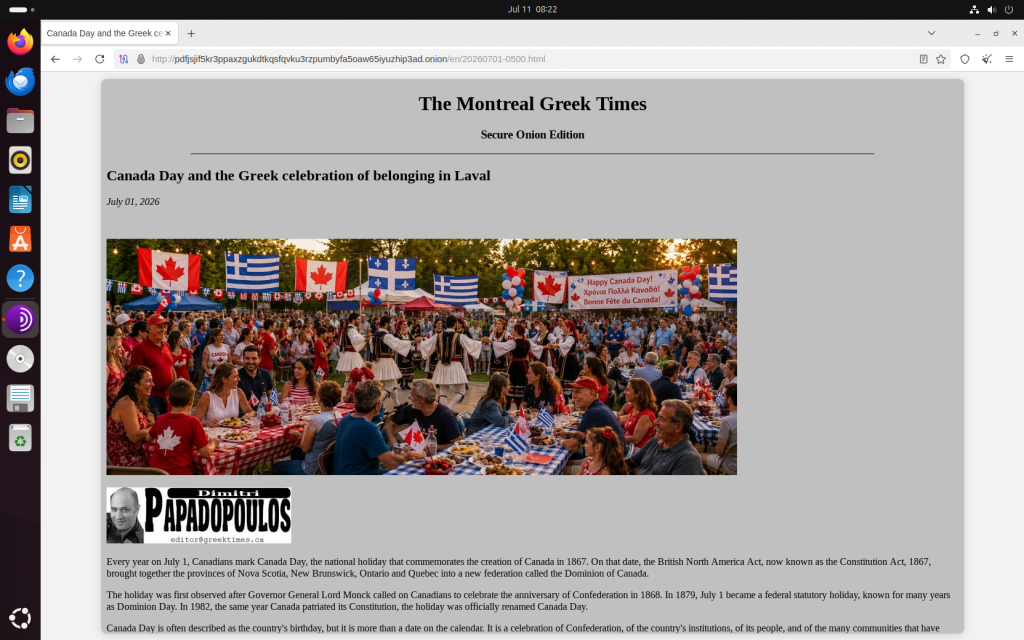
The Montreal Greek Times operates a Tor v3 onion service as part of MGT Unicorn. This provides a privacy-preserving, censorship-resistant access point to our journalism using the Tor network. Unlike the retro protocols within MGT Unicorn, the onion service is modern infrastructure designed for anonymity, network resilience and access from environments where the open internet may be filtered or blocked.
What you will find:
A standards-compliant HTML edition of current Montreal Greek Times headlines, full articles, and active emergency alert notices, optimized for access within Tor Browser. The onion site mirrors current content while reducing reliance on mainstream network pathways.
How to access:
Install and launch the Tor Browser, then enter the following address in the browser’s address bar.
URL:
http://pdfjsjif5kr3ppaxzgukdtkqsfqvku3rzpumbyfa5oaw65iyuzhip3ad.onion
RealAudio live stream
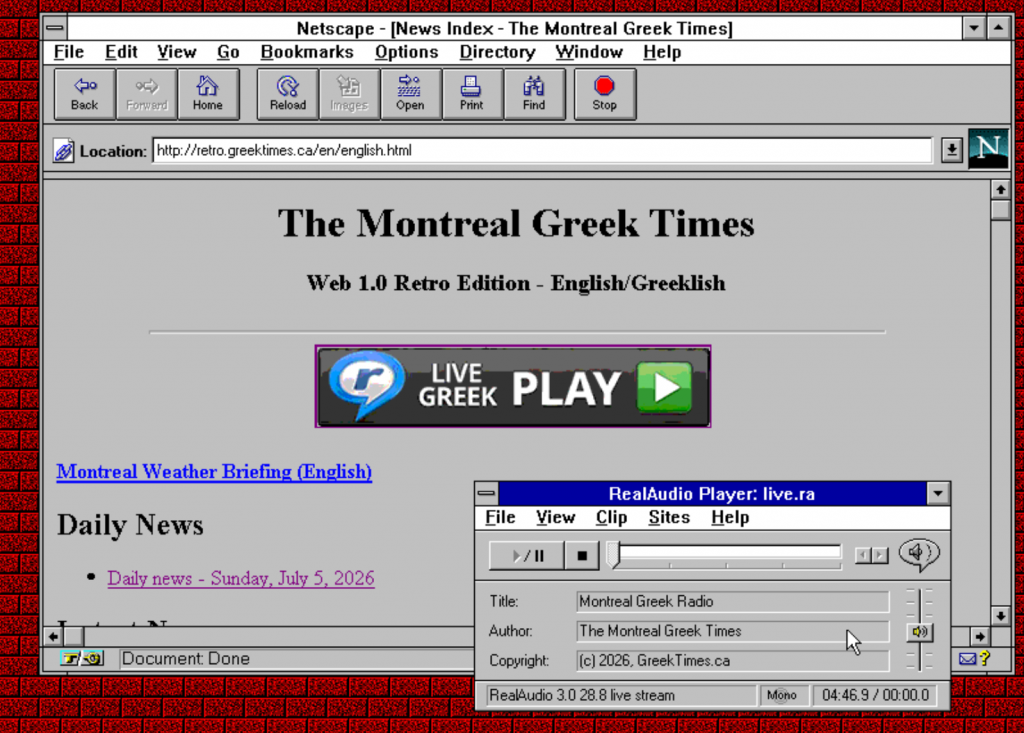
A period-correct RealAudio 3.0 live stream delivered using the original PNA protocol, reflecting the architecture of mid-1990s internet radio. To our knowledge, THE MONTREAL GREEK TIMES maintains the only actively operating RealAudio live server using the original PNA protocol currently in public operation worldwide.
What you will find:
A live Montreal Greek Radio broadcast accessible through compatible RealPlayer software, preserved as a working example of early internet streaming technology. In addition, NAAD emergency alert capability has been integrated into the broader radio delivery chain for applicable alerts affecting the Greater Montreal area.
How to access:
Install RealPlayer 3.0 or later, compatible with Windows 3.1, Windows 95/98, Windows NT, Windows x86/x64, BeOS, Linux, OS/2, and Windows 10/11.
On legacy browsers, clicking the play button on our retro website will automatically launch RealPlayer via the associated .ram metafile.
Modern systems no longer associate .ram files automatically. In such cases, open RealPlayer and select File > Open Location, then enter:
pnm://retro.greekradio.ca:7070/live.ra
This direct method works with both legacy and modern versions of RealPlayer.
CU-SeeMe live television reflector
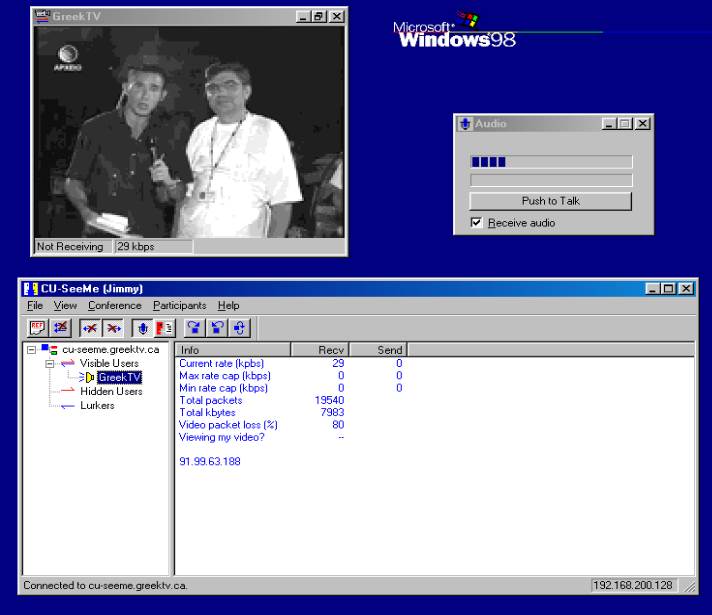
Back in 1992, Cornell University built one of the internet’s first video streaming systems: CU-SeeMe. In an era when most people had never seen live video travel across a network, it let computers around the world share grainy black-and-white video and audio in real time. People used it to talk face to face, but its most memorable moments came when it was turned into something closer to television.
Using a piece of software called a reflector, a single live feed could be sent out to thousands of viewers at once. NASA used it to stream space shuttle launches to a global audience years before online video was ordinary. When the Oklahoma City bombing unfolded in 1995, the feed from KOCO Channel 5 was carried over CU-SeeMe so people far beyond Oklahoma could follow the coverage as it happened, one of the first times a breaking news event reached the world this way. Later that year, ABC carried a live news program over the internet through CU-SeeMe, among the earliest times a television network reached viewers online. For a brief, pioneering window, CU-SeeMe was how the world watched live events on the internet.
Montreal Greek TV, the television arm of THE MONTREAL GREEK TIMES, carries that tradition forward. We use CU-SeeMe the way those early broadcasters did: a single live Montreal Greek TV feed, sent out to anyone who wants to watch. There’s no chat room and no need to send anything back. You simply connect and watch, exactly as audiences did in the 1990s.
What makes ours special is that it’s the real thing. Our reflector runs the original Cornell software from 1995, the genuine article, carefully brought back to life on a modern system so the experience is authentic down to the last detail. We believe it’s one of the very few CU-SeeMe reflectors of its kind still broadcasting anywhere in the world, a small living piece of internet history you can actually tune into today.
To our knowledge, it is the only 24/7 live-TV CU-SeeMe reflector running the original Cornell server still broadcasting anywhere in the world.
What you will find:
A live, receive-only Montreal Greek TV broadcast delivered through a period-correct CU-SeeMe reflector. The video is presented in the original CU-SeeMe visual character, using 160×120 grayscale video at 1 frame per second, with audio carried in the compatible Intel DVI format expected by Cornell CU-SeeMe 0.92b2.
How to access:
Retro computers may connect using Cornell CU-SeeMe 0.92b2 for Windows, compatible with Windows 9x systems. Modern Windows users may access the live reflector through The Montreal Greek Times Unicorn Suite for Windows.
Windows app download:
Download The Montreal Greek Times Unicorn Suite for Windows (ZIP)
When using Cornell CU-SeeMe 0.92b2, open the reflector connection dialog and connect to the server below. In the audio preferences, select Intel DVI. Do not select Delta-mod for this broadcast. After connecting, start receiving video if the client requires that action. The service is receive only. Users should not transmit video or audio to the reflector.
Reflector:
cu-seeme.greektv.ca
Protocol:
UDP
Port:
7648
Mode:
Receive only
Login:
No username or password required
Compatible retro client:
Cornell CU-SeeMe 0.92b2 for Windows
Modern client option:
The Montreal Greek Times Unicorn Suite for Windows
Audio setting:
Intel DVI
IRC
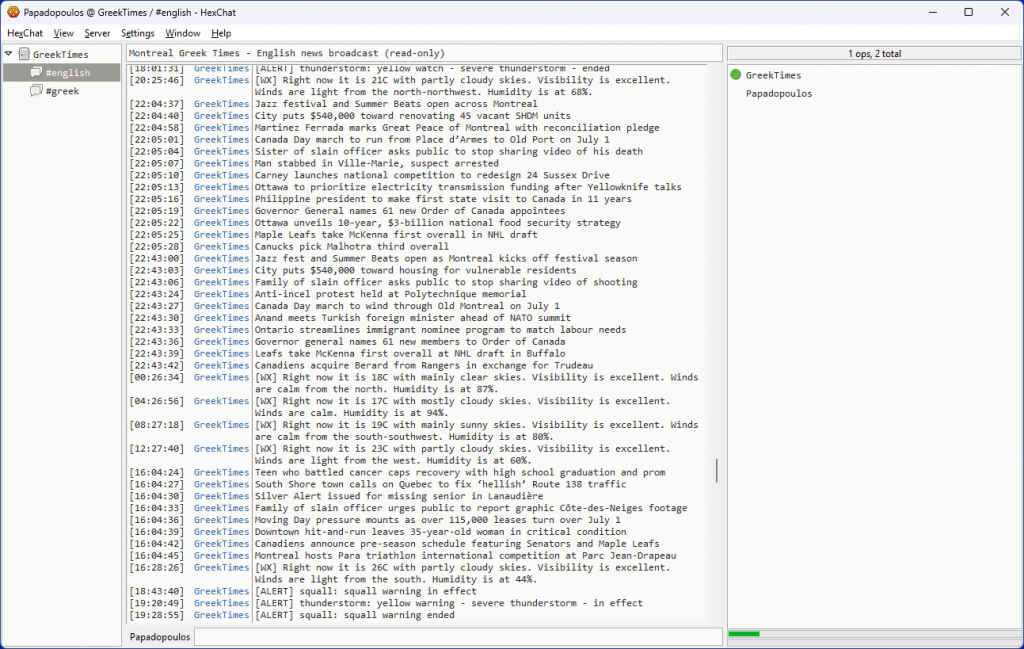
IRC, or Internet Relay Chat, emerged in 1988 as a real-time networked communication system, but it also became an important medium for live news dissemination during major world events. Historical IRC reporting was widely used during the 1991 Gulf War, the 1991 Soviet coup attempt, the 1993 Moscow crisis, the 1994 Northridge earthquake, and other fast-moving events, allowing participants to compare local reports, relay first-hand information, and follow breaking developments across borders in real time. Within MGT Unicorn, THE MONTREAL GREEK TIMES uses IRC in that same broadcast tradition: as a live, read-only distribution channel for news, alerts, and periodic weather updates.
What you will find:
Three permanent read-only broadcast channels:
#englishfor English-language news, alerts, and periodic weather updates#greekfor Greek-language news, alerts, and periodic weather updates#retrofor retro-compatible plaintext broadcasting, intended for older IRC clients and vintage systems
The channels are intended for listening only. The broadcast bot is the only authorized speaker, allowing readers to follow developments in real time without channel noise, discussion, or user-generated interruption.
How to access:
Modern IRC clients may connect securely to irc.greektimes.ca on port 6697 using TLS. For retro computer compatibility, a plaintext listener is also available on port 6667 for the #retro channel. The English and Greek channels are intended for the secure listener, while the retro channel provides a simplified access path for older IRC environments.
On modern systems, clients such as HexChat, irssi, WeeChat, KVIrc, and mIRC may be used. On retro systems, period-appropriate IRC clients for MS-DOS, Windows 3.11, BeOS, and similar environments may connect to the retro channel over plaintext where supported.
Windows users may also access the MGT Unicorn IRC channels through The Montreal Greek Times Unicorn Suite for Windows.
Windows app download:
Download The Montreal Greek Times Unicorn Suite for Windows (ZIP)
Server:
irc.greektimes.ca
Ports:
6697  - IRC over TLS
6667  - plaintext IRC for retro compatibility
Channels:
#english
#greek
#retro
QOTD
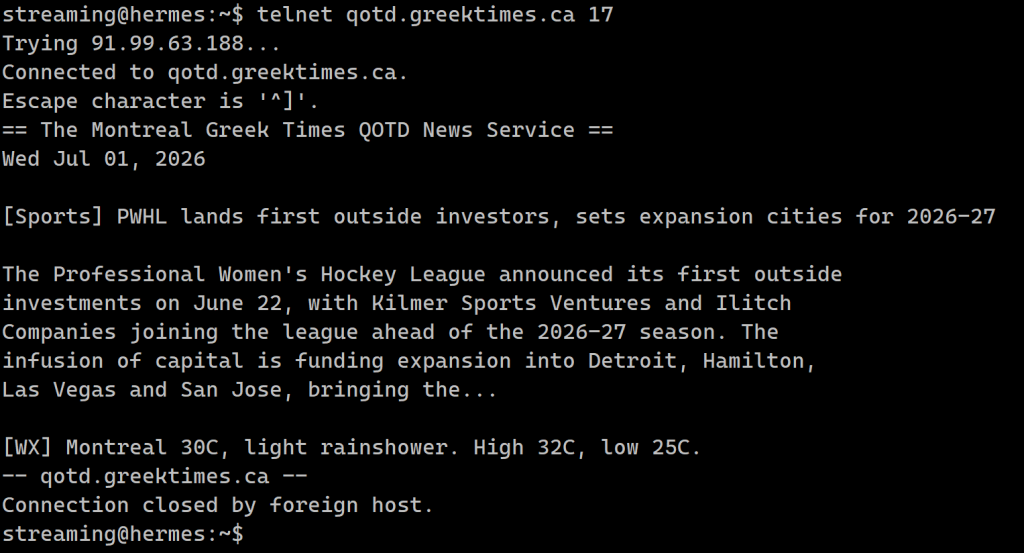
QOTD, or Quote of the Day, is one of the earliest Internet services, defined in RFC 865 (1983). A connection to port 17 returns a short text payload immediately and then closes. While historically used for simple quotes, THE MONTREAL GREEK TIMES operates this service as a modern reinterpretation delivering a rotating “News of the Day” bulletin within the original protocol constraints.
QOTD is the smallest endpoint in MGT Unicorn. There is no login, no menu, no command syntax, no feed parsing, no negotiation, and no client input required. The act of opening a connection is the request, and the complete response is the message returned by the server. RFC 865 also defines QOTD as a datagram-based UDP service, where a received datagram triggers a single answering datagram containing the quote. The live MGT Unicorn service is presently TCP-only, but its short-payload design preserves that datagram-style discipline: one compact public message, suitable for simple clients, scripts, embedded systems, and retro computers.
What you will find:
A short-form, single-response news service presenting one current headline summary per connection, followed by a Montreal weather line. When official NAAD alerts are active, alert messages are inserted into the rotation and delivered in the same compact format. The service is intentionally kept small, with payloads designed around the original under-512-byte QOTD convention.
How to access:
Any client capable of opening a plain TCP connection to port 17 can use the service. No login, negotiation, or client input is required. The server sends the text immediately and closes the connection.
On modern UNIX-like systems, tools such as nc, socat, curl, or telnet may be used. On Windows, access is available through PowerShell, telnet, or ncat. On retro systems, the service can be reached from environments such as MS-DOS, Windows 3.11, and BeOS using period-appropriate TCP/IP stacks and Telnet-capable clients.
Windows users may also retrieve the QOTD News of the Day bulletin through the built-in terminal in The Montreal Greek Times Unicorn Suite for Windows.
Windows app download:
Download The Montreal Greek Times Unicorn Suite for Windows (ZIP)
Connection examples:
nc qotd.greektimes.ca 17 < /dev/null
telnet qotd.greektimes.ca 17
curl telnet://qotd.greektimes.ca:17
ARPANET FTP-Mail
Before today’s Internet existed, there was ARPANET, an early computer network created in the United States to connect universities, research centres, government agencies, and technology laboratories. On January 1, 1983, ARPANET switched from its older Network Control Protocol, known as NCP, to TCP/IP. That change allowed ARPANET to connect more naturally with other TCP/IP networks, helping create the “network of networks” that laid the foundation for the Internet we know today.
In the beginning, electronic mail could not simply travel from one computer system to another the way it does now. In 1971, engineer Ray Tomlinson helped solve that problem on ARPANET by creating a way for a message to move from one connected computer to another. That early idea eventually became part of the history of FTP-Mail, where mail could be sent through FTP commands instead of through modern email systems.
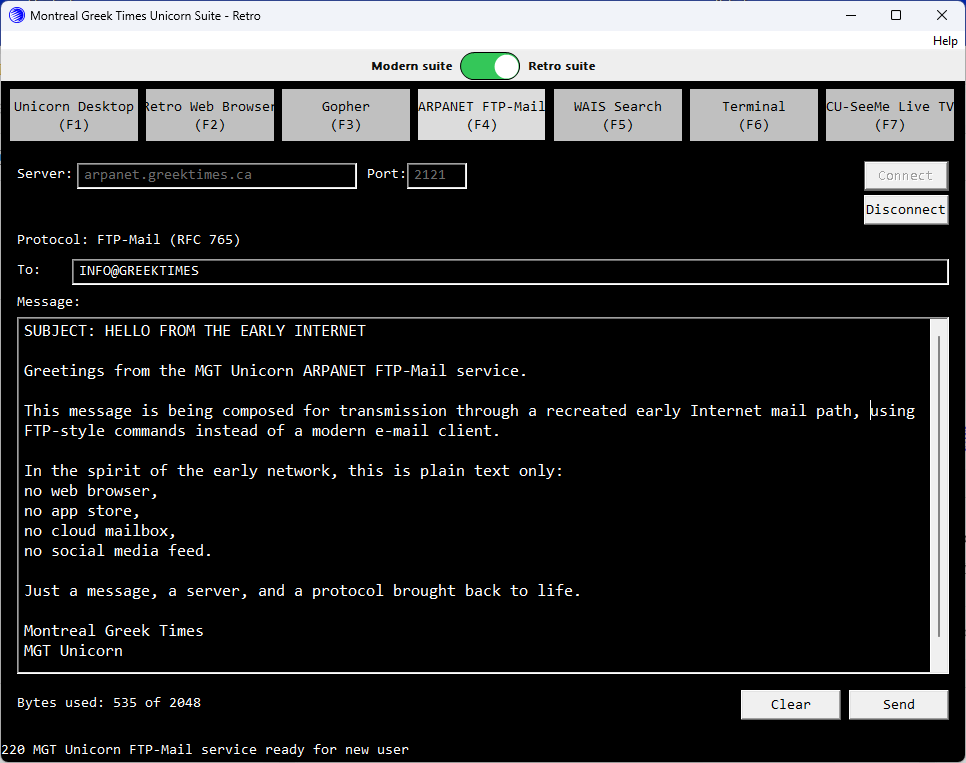
Within MGT Unicorn, THE MONTREAL GREEK TIMES has recreated that early FTP-Mail method as a real working service. This is not a visual simulation or a pretend demonstration. The message is sent using the same kind of command flow defined in the old Internet specifications, so users can experience how electronic mail once moved across the network before today’s email systems took over.
What you will find:
A simple message-submission service that allows users to send text messages to THE MONTREAL GREEK TIMES through an early Internet-style mail system. Messages sent through this service are received by our MGT Unicorn mail system and may be reviewed by the operator or editorial team.
How to access:
Windows users can send ARPANET FTP-Mail through The Montreal Greek Times Unicorn Suite for Windows, our native Windows application. The client handles the historical FTP-Mail command sequence behind the scenes and provides a straightforward message-composition interface.
Windows app download:
Download The Montreal Greek Times Unicorn Suite for Windows (ZIP)
FTP-Mail may also be sent independently, without the Windows app, by users who have a compatible FTP client or custom software that supports the historical FTP-Mail commands. For manual access, use the following connection settings:
Server:
arpanet.greektimes.ca
Port:
2121
Mailbox:
INFO@GREEKTIMES

or

INFO AT GREEKTIMES
Important context
The Montreal Greek Times Unicorn is a heritage initiative rooted in our 1994 online broadcasting origins. It exists because we were there when internet radio began.
It is also now part of a practical, real-time emergency information system. Through our NAAD integration, MGT Unicorn no longer serves only as a historical publishing and broadcasting environment. It also functions as a multi-protocol alert distribution layer for official emergency alerts relevant to Greater Montreal, including publication across legacy protocols and Greek-language adaptation by THE MONTREAL GREEK TIMES.
MGT Unicorn remains available for those who appreciate early internet architecture, protocol history, independent publishing infrastructure, standards-based access methods, emergency information resilience, and the continued operation of working systems that most of the Internet has left behind.
For modern access to our journalism, radio and television services, please use our primary website and apps.