by Dimitri Papadopoulos, with files from John Cocconas
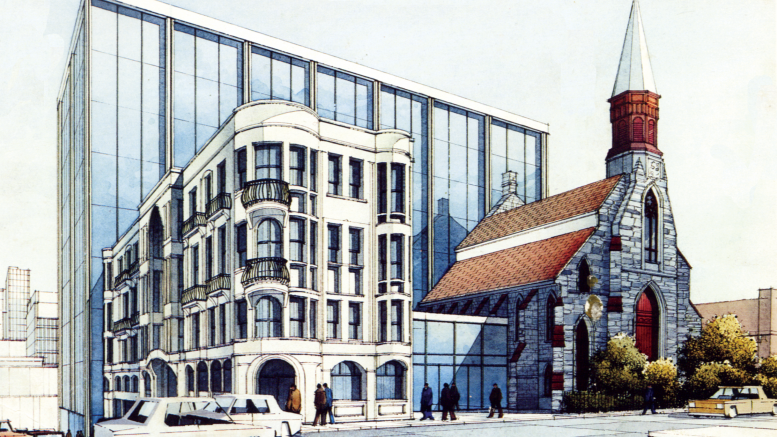
In the previous edition of The Montreal Greek Times, we explored the historic six-decade chronicle of Holy Trinity, a church that constituted the primary space of strategy and development for local Hellenism. For the early generations of Greek immigrants who arrived with unwavering faith and deep cultural pride, this sacred property was the foundation upon which the community had deposited many hopes for the future. Today, exactly 40 years after the devastating flames consumed that sacred space, we continue this ongoing tribute by examining the turbulent events that unfolded after the fire. Archival photographs from that era show a majestic stone facade swallowed by a relentless blaze, juxtaposed against later, highly ambitious architectural renderings that promised a sprawling modern complex. The ensuing narrative of Holy Trinity reveals a complex history where community devotion intersected with political ambition.
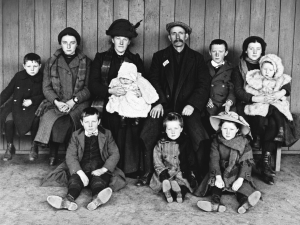
For the older generation of Greeks in Montreal, the original building held an immeasurable emotional weight. It was within those stone walls that countless newly arrived Greek immigrants sought solace, gathering to hear the Divine Liturgy in their native tongue and to celebrate their earliest Greek-Canadian Christmases. The church bore witness to their most sacred life events. It served as the holy site where young couples exchanged wedding vows, where proud parents baptized their children, and where families worked tirelessly to preserve their rich Hellenic heritage. It was a vital institution functioning to ensure that the rich Hellenic identity was passed down unbroken. To understand the depth of this loss for the younger generation of Greek-Canadians, one must recognize that this church functioned as the pulsing heart of community unity and cultural survival in a new world. Today, standing at the corner of Sherbrooke Street and St. Laurent Boulevard, observers see the modern facade of Hotel 10 occupying the exact location where this historic church once stood. The hotel serves as a highly visible reminder of a promised rebuilding effort that failed to materialize.
The interest of the Greek community in the restoration of the destroyed church was immediate and immense. A fundraising committee was swiftly formed under the leadership of Father Konstantinos Chalkias to begin the vital work of gathering resources. Various community fundraising events were organized and executed with the singular goal of collecting money to resurrect the sanctuary, and the response from the Greek community was deeply touching. Families contributed generously, driven by a profound patriotism and a steadfast desire to see their spiritual home restored. The community administration, functioning under the leadership of Adrian Maris, was simultaneously facing a severe financial deadlock. This economic strain stemmed from the creation of a second community centre located on the South Shore of Montreal. The contract for that specific suburban project had been signed with the company Saming Constructions on July 8, 1985, exactly six months prior to the fire that claimed Holy Trinity. The administration proceeded to ignore the immediate goals of Father Chalkias and his dedicated committee, advancing instead toward the creation of plans for massive, grand visions.
These impressive actions orchestrated by Adrian Maris fascinated a large segment of Hellenism, and many individuals accepted the grand proposals with noticeable enthusiasm. The president’s prior success in establishing the two community centres served as a strong foundation of trust for his supporters. The vast gap that had opened between the community administration and the Bishopric at the time was fuelled by Maris’s broader plan for the union of the remaining peripheral communities. Among the fervent supporters of the administration were highly politicized leftist groups, operating entirely under the protective title of “progressive forces”. These specific factions stood as the catalytic forces during the all-night general assemblies, driving major decisions forward with the organized strength of 70 reliable votes. The conservative world of the community expressed intense opposition to the grand visions of Adrian Maris and tried numerous times to obstruct this organized tactic, ultimately failing to halt the administration’s momentum. Adrian Maris was known to be uncompromising, stubborn, imposing, and remarkably combative in defending his positions, representing a symbol of assurance to all those who passionately backed his dreams.
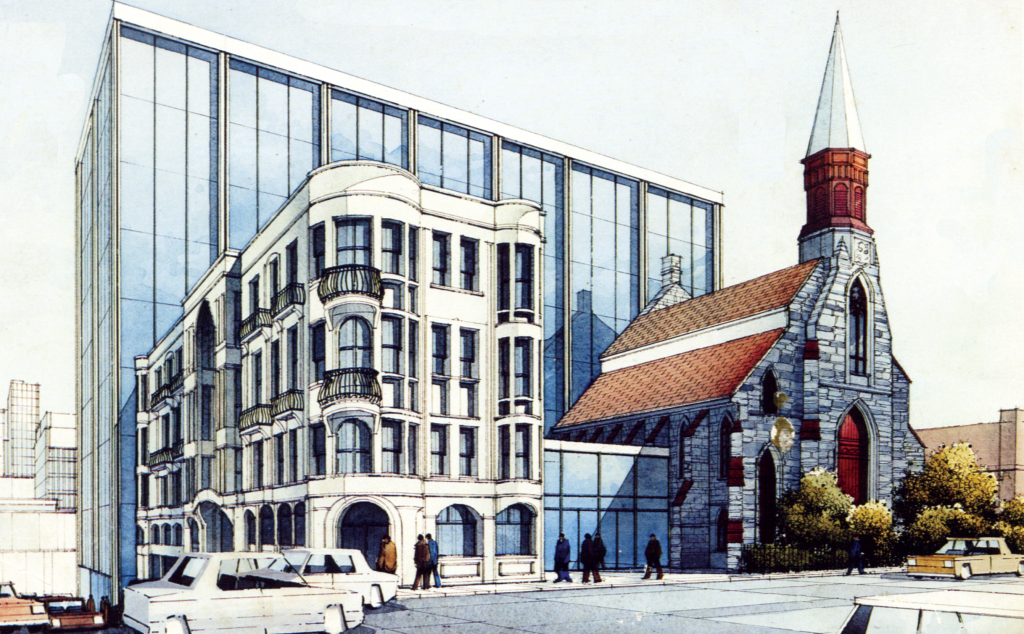
Under these heavily politicized conditions, “the simple and easy restoration of Holy Trinity becomes yet another unattainable dream” for Adrian Maris. The president left everyone completely speechless when he officially released the plans for the creation of what was dubbed the “Parthenon”. Even the most vocal sceptics were deeply impressed by the sheer scale of the venture upon seeing the spectacular architectural model published widely in local newspapers and community calendars. On July 8, 1987, the architect Dan S. Hanganu was called upon to ratify the binding decisions of the plenary session that had been taken earlier on May 6, 1987. The official contract, signed by President Adrian N. Maris and architect Dan S. Hanganu, provided for an extensive architectural study costing $450,000. This massive fee was attached to a proposed project estimated to cost approximately $16,000,000, a staggering sum for a community operating without the necessary capital. The comprehensive plans included the restoration of the Godin building situated at the southwest corner of Sherbrooke and St. Laurent, as well as the restoration of the church itself. The grand vision further required the construction of a massive eight-storey building rising above the Sherbrooke street level, complete with a basement floor and three full levels of underground garage space. A defining feature of the design was the construction of a glassed-in atrium intended to seamlessly connect the Godin building, the historic church, and the new structure.
The pursuit of these grandiose plans stood in stark opposition to the efforts of Father Konstantinos Chalkias and his committee. The priest had received vastly different promises regarding the immediate restoration of the church directly following the fire. Finding himself completely unsupported by his own superior authority, the Bishop, the devoted priest was eventually forced to abandon his community in Canada. He relocated and settled permanently in the United States, receiving necessary help and moral support from the Archdiocese of America. Leaving Montreal deeply disappointed, Father Chalkias made sure to declare loudly to anyone who would listen that the insurance policy for Holy Trinity was explicitly written for “Replacement Cost”. The internal communal chaos was further aggravated by the notorious “Daperis case”. This incident revolved around a formal decision to expel community member and radio broadcaster John Daperis. The expulsion was a direct retaliation for an article he had written and published in his newspaper “Hellenic Voice” eight months earlier. In the piece, Daperis publicly called upon the Bishop “to take up his responsibilities”. The provocative headline of the article read: “[Bishop], your time has come”. The official justification provided for the harsh community decision was that the published article “undermined the foundations” of the community.
The July 8, 1987 contract stipulated that from the total architectural fee amount of $450,000, the Hellenic Community of Montreal was presently making an immediate commitment for $93,000 for the preparation of the survey plans and sketches. The final agreement was officially accepted in Montreal, Quebec, on the ninth day of July, 1987.
In the upcoming edition of The Montreal Greek Times, our ongoing investigation will continue by examining the specific details surrounding the insurance of Holy Trinity. We will present the official estimates provided by the state and the specialized professors of the University of Montreal regarding the true costs of the sanctuary’s restoration.