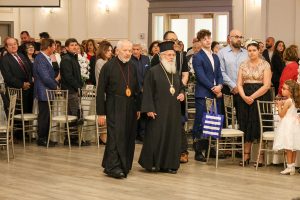
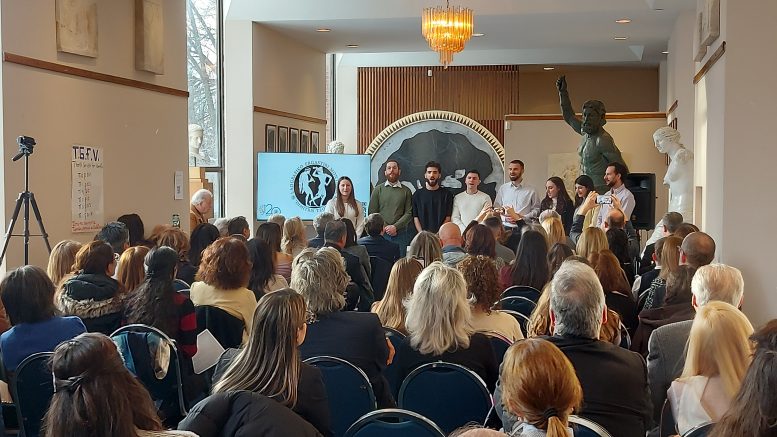
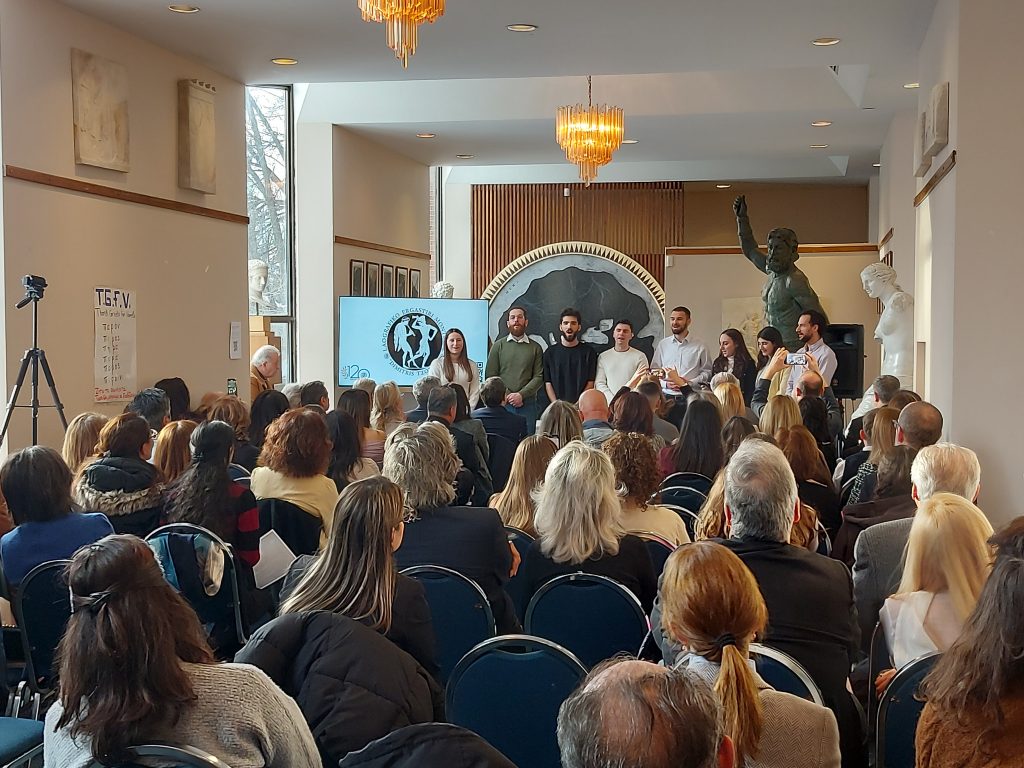
Sunlight streamed across the crowded rows of the Salle Foyer at the Hellenic Community Centre Adrian Maris, illuminating a vibrant gathering of generations united by the resonant sounds of their ancestral tongue. The atmosphere brimmed with a profound sense of cultural continuity, as attendees stood shoulder to shoulder in the overflowing hall to honour the traditions and linguistic heritage that bind the diaspora together. Anchored by this deeply felt communal pride, the gathering highlighted the concerted mission of local cultural, academic, and educational institutions to safeguard the Hellenic identity and ensure the transmission of the Greek language to future generations flourishing abroad.
The celebratory event, held on a Sunday afternoon, marked International Greek Language Day and was jointly organized by the Hellenic Community of Greater Montreal, the Hellenic Cultural Institute, and the Consulate General of Greece in Montreal. Driven by the official theme of highlighting institutions promoting the Greek language in Montreal, the gathering showcased the multifaceted approaches used to keep regional dialects and standard modern Greek alive within the metropolis. Eirini Tourkomanoli, the co-principal of the Campus II of the Socrates-Demosthenes School who hosted the ceremony, explained that the community collaborates extensively to deliver a bilingual and trilingual reality to its youth. Tourkomanoli noted the immense responsibility falling upon the diaspora to continuously speak, preserve, and project the language as widely as possible following the recent global recognition of the date by the United Nations educational, scientific and cultural organization.
The formal acknowledgment by international bodies served as a focal point for several dignitaries in attendance. Nikolaos Karalekas, the Consul General of Greece in Montreal, reflected on the historical weight of the language, referencing its forty centuries of oral tradition and thirty-five centuries of written history starting from the Linear B script. Karalekas shared that the official international decree cited the Italian astronomer Galileo, who described the invention of the Greek alphabet as the greatest discovery of humanity. The consul general emphasized that Greek operated as the primary international language of communication across different peoples for six centuries during the Hellenistic period, ultimately enriching other European languages and laying the foundational vocabulary for modern political, scientific, and philosophical discourse.
Basile Angelopoulos, the president of the Hellenic Community of Greater Montreal, connected this sweeping historical narrative to the tangible reality of the diaspora in Quebec. Angelopoulos stated that active participation means a guaranteed future for the Hellenism of Montreal. He shared a poignant story about young students at the Socrates-Demosthenes School who were asked to draw and colour their internal organs based on their feelings. Angelopoulos recounted that the children coloured their brains with a mix of shades to represent their diverse identities as global citizens and Canadians, while they unanimously coloured their hearts a solid, pure Greek blue. He described the language as a living experience brought to life by teachers, priests, and volunteers who teach the youth to stand upright and proud, ensuring that the community remains anchored to its roots.
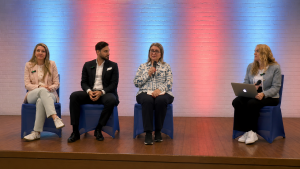
The importance of speaking the language within the family home was a sentiment echoed by Dr. Jacques Bouchard, a professor emeritus of modern Greek literature at the Université de Montréal and the recipient of the 2025 Grand Prize for Greek Literature from the Ministry of Culture. Bouchard implored the audience to converse in Greek among themselves to save the most important language of Western civilization. He noted that the structure and grammatical system of the language provide a unique foundation for scientific thought, encouraging the younger generations to maintain the linguistic wealth they acquire naturally within their households. Anastasios Anastasiadis, an associate professor and chair of the Phrixos B. Papachristidis at McGill University, added that the survival of the language has historically relied on multilingual environments. Anastasiadis explained that supporting trilingual education and resisting the pressures of a strictly monolingual culture are vital steps in protecting the Hellenic cultural footprint in North America.
Personal testimonies further illustrated the profound emotional and practical value of language retention for young adults in the community. Nikita Giannakis, a graduate of McGill University participating in the minor program for teaching Greek as a second language, shared his experiences applying his academic studies to real-world connections. Giannakis described using the language as a powerful tool to engage with immigrant realities, allowing students to articulate stories about their homes, villages, and families. Reflecting on his own travels to the island of Kefalonia, he explained that conversing with his grandparents generated deep and unforgettable emotions. Giannakis stated that every trip to Greece was truly a lesson in culture and language, and that the local hospitality actively birthed the language within him.
The celebration also spotlighted the diverse array of institutions working to catalogue, teach, and perform the cultural artifacts of the Greek people. Stavroula Theodorakopoulou, a philologist working with the Hellenic Library of Montreal, detailed the ongoing efforts to modernize the library and digitize an extensive collection of archives, rare books, and local diaspora literature to preserve the intellectual output of Greek-Canadians. Konstantina Bakopanou, a dance teacher from the Montreal Folklore Workshop Dimitris Tzotzis, explained how traditional dance and song function as living expressions of identity. Bakopanou highlighted that teaching folk songs in rare regional dialects helps maintain the complete mosaic of the culture. The folkloric group invited the audience to join the youth in a traditional call-and-response Vlach song, transforming the linguistic heritage into a communal physical activity.
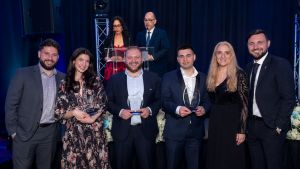
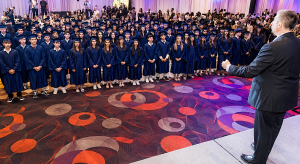
Artistic performances and student recognitions formed a significant portion of the afternoon program. A choir of students from the Socrates-Demosthenes School, dressed in their dark blue uniforms, stood before a large map of the Mediterranean and sang the Epitaph of Seikilos. Maestro Dimitris Ilias explained to the audience that the piece is the oldest surviving complete musical composition from ancient Greece, bridging the classical past with the vibrant present. The youth programming continued with the recitation of verses by celebrated Greek authors including Odysseas Elytis, Nikos Kazantzakis, and Constantine Cavafy. Following the artistic segments, the leadership of the community called a group of grade five students to the front of the hall to receive awards for their outstanding written essays focusing on the one hundred and twentieth anniversary of the Hellenic Community of Greater Montreal. The students proudly held their prize envelopes while posing for photographs alongside the community executives.
The community gathering incorporated modern technology to engage the attendees in a final reflection on their linguistic roots. The organizers displayed a digital code on the presentation screens and asked the audience to use their mobile devices to submit their favourite Greek word. The words populated live on the screens, creating a visual cloud of cultural values that included love, freedom, harmony, and history. The event concluded with the announcement of the poll results, revealing that the word philotimo emerged as the most popular choice submitted by the attendees.