
Local Journalism Initiative Reporter
The chamber of Montreal’s City Hall municipal council carried a sense of ceremony during its March 23 session, where the cadence of formal proceedings gave way to applause, national colours and the visible presence of Greek flags in the gallery. Elected officials rose one after another to acknowledge a community whose imprint spans generations, marking both the 120th anniversary of the Hellenic Community of Greater Montreal and the official designation of March as Hellenic Heritage Month, a recognition rooted in history, identity and civic contribution.
The declaration, introduced during the council’s agenda under item 15.07, situates the Greek presence in Montreal within a broader civic narrative that spans more than a century. Municipal records emphasize that generations of residents of Greek origin have contributed across fields including entrepreneurship, education, health care, arts and public life. The motion, supported unanimously, calls for the city to highlight these contributions while inviting all Montrealers to take part in celebrations tied to Greek Independence Day on March 25 and the anniversary year of the community’s institutional presence.
In the council chamber, the atmosphere reflected that continuity. Representatives acknowledged individuals seated in the gallery, including long-standing community figures and organizers involved in anniversary events. The presence of elders alongside younger attendees underscored the intergenerational nature of the Greek experience in Montreal, where language, faith and tradition are maintained through institutions that have evolved alongside the city itself.
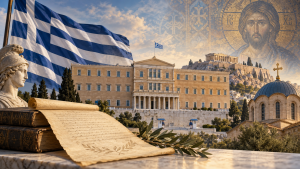
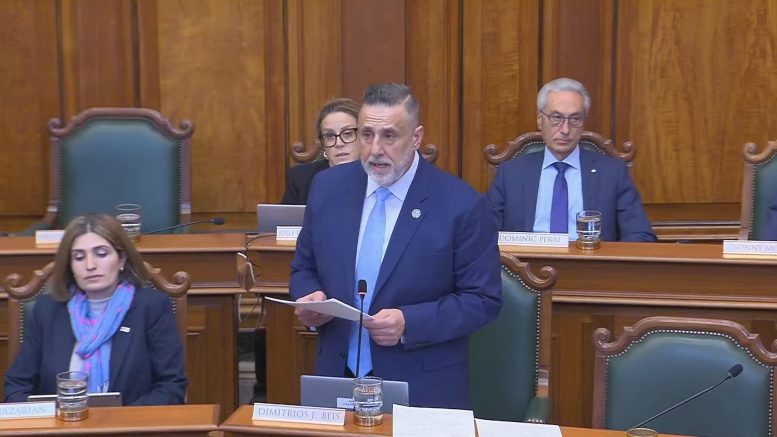
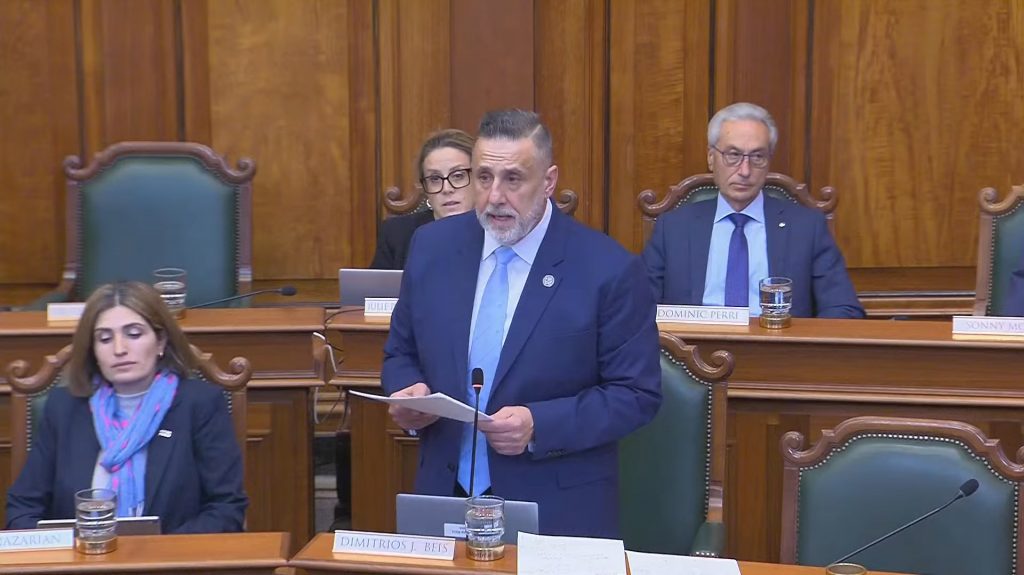
Borough Mayor Dimitrios “Jim” Beis, who introduced the declaration, framed the moment as one of collective memory and civic belonging. “This evening, we gather in this chamber to celebrate two milestones, Greek Independence Day and 120 years of Greek presence in our great metropolis,” he said during the session. He recalled the historical significance of March 25, 1821, noting that the struggle for independence was rooted in dignity, identity and the right to shape one’s own destiny, themes that continue to resonate within diaspora communities.
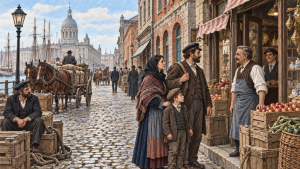
Beis connected that legacy to the immigrant experience in Montreal, describing how successive generations arrived with limited means and built institutions that preserved Hellenic culture while integrating into Canadian society. “They opened businesses, built churches, created schools and organizations that preserved our language, our faith and our traditions,” he said, emphasizing that the community ensured Hellenism would flourish rather than simply endure. His remarks reflected a narrative familiar within Greek Montreal, where the early decades of settlement in neighbourhoods such as Park Extension laid the groundwork for a lasting cultural footprint.
City councillor Effie Giannou, who seconded the motion, placed the declaration within the lived reality of Montreal’s neighbourhoods. She described the Greek community as an integral part of the Montreal fabric for more than a century, noting that tens of thousands of residents of Greek origin continue to contribute to the city’s vitality. Schools, churches and community organizations were cited as pillars that sustain both cultural continuity and civic participation.
Giannou also highlighted the symbolic dimension of the recognition. “We are very proud, here together at city council, to officially recognize March as Hellenic Heritage Month,” she said, adding that the designation affirms both historical memory and ongoing engagement within Montreal’s diverse society. The annual Greek Independence Day parade along Jean-Talon Street, scheduled for March 29, was referenced as a focal point for public celebration, drawing thousands each year in a display of heritage and community pride.
In remarks that drew attention to the neighbourhood of Park Extension, a city councillor emphasized the longstanding Greek presence in the area, describing it as a defining element of its economic and social identity. The commercial vitality of Jean-Talon Street, often referred to as the city’s Greek district, was cited alongside institutions such as Orthodox churches and longstanding businesses that anchor community life. This presence has shaped the neighbourhood and continues to shape it today, with local entrepreneurship and cultural expression maintaining a visible and enduring identity.
Community organizations were also acknowledged for their social impact, including those providing services to families, seniors and vulnerable populations. These institutions, many of which operate in Greek while serving broader communities, illustrate how heritage preservation and social integration intersect in practical ways across Montreal.
Mayor Soraya Martinez Ferrada addressed the chamber with remarks that situated the Greek community within the broader mosaic of Montreal’s cultural life. Drawing on her experience in districts with significant Greek populations, she noted the importance of educational and cultural institutions in sustaining identity across generations. “Communities across Montreal take their place in the city, and one way they do so is through schools and cultural activities that allow future generations to continue what defines them,” she said. She added that the coexistence of multiple identities within Montreal contributes to the city’s character, with Greek Montrealers embodying that dynamic through their dual attachment to heritage and civic life.
The recognition of March as Hellenic Heritage Month aligns with broader efforts at the federal level to establish similar recognition across Canada. In Montreal, where the Greek presence dates back to the early twentieth century, the anniversary year provides a focal point for both reflection and public engagement.
Beyond the council chamber, the declaration coincides with a series of events organized throughout March, including cultural programming, educational activities and commemorations tied to Greek Independence Day. The annual parade remains the most visible expression of these celebrations, bringing together community groups, schools and organizations in a procession that reflects both heritage and civic pride.
The narrative of Greek Montreal, as articulated during the council session, is one of continuity shaped by adaptation. Early immigrants established institutions that preserved language and faith, while subsequent generations expanded that legacy into professional, cultural and political spheres. The result is a community that remains deeply rooted while actively participating in the city’s evolution.
The council concluded its proceedings with the adoption of the resolution, formally designating March as Hellenic Heritage Month and inviting residents of all origins to participate in the commemorations marking Greek Independence Day and the 120th anniversary of the Hellenic Community of Greater Montreal.