
In the previous edition of The Montreal Greek Times, we explored the ambitious architectural visions that eclipsed the immediate desire to restore the Holy Trinity Greek Orthodox Church following the devastating 1986 fire. Our ongoing retrospective now turns to the complex administrative, political, and ecclesiastical struggles that consumed the Greek diaspora in the subsequent years. To ensure a rigorous and accurate historical record four decades later, we sought the direct input of Nicholas T. Pagonis, a former president of the Hellenic Community of Montreal. His extensive firsthand knowledge of the era profoundly clarifies the established narrative, revealing a complex reality driven by shifting demographics, severe financial realities, and high-level banking interventions.
For the pioneering generation of Greek immigrants, the intersection of Sherbrooke Street and St. Laurent Boulevard held the echoes of their earliest Canadian memories and profound spiritual devotion. It was within those stone walls that countless newly arrived immigrants sought solace, gathering to hear the Divine Liturgy in their native tongue and to celebrate their earliest Canadian Christmases. The church bore witness to their most sacred life events. It served as the holy site where young couples exchanged wedding vows, where proud parents baptized their children, and where families worked tirelessly to preserve their Hellenic heritage.
However, the romanticized memory of a thriving cultural hub interrupted solely by a tragic winter fire obscures a harsher truth. Years before the blaze, Holy Trinity was already struggling to survive. The Greek demographic had steadily migrated away from the downtown core. Parishioner participation had declined to alarming levels, with the vast majority of the remaining congregation commuting from the South Shore. The church found itself entirely unable to cover its basic operating expenses, leaving the community administration to manage an increasingly vacant and costly heritage building.
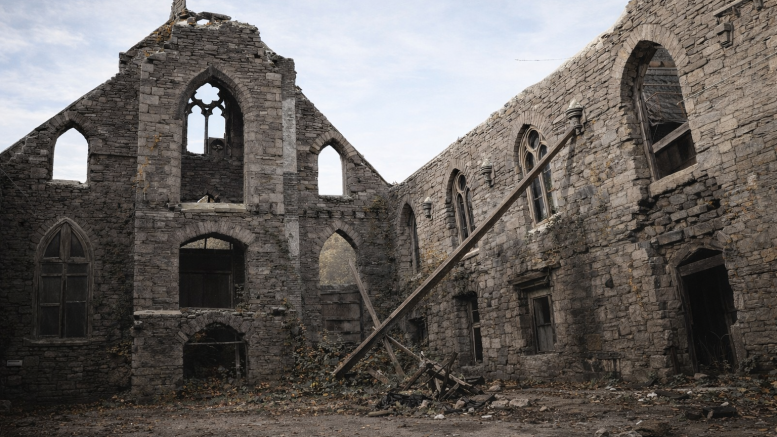
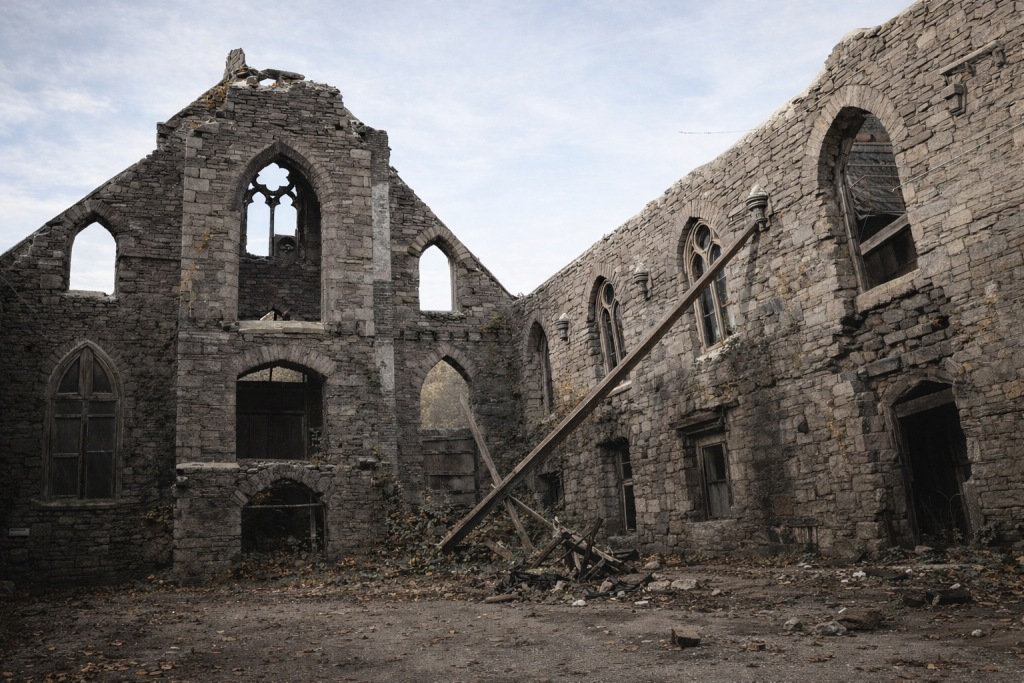
When the catastrophic fire reduced the sanctuary to blackened stone on Jan. 16, 1986, the immediate public reaction was one of grief and mobilization. Early grassroots fundraising efforts, championed by Father Konstantinos Chalkias and later by the late George Savoidakis, successfully raised $115,000 for the church. At the time of the fundraising, Savoidakis was a highly visible advocate for cultural minorities, serving as a municipal councillor for the Jean-Talon district, which encompassed the southern half of the Greek-dominated Parc-Extension neighbourhood. Yet the community leadership, headed by President Adrian Maris, recognized that a standalone reconstruction of the church was financially unviable. Instead of a simple rebuild, the administration actively sought the commercial exploitation of the highly valuable downtown space.
Historical accounts frequently portray Father Chalkias as a tragic figure desperate to return to a rebuilt Holy Trinity. The administrative reality of the time dictates otherwise. The priest did not actively wish to return to the Sherbrooke Street location and was instead seeking a new appointment at St. George’s Cathedral.
The grand architectural visions for the Place Sainte-Trinité project proposed a sprawling modern commercial complex that would include only a small commemorative chapel to honour the site’s religious history. On July 8, 1987, architect Dan S. Hanganu was called upon to ratify the binding decisions of the plenary session taken earlier that May. The official contract provided for an extensive architectural study costing $450,000. This massive fee was attached to a proposed project estimated to cost approximately $16,000,000. The comprehensive plans included the restoration of the Godin building situated at the southwest corner of Sherbrooke and St. Laurent, alongside the construction of a massive eight-storey building rising above the street level, complete with a basement floor and three full levels of underground garage space. A defining feature of the design was a glassed-in atrium intended to seamlessly connect the historical elements with the new structure.
To understand the vast gap that had opened between the community administration and the religious authorities during this period, one must examine a critical legislative maneuver that forever altered the governance of the local diaspora. The root of the conflict was Private Bill 231, formally titled An Act respecting the Hellenic Community of Montreal. Sponsored by Parti Québecois Member of the National Assembly Gérald Godin, this pivotal legislation was adopted as Chapter 58 of the Statutes of Quebec on June 18, 1980. The bill officially changed the organization’s name from the Hellenic-Canadian Community of the Island of Montreal to the Hellenic Community of Montreal.
More importantly, it restructured the polity of the community, transferring administrative and financial authority completely away from the Greek Orthodox Diocese and placing it firmly under the control of lay community directors. By granting these new secular powers, Private Bill 231 provided the civic administration with the absolute legal coverage to manage properties, form regional councils, and pursue the union of peripheral communities independently of the religious hierarchs. The legislation effectively defunded the local Diocese, sparking a bitter administrative war. The strategy employed by the religious authorities involved the illegal, direct collection of fees for sacraments performed within the churches. Community President Adrian Maris utilized the new powers granted by Private Bill 231 to challenge these ecclesiastical actions, taking the dispute directly to the civil justice system.
The internal communal chaos was further aggravated by incidents like the notorious “Daperis case”. This event revolved around a formal decision to expel community member John Daperis. The expulsion was a direct retaliation for an article he had written and published on the front page in his Hellenic Voice newspaper eight months earlier, publicly calling upon the Bishop to take up his responsibilities. The provocative title of the article read, “Bishop your time has come”. The official justification provided for the harsh community decision was that the published article undermined the foundations of the community, leading to legal battles that drained tens of thousands of dollars from the community’s coffers.
This environment of administrative tension attracted the attention of partisan political operatives. Political developments unfolding in Greece, notably the rise of the PASOK party, prompted local loyalists to seek influence within the Montreal diaspora. These political figures initially attempted to gain power independently, forming an electoral slate under the name Democratic Change. When they failed to secure a majority in the community elections, they pivoted to collaborate directly with Adrian Maris. Despite this alliance, Maris never relinquished his authority and maintained full, absolute control over the community’s trajectory and decision-making processes.
The grand architectural designs for the unrealized commercial complex absorbed $262,116 from the community treasury in preparatory fees alone. The community eventually found itself paralyzed by a staggering accumulated debt of roughly $10 million. The monumental task of addressing this crippling financial burden fell upon a succeeding executive committee described in historical records as the insubordinate right-wingers of Vasilios Katsambanis. Previous archival reports suggested that this administration rescued the community through the goodwill of Greek government ministers. The precise financial mechanism, however, was far more pragmatic.
The vital refinancing of the community was secured through the direct intervention of Theodoros Karatzas, the Governor of the National Bank of Greece. At the time, the local Montreal branch of the bank was severely entangled with two non-performing loans, one held by the community and another associated with Adrian Maris. These bad debts were actively creating critical liquidity problems for the local branch. To resolve this banking crisis, a new $5 million loan was issued with the official guarantee of the Greek State. This strategic financial maneuver dynamically served the bank’s interests by clearing the problematic local ledgers, while simultaneously rescuing the Montreal community from immediate financial collapse.
Meanwhile, the physical remains of Holy Trinity sat neglected. The municipal government repeatedly demanded that the community administration properly cover the ruined structure to ensure public safety, an order the administration met with sluggish compliance. Approximately two years after the fire, a specialized team of architects, urban planners, and historians led by University of Montreal professor Janus Baraka expressed significant academic interest in the site’s restoration potential. Comprehensive structural research definitively dismissed widespread rumours that the church’s foundation had been compromised by extreme heat.
The engineering analysis revealed that the original foundation and the surviving walls were constructed from thick, highly durable stone. This robust masonry was capable of bearing structural loads with a safety factor far exceeding the requirements of modern building codes. Furthermore, the natural downward slope of the Sherbrooke Street terrain provided a highly effective drainage path. This rapid drainage prevented the massive volumes of water deployed by municipal firefighters from pooling and causing any structural degradation to the historic footings.
This expert confirmation that the building could have been safely salvaged yielded no tangible results during the administrative tenure that followed.
In upcoming edition of The Montreal Greek Times, the focus turns to a renewed restoration initiative undertaken by the Katsambanis administration. The reporting will also examine the second fire that struck the abandoned structure, an event that further accelerated the site’s decline into what President Pagonis formally recorded as a public urinal and gathering place for illicit activity. Subsequent coverage will detail the final demolition of the remaining ruins, the role and obligations of the financial guarantors, and the emphyteutic lease arrangements that ultimately reshaped the historic site.