
Along the wharves of the St. Lawrence, where ocean ships once unloaded their crews into the river towns of Lower Canada, the Greek story in Quebec began in quiet, carried ashore by sailors whose names slowly dissolved into French and whose grandchildren would grow up knowing little of the islands their forebears had left behind. That hushed beginning, traced today through worn church icons, parish records and the memory of old families, is the thread running through one of the most intriguing chapters of Hellenism in the Americas: the question of when, and how, the first Greeks reached the shores of Quebec, and the slow assimilation that nearly erased them.
The difficulty begins with the records themselves. A precise date for the first Greeks in the greater Montreal region remains, by most accounts, beyond reach, owing to the absence of clear and specific documentation. Their presence can be followed only through the visible marks they left behind, a christened child here, a Hellenized surname there, an heirloom passed down through generations. The prevailing view among researchers and historians holds that the arrival of the first Greek immigrants in the province of Quebec, and in Montreal in particular, began around 1843.
The earliest Greeks in Montreal, whether they came as registered immigrants or slipped ashore as stowaways, were overwhelmingly men of the sea. Many married into the local population, most often French-Canadian women, and over time altered their names. With each passing decade their ties to their origins thinned, until they were absorbed into the wider society and effectively vanished as Greeks.
That pattern was set down decades ago by the educator and historian George Demetrios Vlassis, whose English-language volume “The Greeks in Canada” appeared in Ottawa in 1953 and remains a foundational reference for the community’s early history. “No one can speak with certainty about the first Greeks of Quebec,” Vlassis wrote, in a passage rendered here from the Greek. He went on to observe that from the early 17th century onward many arrived as sailors, lingered for various reasons in the ports along the St. Lawrence, married and were completely assimilated into the local French population.
The idea of a Hellenic footprint on these shores well before organized migration finds its boldest illustration far to the west. Ioannis Phokas, a navigator from the Ionian island of Cephalonia born in 1536, sailed in the service of King Philip II of Spain under the name Juan de Fuca, and in 1592 explored the broad strait that today separates Vancouver Island from Washington state and forms part of the international boundary between Canada and the United States. The Strait of Juan de Fuca still carries his name, and he is widely regarded as the first Greek to set foot on what is now Canadian soil. His voyage, recorded by English chroniclers and confirmed two centuries later by the survey of George Vancouver, places a Greek mariner on the Pacific coast generations before the river towns of Quebec heard their first Greek voices.
The most evocative evidence from Quebec itself survives in an account preserved in the community’s archival press and compiled by journalist John Coconas. It concerns Vasilis Kranidiotis, described in the account as among the few whose presence in the province reached back to the late 18th century. In the winter of 1908, Kranidiotis set out from Sorel, the river town where he had lived for many years, in the company of the painter Spyros Athinaios and a companion named Nikolas Tagaras, intending to seek their fortunes in another city. Their carriage crossed the province to the northwest, and in heavy weather the driver, Spyros Kranidiotis, lost control of the horses. One animal broke loose and bolted onto a large farm, and the three men followed onto the property to recover it.
The owner came out to his front step to see what was happening. The travellers, fluent in French after their years in Sorel, explained themselves and mentioned, among other things, that they were of Greek origin. At those words the farmer, known locally as Monsieur Eustrat Thaken, lit up with joy and told them that his own father had been Greek, a man who had died many years earlier.
Thaken, then past 75 and born in Saint-Antoine, Quebec, spoke of his father with deep affection, recalling a man loved and admired throughout the district.
While his guests sat inside his manor house, Thaken withdrew into the inner rooms and returned holding a very old icon, the names of its saints faded in Byzantine lettering. It was an image of the Three Hierarchs, Basil the Great, Gregory the Theologian and John Chrysostom, the three fourth-century church fathers honoured in the Orthodox tradition as patrons of faith and learning. The icon had belonged to Thaken’s father, a sailor who, in all likelihood around the middle of the 17th century, had carried it across the Atlantic and up the great river, a small portable sanctuary that outlasted the man, his language and even the memory of his homeland.
Other traces point the same way. Across Franco-Canadian society, and especially in the towns strung along the St. Lawrence, a number of Hellenized or altered Greek surnames survive as quiet markers of forgotten origins, lending weight to the view that Greeks were present in Quebec well before the 17th century. These families married, raised their children in French, lost contact with their roots and dissolved into the founding population of the colony, leaving fragments of their names behind.
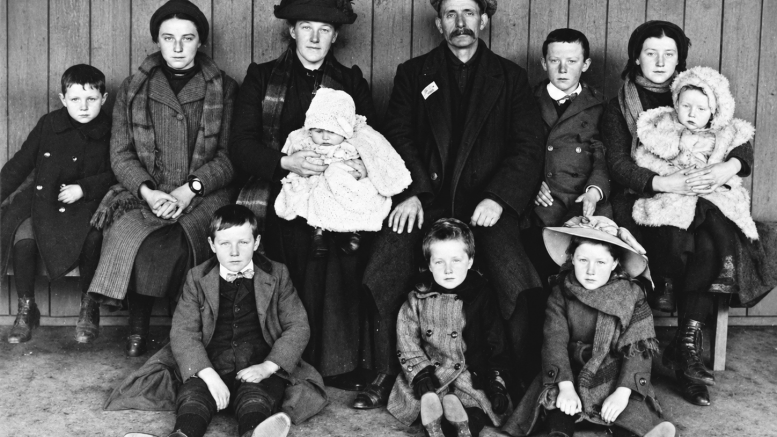
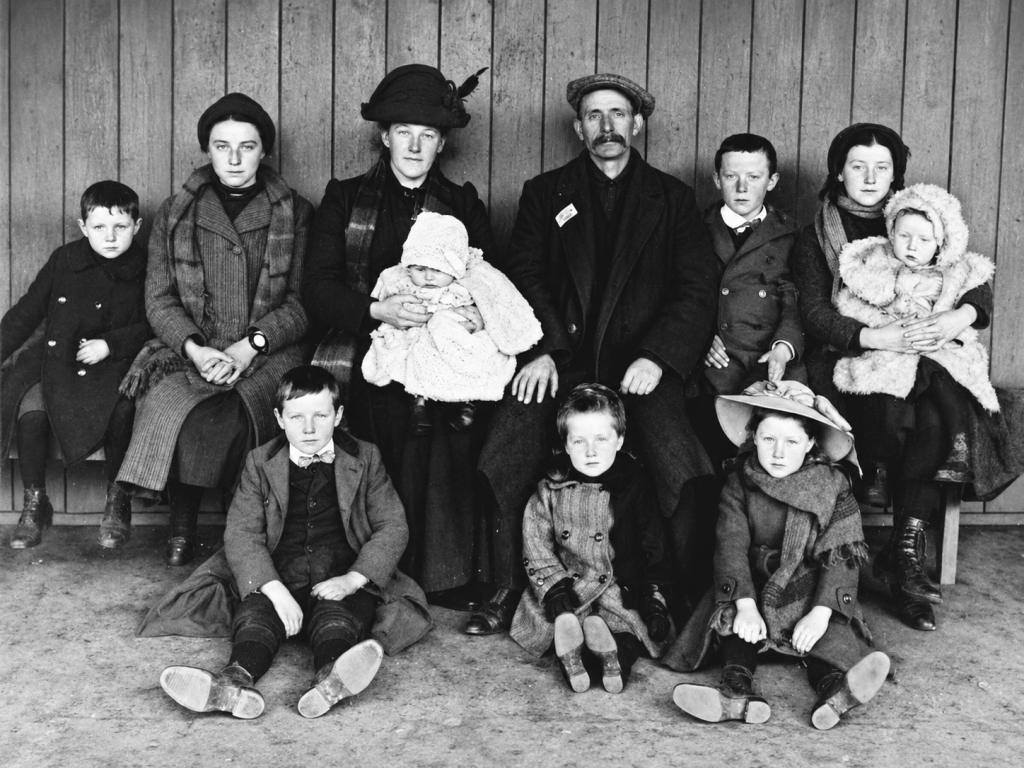
The archival photographs that accompany the original feature capture the human texture of that long arc. In the formal, sober poses common to the period, groups of young immigrants and families stand and sit before the camera, the men in caps and the women in long dresses, a child clutching a white pitcher in the foreground of one image and parents cradling infants in another. They are portraits of a community in the making, a people learning to live as both Greek and Canadian on the banks of a northern river.
By the 1981 census, Canada counted more than 154,000 people of Greek origin, some 49,000 of them in Quebec, with the overwhelming majority living in the greater Montreal area.
In the next issue of THE MONTREAL GREEK TIMES: The first Greek families of Montreal.