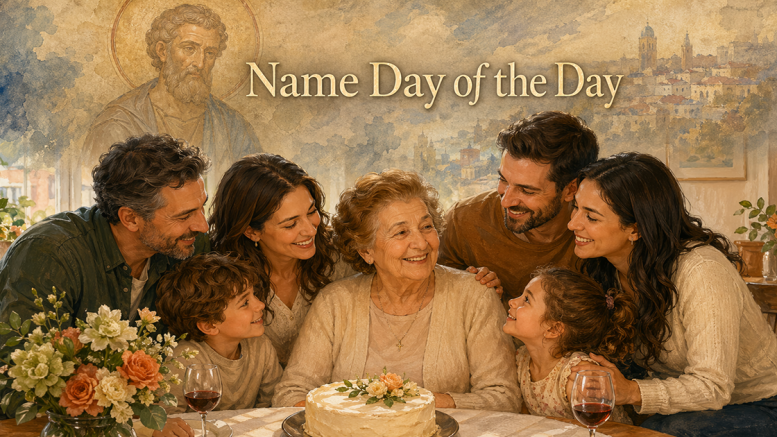
Today’s name day can start with a text to any Myron in your contacts, whether he is Greek or not. And alongside Myron, Greek families are also celebrating Triantafilia and Triantafyllos, names built around one of the most familiar images in the language: the rose. It is the kind of day when a family tradition can travel easily from your aunt’s kitchen to a classmate, co-worker or neighbour who has never heard of name days before.
Myron comes from Greek Μύρων, closely linked to μύρον, the perfumed oil known in ancient Greek and later ceremonial use. The word itself passed into English as myrrh through a different but related historical path, while the personal name Myron stayed recognizably Greek and also gained a wider English life. Triantafilia and Triantafyllos come from Greek τριαντάφυλλο, the modern Greek word for rose, literally “thirty leaves,” a poetic old formation that became the everyday name of the flower.
In Eastern Orthodox Christianity, a person’s name day is the feast day of the saint after whom they were named at baptism.
There is something naturally memorable about these names. Myron has the old, polished weight of classical Greek, the kind of name that suits the professor whose office is lined with books or the customer who always speaks with quiet precision. Triantafilia feels brighter and more fragrant, easy to picture on the theia who keeps a beautiful garden on a small Montreal balcony, or the hairdresser who somehow makes every client leave feeling lighter. Triantafyllos has that same floral richness with a steadier, more grounded sound, fitting for a papou who still cuts roses from the yard for the table or an across-the-street neighbour who never arrives empty-handed.
Chronia Polla! to everyone celebrating today, Greek and non-Greek alike. If you know a Myron, or someone in your family named Triantafilia or Triantafyllos, today is a lovely excuse to send your wishes and share a small Greek custom with someone who may not even know they are being celebrated.