Today’s name day is a good reminder that Greek names often travel further than we think. If you know a Chariton, a Hariton, or even someone in a Slavic or Balkan circle who carries a related form of the name, they share in a tradition being marked today in Greek families too. It is the kind of small custom that turns into an easy text, a quick explanation, and a lovely cultural exchange.
Chariton comes from the Greek Χαρίτων, built on χάρις, one of the richest words in Greek. In classical Greek, charis carried the sense of grace, favour, beauty, generosity, and the warmth that passes between people. The ending gives the name an old Greek shape, and that deep root is why it feels both ancient and immediately human.
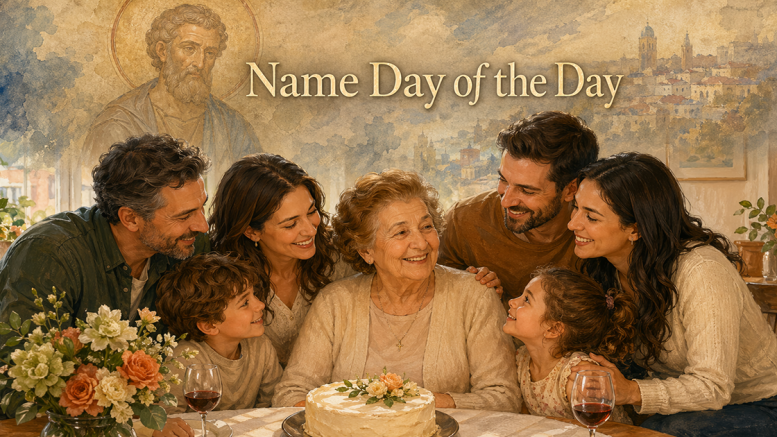
In Eastern Orthodox Christianity, a person’s name day is the feast day of the saint after whom they were named at baptism.
There is something naturally warm in this name. It suits the uncle who never arrives empty-handed, the colleague who smooths out a tense meeting with good humour, or the across-the-street neighbour whose kindness seems to reach people before his words do. Even the shorter modern form Haris carries that same easy brightness, the feeling of someone who leaves a room lighter than he found it.
Today also catches a wider circle around the formal Greek form, including families who use Chariton in English letters and others who know the Romanian Hariton or Russian Khariton. For Greek-Canadians, that is part of the charm of a name day like this one: the name is distinctly Greek, but the wish can travel comfortably into everyday Canadian life.
Chronia Polla! to everyone celebrating today, whether you are Chariton, Hariton, Haris, or part of the family around them. If you know someone with the name, send the message along today and let a small piece of Greek tradition land somewhere it was not expected.