The second instalment of this series traces the pioneers who came ashore from 1843, the crop crisis that swelled their ranks, and the founding of the first Greek Orthodox community in Canada.
By Dimitri Papadopoulos
with files from John Coconas
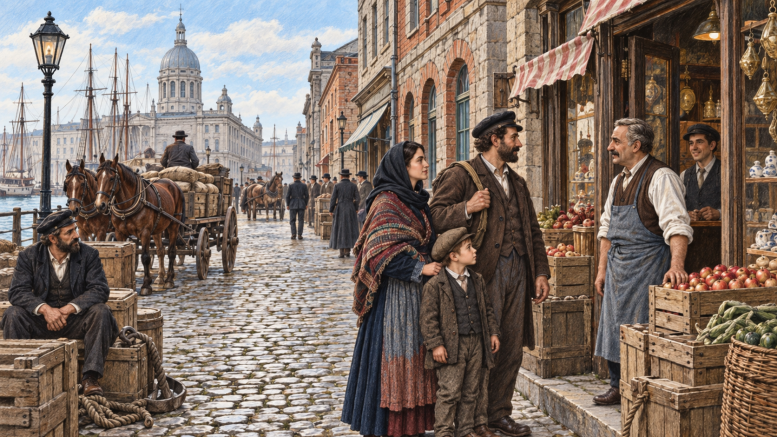
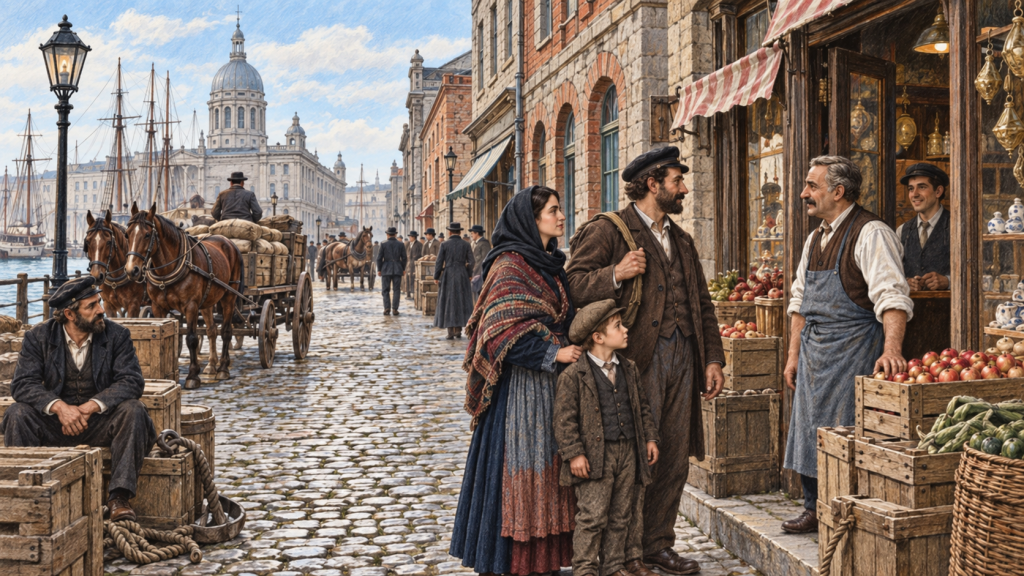
Along the timber wharves of the port of Montreal, where the masts of ocean sailing ships once crowded the edge of the young city, a small band of Greek seamen came ashore and stayed, the first of a community that would rise over six decades from a scattering of sailors into families, shops and, in time, a church of its own. This account picks up where the first part of the series, published in the previous issue of GREEK TIMES, left off, following the earliest Greek arrivals of the 1840s through the great migration of the 1890s to the founding, at the turn of the 20th century, of the first organized Greek Orthodox community in Canada.
As the earlier chapter recounted, the first Greeks to reach Montreal, whether as registered immigrants or as men who slipped quietly ashore, were sailors by trade. The historians of the community, chiefly George D. Vlassis in his 1953 volume “The Greeks in Canada” and Georgios Vasilakis in his 1983 history, place the first to disembark in 1843: Panagiotis Nonis and Theodoros Lekkas, both natives of Kranidi in the Argolic district of Ermionida, and both veteran seamen of the Greek War of Independence of 1821. They had fought for a free Greece and carried that memory across the Atlantic to a French-speaking city on the St. Lawrence.
Two years later, in 1845, three more sailors landed from the island of Psara, remembered only by their given names of Michalis, Giannis and Dimitris. Psara had ample reason to send its sons abroad, its proud merchant fleet, third in Greece after those of Hydra and Spetses, having been destroyed by Ottoman forces in June 1824, with thousands of its people killed or scattered. In the years that followed came A. Zervoudakis of Kamares, in the Chania region of Crete, who kept an elegant confectionery until 1876 at 26 Saint Paul Street, the oldest commercial artery of Old Montreal, together with a Cretan known as Manios and a man named Nikolas from Mesolongi, the town of the celebrated 1826 exodus, who reached the city in 1880.
For decades the numbers stayed small. From 1843 to 1885 the community, by the most careful reckoning of these historians, amounted to perhaps ten souls. A few more followed before the decade was out: Giorgos Gerasimou, another son of Kranidi, in 1886; Markos Pepesis and Michalis Nikolakakos in 1887; and Michalis Gianoutsos in 1889. Their livelihoods often lay in the food, fruit and confectionery trades that early Greeks across North America made their own, work that let a man with modest savings open a shop of his own.
The final decade of the 19th century turned that trickle into a current. The cause lay in the vineyards of the Peloponnese, where the Corinthian currant had become the economic lifeblood of the young Greek state, at times three-quarters of all its exports. When France, whose own vines had been devastated by the phylloxera blight, restored its harvests and raised tariffs against Greek fruit around 1893, prices collapsed, and a sovereign default that same year deepened the ruin. Poor and often illiterate farmers from the mountainous heart of the Peloponnese, from Laconia and Arcadia, along with families from Epirus and the islands, set out for the New World. Between 1890 and 1914, close to a sixth of the population of Greece emigrated. Most passed through the Atlantic ports of Halifax, New York and Boston on their way to Montreal.
By 1893 the Greeks of Montreal numbered around 300, most of them Laconian, Arcadian, Epirote and islander in origin. The historians count among the first Greek families of that year those of Dimitrios Pergantis, Kostas and Leonidas Mitrakos, Giorgos Agiorgitis, Dimitrios Zarafonitis, Vasilis Brahalis, Dimitrios Hatzizisiou, Panagiotis Panoulas, Nikos Fouriezos, Panagiotis Smyrlis, Panagiotis Nikolaras, Kostas Zervos and Charalambos Koutsogiannopoulos, names that would soon anchor the community’s institutions.
A year later, in 1894, the count reached some 400, with other estimates of the day running to 700 and more. Such numbers gave rise to the first talk of founding a Greek Orthodox community and a school. In the meantime the faithful found shelter within another Orthodox house of worship, a Greek-Syrian church whose Syrian priest tended to the religious and social needs of the small colony. The record confirms that in August 1897 the Greeks of Montreal joined Syrians and Russians in a Divine Liturgy celebrated by the Damascus-born Archimandrite Raphael Hawaweeny, later honoured as a saint, who would establish a Syrian Orthodox parish in the city in 1908.
The mounting spiritual and cultural weight of a growing population pressed the Greeks toward common action. At the dawn of the new century they drew up a plan, petitioned the Holy Synod of the Church of Greece for a priest of their own, and set about forming the Greek Orthodox Community of Montreal under a temporary administrative council of the pioneers. The record names Charalambos Koutsogiannopoulos as president, Kostas Mitrakos as general secretary and Dimitrios Pergantis as treasurer, with Michalis Nikolakakos, Thanasis Spyridakos, Dimitrios Zarafonitis, Giorgos Kyriazopoulos, Michalis Koliadis, Giorgos Klavdianos and Giorgos Agiorgitis serving as councillors.
That effort took firm shape in 1906, when the community organized formally under Koutsogiannopoulos as the first Greek Orthodox community in all of Canada. Its first priest, Father Agathodoros Papageorgopoulos, arrived on Oct. 25, 1906, and served at first in a rented hall. The community secured land in Old Montreal in 1908, received its provincial charter in May 1909, and on Dec. 10, 1910, consecrated the Evangelismos, or Annunciation, church on Saint Lawrence Boulevard, the first purpose-built Greek Orthodox church in the country, soon joined by the Platon Greek school.
The historical account this series follows, drawn from the community’s own chroniclers Vlassis and Vasilakis and the journalistic references of Takis Petritis, closed its second chapter by announcing the next: the arrival of a self-styled “priest” of Greek origin, named in the community’s accounts as Iakovos and remembered as the notorious fake priest from Lowell, Massachusetts, whose appearance would unsettle the young society of the Greeks of Montreal.
In the next issue of GREEK TIMES: as word of the first temporary administrative council spread through the community, a Greek-born man remembered as the notorious fake priest from Lowell, Massachusetts, known by the name Iakovos, made his appearance and threw the small society of the Greeks of Montreal into open turmoil.