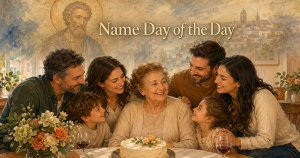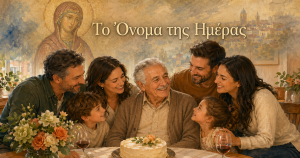
Today’s name day may not reach a dozen Jameses or Catherines in your contacts, but it still carries that same Greek custom into the wider world. If you know an Onuphrius, an Italian Onofrio, a Spanish or Portuguese Onofre, or a Ukrainian Onufriy, they share the name being marked today in Greek homes. Even a rare name can become a conversation starter, especially when it has travelled so far.
Onuphrius comes into Greek as Ονούφριος from the late antique form Onuphrius, itself tied to the Egyptian name Onnophris. The name is generally traced to ancient Egyptian roots meaning something close to “the good being” or “he who is continually good,” and it entered the Greek-speaking Christian world through the fame of the desert ascetic Saint Onuphrius of Egypt. From Greek and Late Latin, related forms spread into other languages, including Italian Onofrio and Slavic Onufriy.
In Eastern Orthodox Christianity, a person’s name day is the feast day of the saint after whom they were named at baptism.
This is one of those names with a quiet, unmistakable character. It suits the grandfather who never says much but misses nothing, the monastery-loving uncle whose shelves are lined with old books, or the neighbour whose steadiness makes a whole street feel calmer. Even in its rarer modern use, Onoufrios carries a sense of reserve, endurance and inner strength that people tend to recognize immediately.
So if there is an Onoufrios, Onoufris or Onoufria in your family, or an Onuphrius, Onofrio or Onofre somewhere in your wider circle, today is a good day to send a note. Chronia Polla! to everyone celebrating, in Greek and non-Greek circles alike, and especially to the friend who may never have heard of a name day until your message arrives.