Today, every Violet you know shares a name day with the Greek tradition. It is one of those easy, generous names to pass across languages: Violet in English, Violette in French, Viola in Italian, Violeta across the Balkans and the Spanish-speaking world. A Greek-Canadian can wish a cousin named Violeta, a classmate named Violet and a neighbour named Violette all on the same day, and the custom makes immediate sense to everyone.
Violet comes through English and French from Latin viola, the violet flower, a word that fed a wide European family of names including Viola, Violeta and Violetta before entering modern Greek as Βιολέτα. It belongs to the long tradition of floral given names, where a plant name moved naturally from poetry and colour into everyday naming. In Greek usage, Βιολέτα feels both familiar and cosmopolitan, one of those names that travels easily without losing its softness.
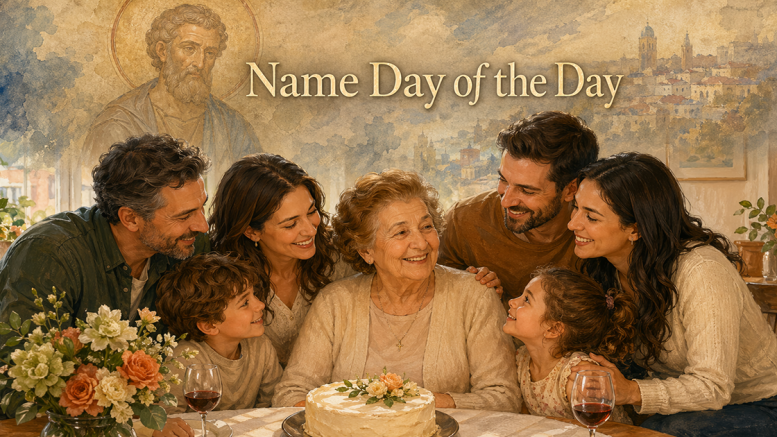
In Eastern Orthodox Christianity, a person’s name day is the feast day of the saint after whom they were named at baptism.
There is something quietly fitting about a name like Violet turning up in different corners of the day: the theia whose table always has fresh flowers, the co-worker who brings a little colour to a grey office week, the across-the-street neighbour whose garden is the first to catch your eye in August. Even when the name appears in another language, it keeps that same graceful note.
The rarer Greek name Eksakoustodianos, along with shorter forms such as Eksakoustos and Xakoustos, has a distinctly Greek shape and resonance. Built from the idea of being widely heard of or renowned, it carries the old sense of a name that travels by reputation. Maximilian comes from the Latin name family built on maximus, meaning greatest, and reached modern use across Europe in forms such as Maximilian, Maximilien and Massimiliano before appearing in Greek as Μαξιμιλιανός.
Chronia Polla! to everyone celebrating today, whether they are called Violet, Violeta, Violette, Eksakoustodianos or Maximilian. It is a lovely day to text a friend who might not even know they are being celebrated and share a small Greek custom with them.