Photo by Harry Barba

Local Journalism Initiative Reporter
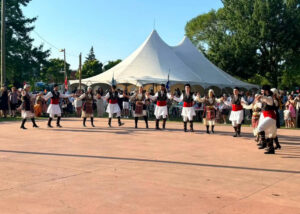
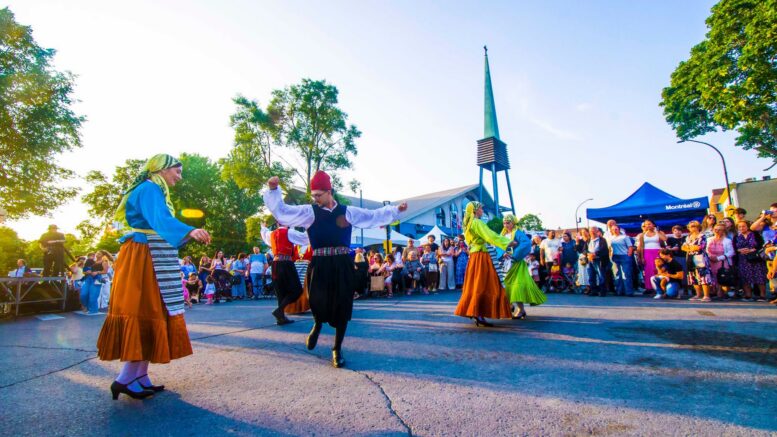
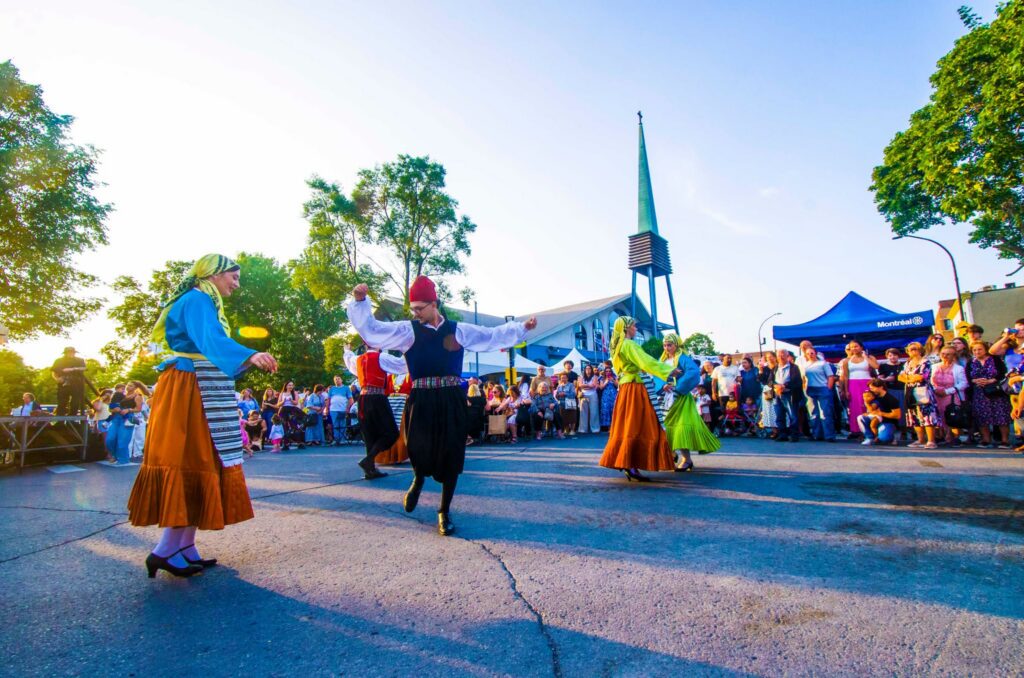
For two August evenings, Saint-Roch Street belonged to the parikia again. Traffic gave way to long rows of banquet tables running down the middle of the road, the smoke of the grills drifted past the sign of the Afroditi bakery, and under the slender spire of the Evangelismos tis Theotokou church, three generations danced on the asphalt where Greek Montreal first put down roots. The festival carried more than nostalgia for the old neighbourhood. It bound a street party to one of the holiest days of Orthodoxy, showcased a volunteer corps renewed by the young, and closed the summer season of a community marking 120 years.
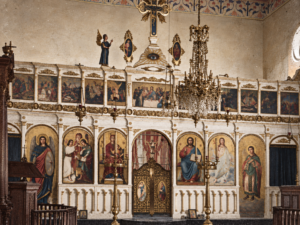
Officially named La Flamme Hellénique, the Hellenic Flame, the festival of the Regional Council of Montreal of the Hellenic Community of Greater Montreal was held August 14 and 15 in the forecourt of the church at 777 Saint-Roch Street and along the street itself. It is the community’s panigiri of the Panagia, timed to the Dekapentavgousto, the August 15 feast of the Dormition of the Theotokos. On the eve of the feast, vespers and the procession of the icon were held at the church, and the celebration continued the next day through the final night of the community’s summer festival calendar.
“Today we celebrate one of the most important feasts of Orthodoxy, the Dormition of the Theotokos,” said Sotirios Antypas, president of the Hellenic Congress of Quebec, in an interview with The Montreal Greek Times at the festival. “May all who celebrate have blessed years, and may we have the health, the strength and the blessing of our Panagia.”
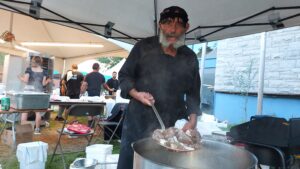
The work behind the two days fell to roughly 40 volunteers, from the grillers and the kitchen crews to the young members of the Greek Roots group who moved through the crowd in their blue shirts. “Organizing a festival is exhausting, but at the same time it offers great satisfaction,” said Kyriakos Polymenakos, president of the regional council. “There is the preparation, the work, and then the joy of seeing families and friends meet, laugh, dance and eat together.”
The roll call of that work ran deep. The community singled out the Greek Roots youth under Giorgos Andreopoulos, the crews at the grills and in the kitchen, the volunteers who staffed the cash desks through both days, the Filoptochos ladies’ auxiliary and the youth of the church, along with members of the Regional Council of Montreal and a large contingent from the Regional Council of the South Shore who crossed the river to stand beside the organizers. Special recognition went to George Tsantrizos, Kyriakos Polymenakos and Christos Petsinis, who worked endless hours in the preparation and the running of the festival.
Speaking with this newspaper earlier in the summer, Polymenakos explained why the festival stays rooted to the church block rather than moving to a larger site such as Jarry Park, for which permits were sought without success. “We hold the traditional festival to honour our churches, because everyone who comes to the panigiri also goes into the church and lights a candle,” he said, noting that the Filoptochos sells loukoumades and the church youth run their own stands. “It is not only what the festival itself raises. Many others connected to it are helped as well.”
For Basile Angelopoulos, president of the Hellenic Community of Greater Montreal, the evening confirmed a year of growing momentum. “Once again we are breaking records. Look how much of the world is here tonight, and above all, look how many young people are embracing their culture,” he said. “The volunteers are the ones who, in essence, built this community. Those of us who enjoy a festival like this rarely grasp how much work and organization it demands. Enormous sacrifices are made, and I thank everyone who contributed to this great success.”
George Tsantrizos, executive director of the community, saw in the crowded street a statement about the place of Hellenism in the city. “Once again this year, our annual festival gathered the Hellenism of Montreal here in Park Extension,” he said. “It is an evening that shows one more time how much Hellenism means here in Montreal, and above all here in Park Extension. We are very proud that we were able to organize this festival again this year, to celebrate and to feast on this great day of the Panagia.”
Elected officials from all three levels of government walked the street. Marjorie Michel, member of Parliament for Papineau, the riding that includes the neighbourhood, attended the festival for the first time and promised to come dressed for the occasion next year. Michelle Setlakwe, member of the National Assembly for Mont-Royal-Outremont, brought greetings on behalf of the Quebec government and praised a community “so well established” in Montreal and so open to the rest of the city. City councillor Effie Giannou, born in Greece, came with council colleagues from across Montreal, and Mary Deros, who served Parc-Extension as city councillor for 27 years, received the welcome of a woman of the house.
The festival has also become a homecoming. Though much of the community long ago dispersed toward Laval, the South Shore and the suburbs, the feast of the Panagia pulls its children back to the old quarter each August. Sona Lakhoyan Olivier, member of the National Assembly for Chomedey, grew up in the neighbourhood, where her brother played hockey at the Howie Morenz arena and her summers were spent in Jarry Park. “This is where I was born,” she said. “When I come here, I come home.”
Eleni Bakopanos, the former member of Parliament who has attended the festival since 1992, turned her thanks to the people behind the tables. “Nothing happens without the volunteers, with the hours they put in and the heat they endure,” she said. “May the Panagia bring us strength and health, because that is what matters most, and may we all be well again next year.”
The grace of the Panagia was the night’s refrain, offered from the stage by Deros to “all of Hellenism, everywhere in the world.” The Hellenic Flame closed on the night of August 15 as the last festival of the community’s summer season.