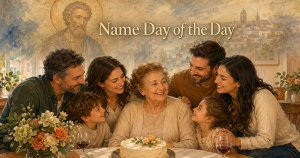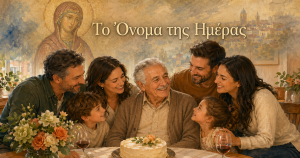
Today’s name day has an easy Canadian echo, especially if you know an Efi or someone whose full name is Eftychia. While Aitolia stays distinctly Greek, Eftychia belongs to that lovely group of names whose feeling is instantly understandable even to non-Greek friends: happiness, luck, a life that seems to open well. It is the kind of day to text the Efi at work or the Eftychia in the family and share a tradition that travels well.
Eftychia comes from the Greek ευτυχία, “good fortune” or “happiness,” built from eu, meaning “good” or “well,” and tyche, “fortune” or “chance,” a word with deep roots in ancient Greek thought and literature. The masculine forms Eftychios and Eftychis grow from the same source, carrying the sense of someone fortunate or blessed by good outcome. Aitolia, by contrast, is an old regional Greek name tied to Aetolia in western Greece, preserved as a place-name and personal name with a strongly classical sound.
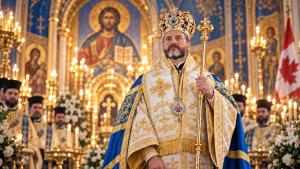
In Eastern Orthodox Christianity, a person’s name day is the feast day of the saint after whom they were named at baptism.
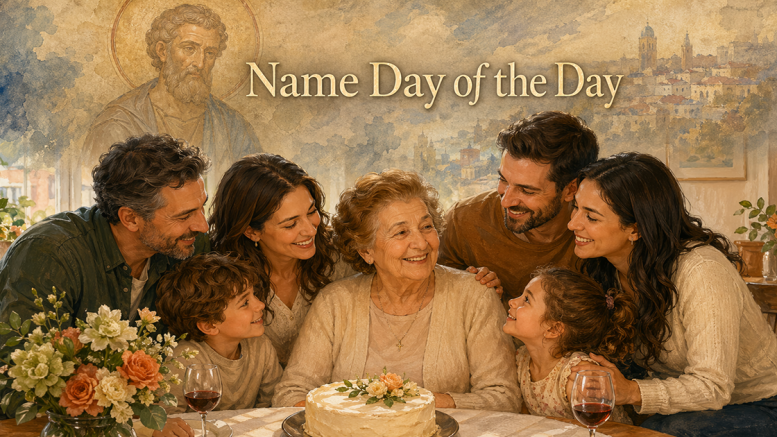
There is something naturally bright about these names in daily life. An Efi who always lifts the mood in the office, a cousin Eftychia whose laugh fills the room, or a Papou Eftychios who has the rare gift of making even ordinary afternoons feel generous all seem to fit the day without trying. Aitolia carries a different resonance, more rooted and rare, the sort of name you remember after meeting the across-the-street neighbour or a university friend who wears it with quiet confidence.
Chronia Polla! to everyone celebrating today, Greek and non-Greek alike. If you know an Efi, an Eftychia, an Eftychios or an Aitolia, today is a perfect excuse to send a warm wish and introduce a small Greek custom to someone who may not even know they are being celebrated.