
Today’s name day is one of those Greek calendar moments that can start a real conversation beyond family. Most of the names are distinctly Greek, but one of them reaches easily into English too: every Phoebe you know shares a linguistic cousin with today’s Phoebus and Phoivi. It is the kind of day to text a classmate, colleague or neighbour and let a small Greek custom travel.
Anthimos comes from the ancient Greek word anthos, “flower,” giving the name a floral, old Hellenic character that has stayed recognizably Greek through the centuries. Aristea and Aristion belong to the Greek root aristos, “best” or “excellent,” a stem familiar from names like Aristotle. Archontia and Archontion come from archon, a ruler or leading figure in ancient Greek civic life. Polydorus, from poly, “many,” and doron, “gift,” is one of the great classical compound names, while Phoebus comes from Phoibos, the ancient epithet associated with brightness and radiance; its feminine line survives in English as Phoebe.
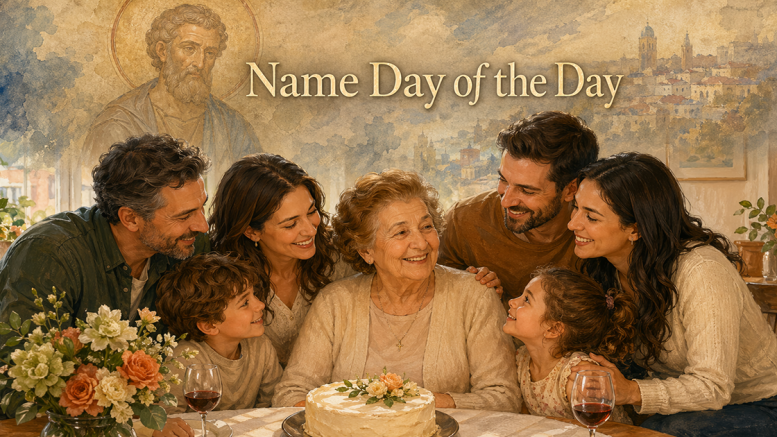
In Eastern Orthodox Christianity, a person’s name day is the feast day of the saint after whom they were named at baptism.
There is real texture in today’s circle of names. An Anthimos may bring to mind the grandfather whose presence still freshens a room, or the local barber whose good humour never seems to wilt. An Aristea or Aristi can sound right at home on the friend who always carries herself with quiet confidence, while an Archontia suits the theia who never has to raise her voice for everyone to feel her natural dignity. And for the Phoebe at work, or the Greek Phoivi in the family group chat, there is something unmistakably luminous in the name itself.
Polydorus and Polydora add a more classical note, the kind of names that feel rich, generous and memorable even when you do not hear them often. Maybe it is your customer named Dora, your old friend known as Polis, or a cousin whose formal Greek name only comes out on special occasions. Today gives all of them a moment in the light.
Chronia Polla! to everyone celebrating today, in Greek and non-Greek circles alike. If you know an Anthimos, a Phoebe, a Polydora or an Archontia, send the wish along and share what a name day means.