
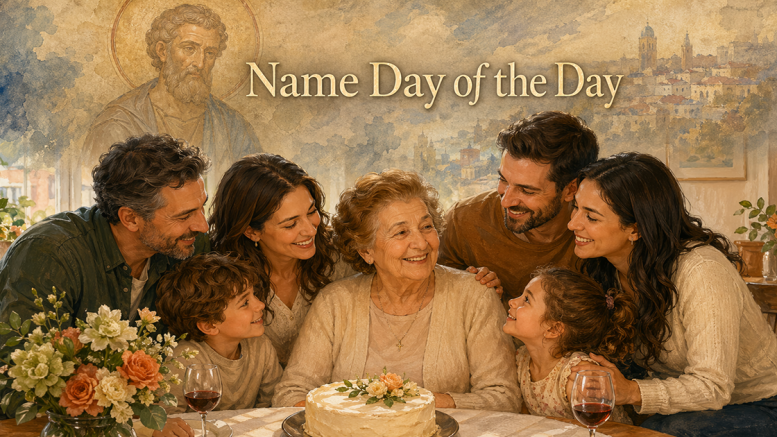
Today, every Clementine and Clement you know shares a name day with the Greek calendar. The Greek forms include Klimentini and Klímis, alongside rarer names such as Menodora, Metrodora, Nymphodora and Pulcheria, but the easiest conversation starter may be the Clementine in your contacts or the Clement at work who has never heard of a name day and would probably smile to learn they have one.
Clement and Clementine trace back to Latin clemens, meaning mild, gentle or merciful. The Greek forms Κλήμης and Κλημεντίνη came through the long exchange between Greek and Latin Christian naming, while Clementine developed in French and then English as a feminine form. The other names celebrated today are older Greek compounds: Menodora joins an ancient word for the moon to the familiar ending -dora, “gift”; Metrodora is built on meter, “mother,” plus “gift”; and Nymphodora follows the same Greek pattern.
In Eastern Orthodox Christianity, a person’s name day is the feast day of the saint after whom they were named at baptism.
There is a quiet warmth to Clement and Clementine, and you can feel it in the people who carry the name well: the aunt who never raises her voice but somehow steadies the whole table, the colleague who keeps an office humane on a hard week, the across-the-street neighbour whose kindness arrives without ceremony. Menodora, Metrodora and Nymphodora are much rarer in everyday Canadian life, but that rarity gives them a kind of luminous presence too, the sort of names a yiayia remembers exactly and a younger cousin wants the story behind.
Pulcheria belongs to the day as well, another distinctive old name that stands out the moment you hear it. And if it feels natural, you can also extend a wish to Erasti or Erastos, who are also listed today in Greek name-day sources.
Chronia Polla! to everyone celebrating today, Greek and non-Greek alike. If you know a Clementine, Clement, Clem or one of today’s rarer Greek names, this is a lovely day to send a quick message, explain the tradition, and let a small piece of Greek culture brighten someone else’s day.