Today’s name day is a chance to celebrate some rarer names that still travel across languages and communities. A Bessarion in a Greek family may share the day with a Vissarion or Besarion elsewhere, while Niketas opens naturally toward Nikita, Mykyta and Nichita, and Gerasimos meets Gerasim in other Eastern European traditions. Even when the English-speaking world does not use these names every day, they still make an easy conversation starter and a small cultural bridge.
Bessarion, from Greek Βησσαρίων, is an old Greek name preserved mainly through historical and religious use; its wider family includes forms such as Vissarion and Besarion in neighbouring traditions. Niketas comes from ancient Greek Νικήτας, built on the same root as νίκη, victory, and closely related to νικητής, a victor or winner. Gerasimos comes from Greek Γεράσιμος, from geras, a word for honour, dignity and the esteem granted with age or distinction, which gives the name a deep classical texture.
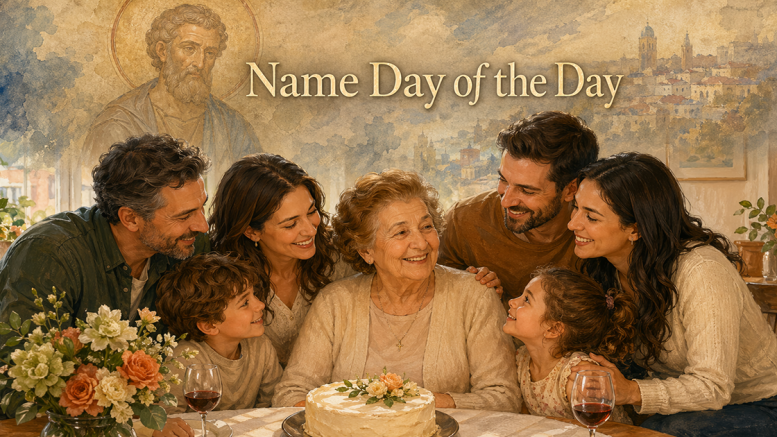
In Eastern Orthodox Christianity, a person’s name day is the feast day of the saint after whom they were named at baptism.
That sense of victory sits easily on the Niketas in your life who never seems rattled, whether he is the cousin who always finishes what he starts or the coach who keeps a whole team steady in a close game. Gerasimos carries a quieter kind of weight: it suits the papou whose presence settles the table, or the barber who knows everyone on the block and treats each customer with the same unhurried respect. And Bessarion has the feel of a name that keeps memory alive, fitting the retired professor, the thoughtful godfather or the old family friend who still saves books, stories and photographs no one else would think to keep.
Chronia Polla! To everyone celebrating today, Greek and non-Greek alike, may it be a good excuse to send a message, make a call, and wish someone well. If you know a Nikita, a Gerasim, a Vissarion or a Beso, today is a lovely day to say happy name day and share what the tradition means.