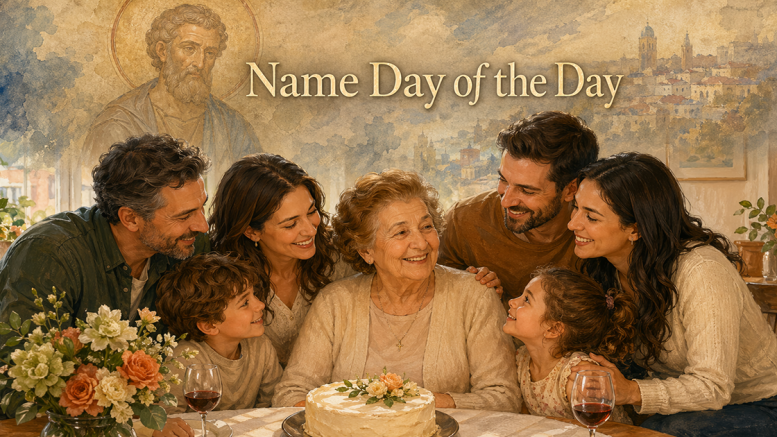
Today’s name day is a chance to share a very Greek kind of greeting beyond the family table. Antigonus is not a name most Canadians hear every day, but anyone with a love of classical history will recognize its echo, and Eyprepios, along with Eyprepia, carries the kind of old Greek elegance that still feels memorable when it appears in a family, a classroom or a contact list.
Antigonus comes from Greek Ἀντίγονος, an ancient name built from anti and gonos. In Greek, gonos refers to birth, offspring or lineage, so the name carries a strong sense of descent and family line. It is especially tied to the Macedonian world of the Hellenistic age, where Antigonus became a royal name remembered through the Antigonid dynasty after Alexander the Great.
Eyprepios comes from Greek εὐπρεπής, meaning fitting, comely, graceful or well-presented, from eu, “well,” and a root related to what is proper or distinguished in appearance. The feminine form Eyprepia shares that same tone of poise and refinement. These are deeply Greek names, less common in English, but their meaning still lands clearly even for readers meeting them for the first time.
In the Eastern Orthodox Christian tradition, a person’s name day is the feast day of the saint after whom they were named at baptism.
So today’s wishes can travel in different directions. Maybe there is an Antigonus in the extended family whose name always sounded like it stepped out of a history book, or an Eyprepia whose quiet polish is felt before she says very much. A godfather, a professor, a cousin, even the across-the-street neighbour with one of these rarer names can turn an ordinary Saturday into a small cultural exchange just by hearing, “happy name day.”
Chronia Polla! to everyone celebrating today, Greek and non-Greek alike. If you know an Antigonus, an Eyprepios or an Eyprepia, send the message along and let a small piece of Greek tradition brighten someone’s day.