
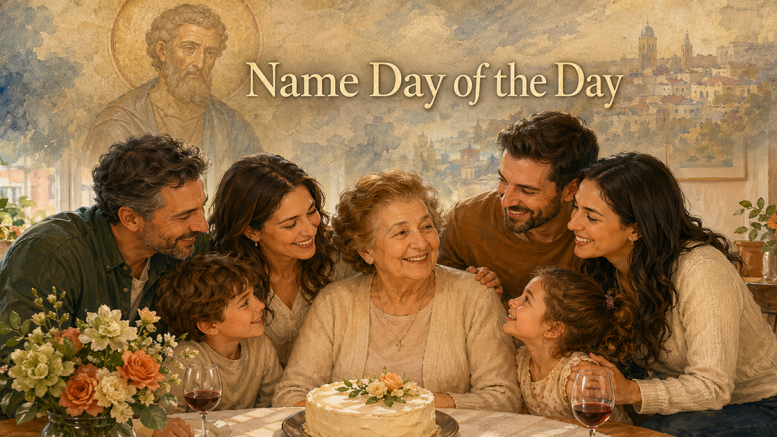
Today’s name day reaches well beyond Greek homes. Every Demetrius, Dimitri or Dmitri you know shares the day with Greek Dimitris, while Demeter and Demetra also have their place in today’s celebration. Alongside those familiar names, rarer Greek names such as Glykon, Glykos, Leptina and Leptinos give the date an older, more distinctly Greek texture.
Demetrius and Demeter both go back to ancient Greek roots built around Demeter, the old Greek name of the grain and earth goddess. The masculine form Demetrios originally meant someone belonging to or devoted to Demeter, and it passed into Latin as Demetrius before spreading into many European languages, from French Dimitri to Slavic Dmitry. The feminine Dimitra comes directly from the same ancient base, preserving one of the oldest name-families still in everyday use.
In Eastern Orthodox Christianity, a person’s name day is the feast day of the saint after whom they were named at baptism.
That old agricultural depth still suits the name beautifully. You can hear it in the theo Dimitris who never arrives empty-handed, in the neighbour Demetra whose garden somehow keeps producing long after everyone else’s has given up, or in the co-worker Dimitri who brings a steady, grounded calm to a busy office. Even the rarer names carry a strong Greek flavour: Glykon comes from the Greek word for sweetness, while Leptina and Leptinos echo the old Greek sense of something fine, slender or delicate.
For Greek-Canadians, that makes today easy to share. You might call your uncle Dimitri, your cousin Dimitra, or your hairdresser Demetra, but you can just as easily text a non-Greek friend named Dmitri or Demetrius and let them in on the tradition too.
Chronia Polla! to everyone celebrating today, Greek and non-Greek alike. If you know a Demetrius, Dimitri, Dmitri, Demeter, Demetra, Glykon, Glykos, Leptina or Leptinos, today is a perfect day to send a quick happy name day message and pass along a small piece of Greek culture.