Today’s Greek name day has a wider circle than it first appears. Alongside the Greek Ιλαρίων, the celebration reaches Hilarion in English and French, Hilaire, Hilary, Hilario and Ilario too, which means a Greek custom can easily become a thoughtful text to a friend, colleague or neighbour who has never heard of name days but shares the same name family.
Hilarion comes from Greek Ἱλαρίων, a form built on Greek ἱλαρός, meaning cheerful, glad or gracious. The name moved from Greek into Latin as Hilarion and spread through Christian and European languages, producing related forms such as Hilary in English, Hilaire in French, Hilario in Spanish and Ilario in Italian. Its history is a good example of how an old Greek word could travel widely and settle into everyday Western naming.
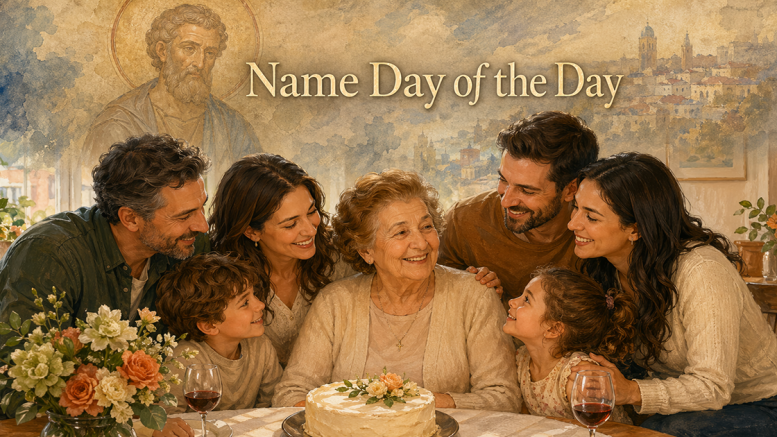
In Eastern Orthodox Christianity, a person’s name day is the feast day of the saint after whom they were named at baptism.
There is something naturally warm in this name’s sound and history, and you can feel it in the people who carry it. It suits the uncle who is always the first to laugh at the family table, the customer whose good humour brightens a long shift, or the retired neighbour who still greets everyone on the block with an easy smile. Even when the name appears in its rarer Greek forms, like Ilarion or Ilariona, it carries that same light touch.
For Greek-Canadians, that is part of the charm of name days. They are rooted in a specific tradition, but they travel well. A small message saying “happy name day” to a Hilary, Hilarion or Hilario can open a conversation, share a custom and make an ordinary June day feel a little more personal.
Chronia Polla! to everyone celebrating today, in Greek and non-Greek circles alike. If you know a Hilarion, Hilary, Hilaire, Hilario or Ilario, today is a lovely day to send the wish and share what a Greek name day means.