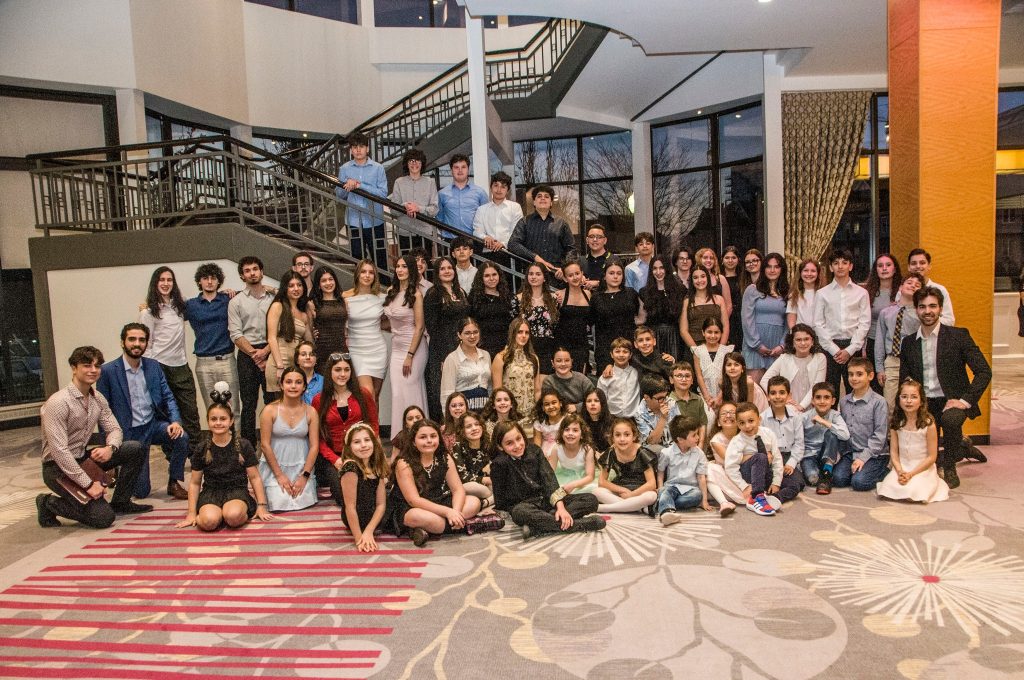
Photo by Harry Barba

Local Journalism Iniiative Reporter
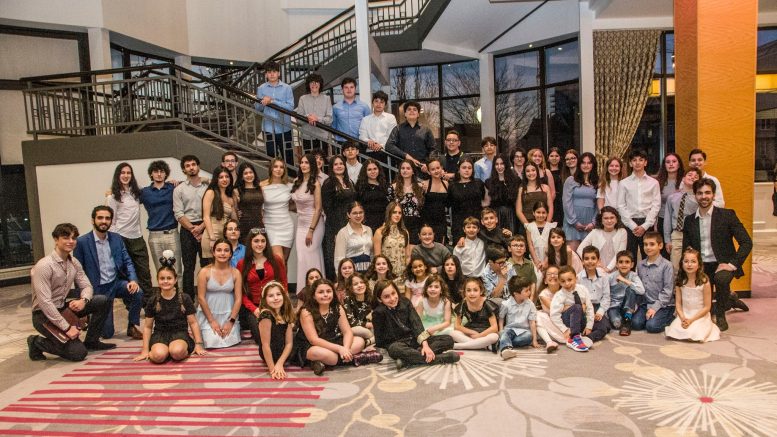
The ballrooms of Château Royal carried the sound of Greek music well into the evening of April 26, as families from across Greater Montreal gathered for a celebration that had been more than a generation in the making. Bouzouki melodies rose above the clinking of glasses, students in traditional dress threaded their way through tables of parents and grandparents, and three school communities from across the metropolitan area met under a single roof for the first annual Supplementary Education School Dance. Hosted by the Hellenic Community of Greater Montreal and joining the Laval, Montreal and South Shore campuses, the event placed three weighty themes in the foreground: the transmission of the Greek language to a generation born outside Greece, the role of the Saturday schools in sustaining that transmission, and the durability of a community institution that marks its 120th anniversary in 2026.
The dance arrived after a long pause in the school calendar. Vasilios Christodoulopoulos, secretary of education at the Hellenic Community of Greater Montreal, told guests from the podium that the last comparable dance had been held in 1994, when he was a third-year student at the Aristotelis school. “We’re back,” he said, drawing applause from a room of more than 250 guests.
Christodoulopoulos said the years following the pandemic had weighed on enrolment across the supplementary system, and described the evening as a deliberate effort to rebuild participation. He pledged that the curriculum across the three schools would be modernized to serve current students and attract new families.
The president of the Hellenic Community of Greater Montreal, Basile Angelopoulos, used his remarks to place the Saturday schools at the centre of community life. “In Greece, a child is born Greek,” he said. “Here, a child must become Greek, and the only way we can make that happen is through our education system, through the sacrifices made by our teaching staff.” He told the audience that the community’s most recent Radio Marathon, held earlier in 2026, had raised approximately $450,000, the highest figure in the campaign’s history. Those funds, he said, were distributed equally among the five branches of the Socrates-Demosthenes school network where supplementary education operates. Angelopoulos closed with an appeal for continued participation in the Lahioforos lottery campaign now underway.
Eleni Tourkochoriti, general director of supplementary education, addressed the room on behalf of the three schools she oversees: Agios Nikolaos, Platon-Omiros and Aristotelis. She framed the evening as the start of a tradition that the community hopes to institutionalize. “The supplementary education system is a demanding undertaking,” she said, “and it requires sacrifice, time and consistency, especially because it takes place on Saturdays, which is a sixth school day for our students.” Tourkochoriti credited the three Parents’ Committees, drawn from each campus, with the logistics of the evening, and thanked the dance instructors who had prepared the students over months of weekly rehearsal.
Jacques Bouchard, professor of modern Greek Studies at the Université de Montréal, addressed the parents directly on the question of language transmission at home. “A child at home may learn only 700 or 1,000 words,” he said, “but the child gains something that money cannot buy. It is the linguistic sense.” Bouchard reminded the audience that Greek had been spoken for 40 centuries and written for 36, and that its grammatical structure continued to inform speakers of Western languages. He described Greek as the mother tongue of Western civilization. Nikolaos Karalekas, general consul of Greece in Montreal, joined the gathering between engagements and described Tourkochoriti as “the soul of the supplementary schools.”
The dance program, prepared jointly by the dance teachers of the three schools, opened with the Tsakonikos, a slow ceremonial dance from Tsakonia in Laconia traditionally performed to close a panigyri. “It is a dance that usually closes the celebration,” said Leonidas Papazoglou, the dance teacher for the South Shore campus. “We will use it to open ours, with all the children from all three of our Saturday schools.” Approximately 60 to 70 students took part, performing dances drawn from Epirus, the Aegean islands, Arcadia, Crete, Macedonia and Zakynthos. Loukas of the Platon-
Omiros campus and Chrysovalantis of Laval shared the floor with Papazoglou. Each instructor works with limited rehearsal time, since dance is taught for roughly half an hour each Saturday in each class.
Athina Sita, co-director of the South Shore campus and herself a dance instructor, told guests that the size of the gathering had exceeded expectations. “We had more than 250 people here for our first dance in 30 years,” she said. “I am amazed by how supportive everyone has been.” Her co-director, Vasilis Bourbounis, called the evening a powerful start for the joint program. The three Parents’ Committees that organized the event, with members drawn from Laval, Montreal and the South Shore, described the dance as the result of months of co-ordinated planning across the three campuses.
Sound and Professional DJ services were provided by Technosonic