
In our previous edition, we detailed the severe financial deadlock and administrative infighting that paralyzed the Hellenic Community of Montreal following the devastating 1986 fire at Holy Trinity Greek Orthodox Church. This month, we conclude this ongoing retrospective by examining the final, tragic chapter of the Sherbrooke Street sanctuary. Archival documents and historical accounts from the late 1990s reveal a chaotic era where the remaining hopes of resurrecting the church finally buckled under the weight of insurmountable institutional debt, high-profile political scandals, and abrupt municipal intervention.
For years, the ruined church stood as a visible testament to the community’s financial paralysis. The shattered stone facade offered a daily, sad contrast to the rapidly developing downtown core of Montreal. This stark reality sparked deep resentment among the Greek public who had generously contributed to the initial grassroots fundraising efforts based on grand promises from community leaders. The refinancing efforts secured in the early 1990s served merely as a temporary economic relief that delayed outright bankruptcy. Historical community records and public critiques frequently referenced the use of reckless loans to satisfy immediate, lingering obligations to creditors like OLTON from the previous 12-year administration. The then leader of the EPOK political faction heavily criticized these specific financial decisions during radio broadcasts, describing them as reckless “maritime loans” (thalassodaneia) designed to satisfy a loyal base of 70 followers.
Despite this crushing financial reality, no community leader formally abandoned the objective of restoring the church until 1997. In 1996, President Vasilis Katsampanis and former president Adrian Maris formed a specialized committee to aggressively promote the Holy Trinity restoration file. The committee included Rev. Nikolaos Papageorgiou alongside prominent community members Kostas Papachristou, Constantine Milonopoulos, and Theodore Christeas. The group conducted extensive public and private hearings and distributed participation bulletins across the community.
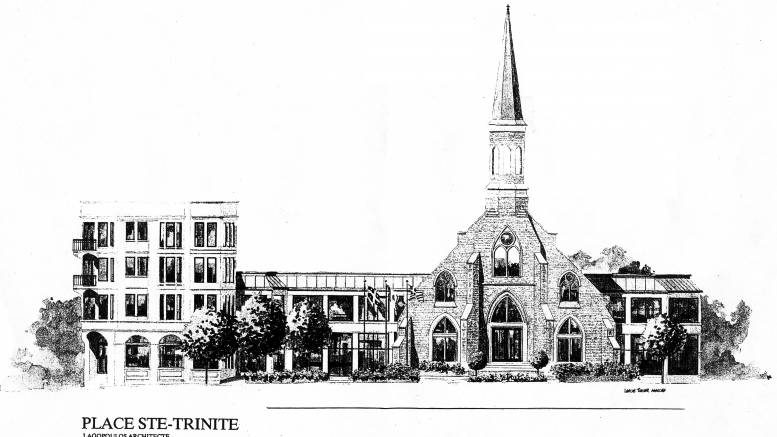
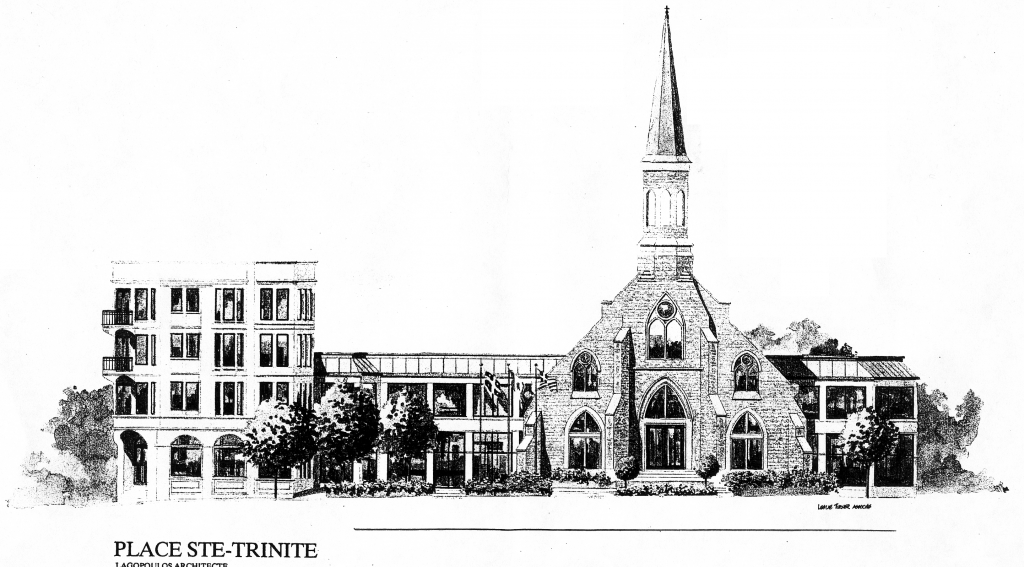
This 1996 initiative introduced a highly conservative architectural draft prepared by architect Lagopoulos. This pragmatic design aimed to rebuild the church while centralizing and housing Greek state and consular services within the same complex. Historical observers note that this concept carried significant potential had the consular authorities advocated for it with the Greek government. The initiative ultimately collapsed amidst bitter internal divisions fueled by local controversies, known historically in the community as the Greek consular wines scandal and other issues.
The failure of this final restoration push coincided with the collapse of a major school merger initiative between Montreal and Laval. This subsequent failure prompted the sudden resignation of the Katsampanis administration. Nicholas T. Pagonis assumed the presidency without an electoral mandate in 1997. The three-year administrative period under President Pagonis proved catalytic for the property’s ultimate fate. This administration operated with the absolute and constant support of the political faction EPOK, led by the late Kostas Vrakas and Filippas Sofronas.
The new administration immediately faced intense pressure from an increasingly impatient roster of creditors. The most prominent demands came from the Caisse de dépôt et placement du Québec alongside the private individuals who had personally guaranteed $1,500,000 of that specific institutional loan. Paralyzed by monthly debt obligations they could not meet, the Pagonis administration officially shifted the community priority toward selling the highly valuable Sherbrooke Street lot.
By this time, the abandoned property had suffered profound physical degradation. Left completely unprotected and unfenced, the sacred site became a haven for illicit downtown activity. A second fire broke out in the ruins in 1996, followed shortly by another blaze that completely destroyed the adjacent presbytery. The church that had once echoed with the Divine Liturgy had devolved into a severe public hazard. President Pagonis justified the decision to sell the property by accurately recording that the site had become a public urinal and a gathering place for drug addicts.
Desperate for immediate liquidity, the administration entertained various commercial offers. In 1997, the proprietors of the popular Club Soda entertainment venue made an initial approach to purchase the lot through an anonymous broker. The negotiations failed, as did a second acquisition attempt by the venue in 1998. The prolonged indecision surrounding the property was eventually violently interrupted by municipal authorities. On April 8, 1997, the City of Montreal, citing severe public safety concerns, issued a strict demolition order without any prior warning and dispatched heavy machinery to Sherbrooke Street.
The demolition of the Holy Trinity ruins stands as one of the most agonizing moments in the history of the local Greek community. As the municipal bulldozers moved in, dozens of Greeks rushed to the intersection. Recognizing that the destruction of the structure would be completed in a mere half hour, they gathered as silent mourners. They stood weeping on the sidewalks, waiting for the dust to settle so they could collect the scattered stones. The rubble represented a collection of consecrated relics from their youth. Today, fragments of the Holy Trinity masonry remain carefully preserved as holy artifacts in the homes of countless Greek families across Montreal.
The eventual disposition of the land involved complex financial maneuvering that culminated in an emphyteutic lease, transferring control of the property to private developers for decades. The historical context of the site adds layers of irony to its modern incarnation. The original 1865 building functioned as a Methodist church before the Greek community purchased it in 1925 to serve as their primary religious and cultural center. In the early 2000s, investors developed the corner into the boutique Hotel Opus, later rebranded as Hotel 10. This development integrated the adjacent Joseph-Arthur Godin building. Built in 1915, the Godin building holds rich heritage value as one of Canada’s first residential structures constructed with reinforced concrete in the Art Nouveau style. The hotel developers commissioned architect Dan S. Hanganu to design a massive contemporary structure directly over the footprint of the demolished church, linking it to the historic Godin building. Hanganu was the exact same architect the Hellenic Community of Montreal had hired in 1987, paying him hundreds of thousands of dollars in community funds to draw the unrealized Place Sainte-Trinite project that initiated the financial ruin of the church.
The current generation of Greek-Canadians inherits a complex history regarding the Sherbrooke Street property, governed by legal documents crafted by their predecessors. According to the structural timelines of the emphyteutic lease signed roughly a quarter-century ago, the underlying property rights will revert to community control in 2055, just 29 years from today. At that distant date, the future custodians of Montreal Hellenism will possess the authority to finally erect a small commemorative shrine on the site to honour the faith, culture, and resilience of the immigrants who built the foundation of this community.