
Local Journalism Initiative Reporter
In the blue half-light of a gallery in Old Montreal, beneath a long frieze of meander patterns and among marble gods carried across the Atlantic, a row of small display stands holds something unexpected: the French handwriting and bright drawings of children, set beside vases and figurines made nearly 3,000 years ago. The pairing is the heart of a collaboration between the Pointe-à-
Callière museum and the Socrates-Demosthenes school that turned 21 Grade 4 students into co-authors of one of the largest celebrations of Hellenic heritage ever mounted in North America.
That exhibition, La Grèce des héros. Au temps de Troie, gathers close to 400 objects from 28 Greek museums and archaeological sites, many of them shown for the first time on this continent. Produced jointly with the Ministry of Culture of the Hellenic Republic, it leads visitors through the world of Homer by way of statues, jewellery, weapons, ceramics and ritual objects, tracing the line where the passions of mortals meet the gods of Olympus. The journey moves between two founding ages, the bronze age of palaces and goldwork and the iron age of the poet, and includes a rare warrior’s helmet made of boar tusks and delicate gold ornaments from the royal tombs of Mycenae. “In his account, Homer refers to real elements of his time,” the museum’s director general, Anne Élisabeth Thibault, has said of the period the show recreates. “Rarely has Greece granted a heritage collection of such scale to a museum in North America,” she said.
The exhibition also marks the work of a Greek-Canadian archaeological mission active for more than 30 years at Argilos, in northern Greece, led by Jacques Y. Perreault of the Université de Montréal, a reminder of the ties already binding Canada to the Greek world.
For the families of the Greek community, the show carried a second meaning. The museum invited the Socrates-Demosthenes school, an institution of the Hellenic Community of Greater Montreal, to take part directly in an innovative museum-education program, in recognition of the long bond between the community and the cultural heritage of Greece. The idea grew out of the strong response the community had shown to the museum’s 2015 exhibition on the Greeks, from Agamemnon to Alexander the Great. This time the museum wanted the children of the community to contribute in a lasting way to the telling of the history and mythology of their ancestors’ homeland.
The Grade 4 class at Campus II was a natural fit, since its students had already studied Greek mythology and ancient history and arrived with the background the project required. From the first days of the 2025-2026 school year, students, parents and teachers embraced the plan. The museum chose 21 of its exhibits and matched each one to a child. Working with their Greek and French teachers, the students were paired with a hero or a god according to personality, interests and character. Who would speak for the resourceful Odysseus? Which student best suited the beautiful Helen? Who would carry the weight of the powerful Agamemnon? The questions gave the children the sense that they belonged to a genuine cultural mission.
In October 2025, the Quebec troubadour Thomas Hellman visited the classroom three times. With his guitar and a gift for storytelling, he brought the episodes of the *Iliad* and the interventions of the Olympian gods to life in front of the students. Like a modern rhapsode, he carried the children into the world of the Trojan War and stirred both their knowledge and their imagination, setting the stage for the work that followed.
Then came the research. Each student studied the figure entrusted to them and gathered information in French, and with the help of the teachers and the museum team composed an original caption for the matching exhibit. Those short texts, written with the freshness of a child’s thinking, now stand beside the artifacts and form a distinctive part of the visitor’s path through the galleries. Leanea, 9, took up Cassandra. “This princess was given the gift of seeing the future in exchange for promising herself to Apollo,” she wrote, before adding her own verdict: “I like that Cassandra can see the future and is beautiful.” Kalliopé, 9, told the story of Menelaus. “Menelaus was the king of Sparta, Agamemnon’s brother, husband of Helen, and a hero of the Trojan War,” she wrote. “His wife was kidnapped by Paris, so he teamed up with Agamemnon, Odysseus, and Ajax to wage war on Troy to get his wife back.”
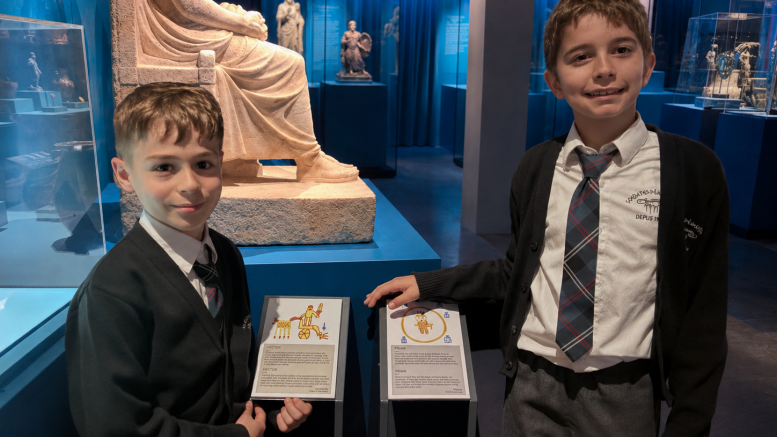
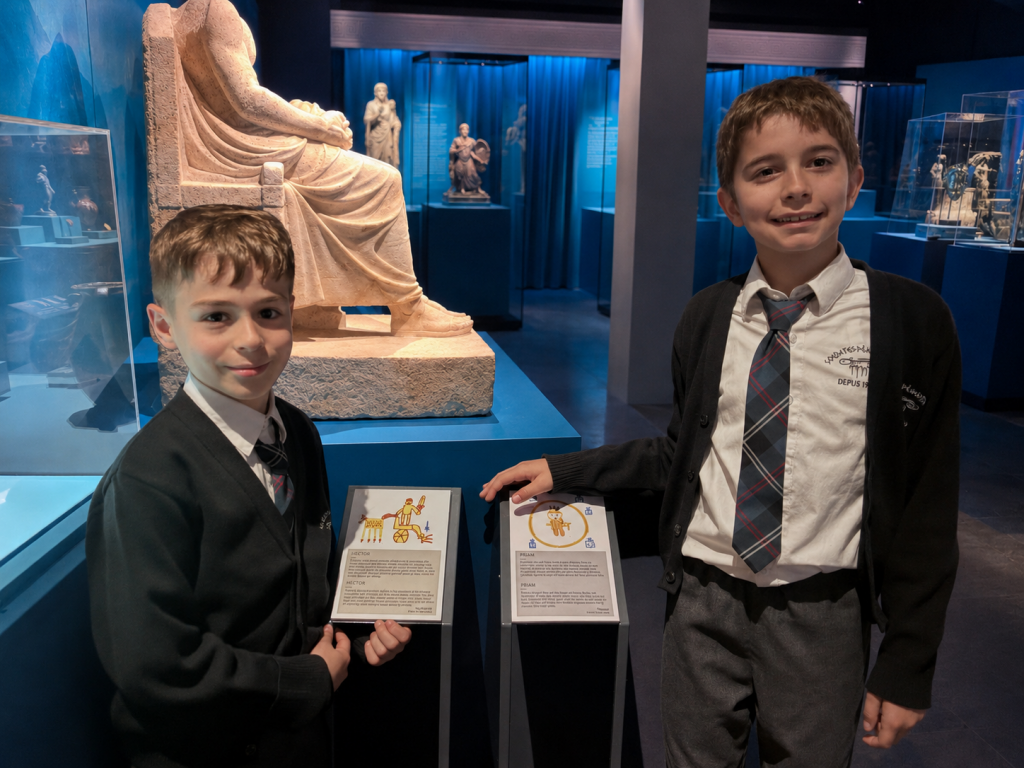
The creative work continued on paper. The painter and graphic artist Marie Joelle Fournier came to the classroom and led the children through a series of art workshops over three sessions. The students drew and painted their heroes and gods in strong colour and personal style, giving Cassandra a crowned profile and a blue diadem and arming Menelaus with sword and helmet. Their paintings now hang in the exhibition under their own names, offering visitors a glimpse of Greek mythology through the eyes of a new generation. In the galleries, students in the white shirts and crested uniforms of the school can be seen beside their stands, some next to Apollo and Athena, others by Hector and Priam, with towering seated statues and cases of Mycenaean gold rising behind them.
The high point arrived on June 5. The Grade 4 class of Socrates II walked the completed galleries as official guests, among the first to pass through the exhibition, accompanied by their teachers, Eirini Tourkomanoli and Andréanne Gauvin-Gagnon. The emotion showed on their faces. Their eyes lit up at the sight of the authentic vases and archaeological objects they had known only from books and history class. Their command of the material impressed the museum’s guides, and their pride reached its peak when they found their own words and artwork standing as part of an international exhibition of the first rank.
The school described the partnership as an example of education, culture and community joining forces to create an experience the children would carry for the rest of their lives, and extended its thanks to the students and teachers and to the museum team, including Annick Deblois and Andréane Nadeau, for the collaboration and its result. For generations, classical Greek, mythology and the great authors of antiquity formed part of the intellectual training of thousands of Quebecers, and the project added its youngest contributors yet to that long thread, giving the children of the diaspora a hand in presenting the story of their ancestors to the city.
La Grèce des héros. Au temps de Troie runs at the Pointe-à-Callière museum, in Old Montreal, until March 7, 2027.