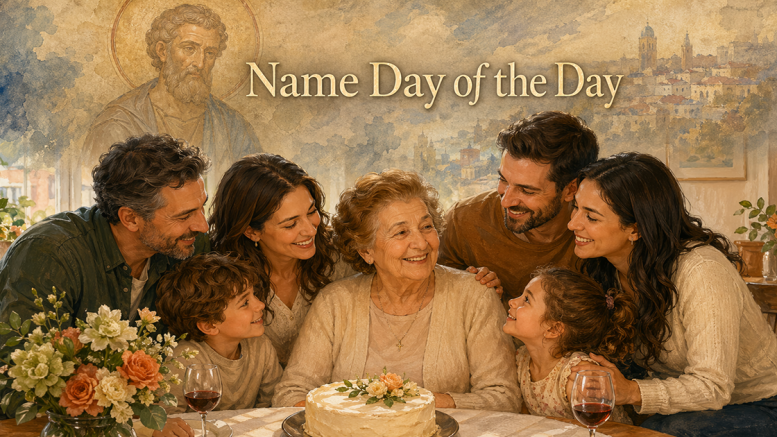
Today’s name day travels farther than family. Alongside Greek Pelagia, the same celebration can quietly include a Pelagie in French, a Pelageya or Pelagiya in Slavic circles, and anyone in your contacts whose name carries that same sea-born root. It is the kind of day that can turn into an easy conversation starter over coffee, at school pickup, or in a text message.
Pelagia comes from the ancient Greek word pelagos, meaning the open sea, the high sea beyond the shoreline. The name is deeply classical in sound and image, formed in Greek long before modern national borders and later carried into Christian usage and into other European languages. It still feels unmistakably Hellenic, with salt, distance and horizon built into it.
In the Eastern Orthodox Christian tradition, a person’s name day is the feast day of the saint after whom they were named at baptism.
That sea-wide feeling gives the name its own kind of presence. You can hear it in the theia who keeps everyone steady when plans change, in the across-the-street neighbour whose door always seems open, or in the co-worker who moves through a hectic day with calm room around her. Pelagia is not a small, tucked-away name. It has breadth to it, and a little wind.
So if you know a Pelagia, a Pelagie, a Pelageya, or someone at home called Pelagio or one of the familiar Greek forms like Pelagio or Pelagio’s affectionate household versions, today is a lovely reason to reach out. Chronia Polla! to everyone celebrating today, Greek and non-Greek alike, and especially to the friend who may be delighted to learn that a Greek tradition has been waiting quietly inside their name.