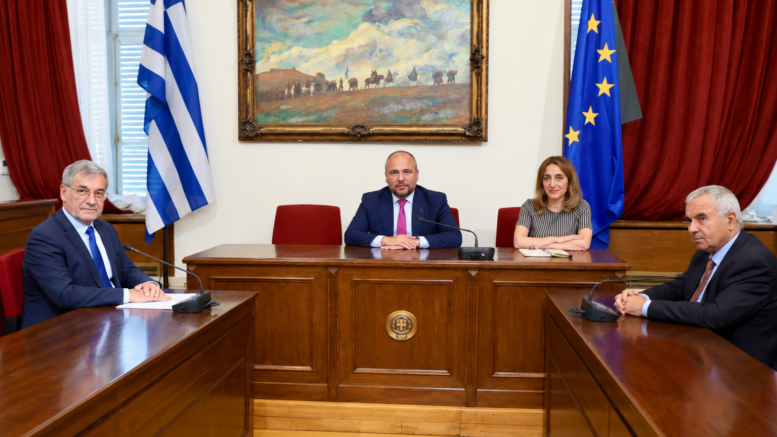
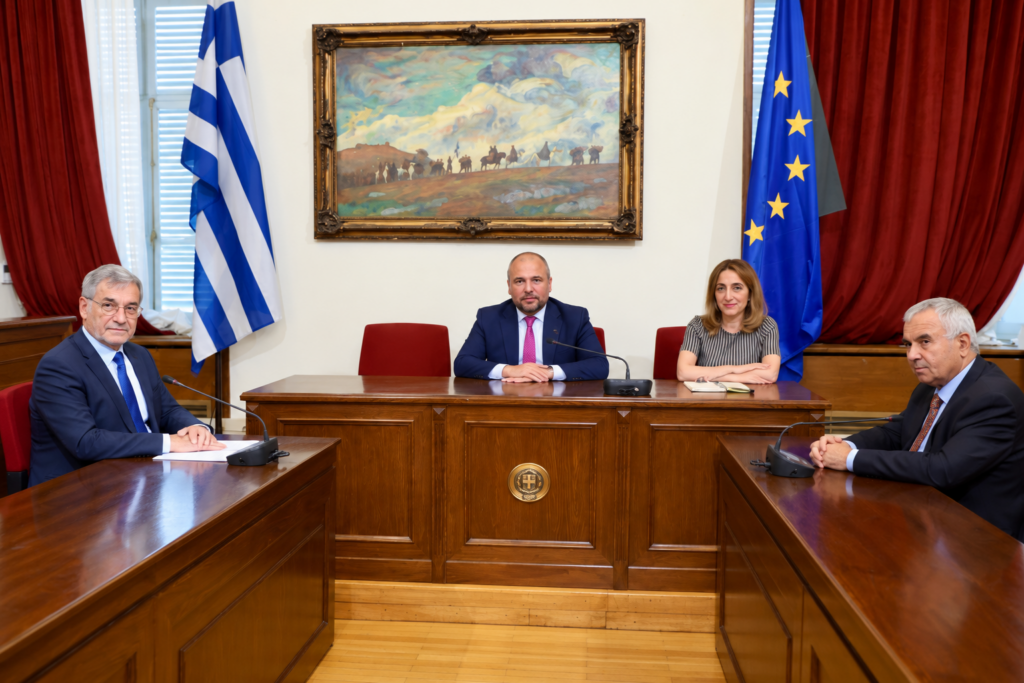

Beneath a Greek flag and the blue banner of the European Union, in a wood-panelled committee room hung with deep red curtains and a painting of horsemen crossing a sunlit plain, the Hellenic Parliament turned its attention across the Atlantic on September 23 to one of the oldest organized Greek communities in North America. The Special Permanent Committee on Hellenism of the Diaspora devoted the first item of its evening sitting to the Hellenic Community of Greater Montreal and its 120 years of service, placing on the parliamentary record the community’s case for Greek-language schooling, faster consular services, public health coverage for Greeks abroad and stronger ties for a new generation, in a hearing that would also show how quickly an institutional presentation can lose its way.
Committee chair Filippos Fortomas, a New Democracy member of Parliament for the Cyclades, welcomed community president Basile Angelopoulos, anniversary committee chair Justine Frangouli and Father Nicholas Alexandris in the chamber, with executive director George Tsantrizos and several board members joining by videoconference from Montreal.
Angelopoulos read a memorandum describing the community as “one of the most historic and most active organizations of the Greek diaspora.” He asked Athens for a stable, institutional posting of teachers from the Ministry of Education to staff the five branches of its trilingual Greek, French and English day schools, a permanent cultural partnership with the Ministry of Culture, free camps and visits to Greece for diaspora students, and more staff at the consulate in Montreal, where he said appointments for citizenship and passports are being given as much as a year out.
“The community has the infrastructure, the experience and the audience,” he said. “It needs, however, the active participation of the state to strengthen Greece’s cultural presence in Montreal.”
Tsantrizos described an institution that oversees five private day schools, a high school, six churches, a cultural foundation and social services, with Greek instruction dating to its first school in 1909.
Frangouli recounted an anniversary year that saw March recognized as Greek Heritage Month in Ottawa, followed by recognitions in Laval, in Montreal and in the National Assembly of Quebec, along with three summer festivals. “It was a moment, one summer, when everyone was drinking to the health of the Hellenic community,” she said.
The most moving testimony came from Angelopoulos, who left Nafpaktos at four months old. His father earned $25 a week, and every Saturday the family wrote to the grandparents in Greece, slipping $5 into the envelope. “If you keep us at a distance, we will stay at a distance,” he told members. Alexandros Kazamias of Course of Freedom said he obtained his own Greek social security number only at 54, upon his election, despite travelling to Greece since he was five.
Fortomas pledged to forward the memorandum to the deputy foreign minister responsible for Greeks abroad and to the ministers of education and culture. “The Hellenic Parliament must listen to the diaspora, record its real needs and carry the voice of Greeks abroad to the state,” he said in a statement on September 25.
The hearing began to unravel once Frangouli, after noting her anniversary mandate ends with the year, introduced herself as president of the Lyceum of Greek Women of Montreal, a separate organization, and used the community’s time to promote its immigrant monument and its proposed Greek museum, closing that segment by placing “the Lyceum of Greek Women” at Parliament’s disposal. She then turned to health coverage, contrasting diaspora Greeks with “all the migrants, the illegal ones,” and urged members to pressure their parties “especially before the elections.”
A running dispute over pension taxation with Paraschos Papadakis of Greek Solution followed, until Fortomas cut in: “Let’s not have a dialogue.” Father Alexandris from Toronto then ranged across postal voting, investment incentives and 3,000 diaspora cars with foreign plates.
Retaking the floor, Frangouli urged members “not to take the focus away from the 120 years of celebrations and the community’s requests,” then moved directly into European election turnout, credited New Democracy, accused the other parties at the table of “petty politics” over diaspora constituencies and recalled being elected a vice-president for the media at the Council of Hellenes Abroad in Thessaloniki. Fortomas thanked her for a “very assertive” intervention. “I agree with a great many of these points, but it is another conversation, and not one for today,” he said, handing the floor back to Angelopoulos “to close as brilliantly as he began.”
The transcript shows the anniversary chair speaking roughly 2,400 words across 16 interventions, against about 1,600 for the president in three. When Fortomas asked whether the president wished to close, it was Frangouli who answered, “Let the president close.” On a day meant to showcase a 120-year-old institution, its elected president spent long stretches of his own hearing as a supporting speaker, and it fell to a Greek parliamentarian to steer the delegation back to its own agenda.
An official presentation before a national legislature carries a narrow and demanding brief: a single voice, led by the elected president, speaking for the institution named on the agenda and leaving members with a short list of requests they can carry to the ministries. The Montreal delegation delivered that list in its opening memorandum, then buried it beneath a separate association’s museum project, a quarrel over pension taxation, partisan credit for the governing party and a history of the defunct Council of Hellenes Abroad. The committee draws its members from every party in the chamber, several of whom had just heard a community guest accuse their parties of “petty politics,” and the community needs their goodwill for its requests to travel any further. Papadakis had already told the delegation he hoped “we do not stay only at the level of theory.” The parliamentary record of September 23 now holds a clear account of what Montreal’s Greeks need, set beside an equally clear account of a delegation that struggled to keep to its own agenda.
Frangouli also spoke the delegation’s final words in the chamber, asking leave for the Montrealers to withdraw so the committee could attend to its internal business.