From a summer liturgy to Saint Lawrence Boulevard: the founding of Montreal’s first Greek church

Three decades after a borrowed hall first echoed with the Divine Liturgy, the Greeks of Montreal weathered an impostor in a cassock, welcomed their first priest and consecrated the Evangelismos church in 1910.
On the first Sunday of August 1897, in a hall above a confectionery on one of Old Montreal’s commercial streets, a few score Greeks stood shoulder to shoulder with Russian and Syrian worshippers and heard the Divine Liturgy for the first time in years, the responses rising in Arabic and Greek together beneath an icon of the Mother of God. The scene, recalled decades later by one of the city’s pioneer Greeks, carried within it the longing that would shape the next thirteen years of community life, the wish for a priest of their own, a sanctuary of their own and a school for their children. This instalment of the series, continuing the account carried in the previous issue of Greek Times, follows that longing from the rented halls of Saint Catherine and Notre Dame streets through the organizing of the first Greek Orthodox community in Canada, the impostor whose conduct nearly undid it, and the raising, in 1910, of the Evangelismos church on Saint Lawrence Boulevard.
The memory of that summer liturgy survives in the testimony of Charalambos Koutsogiannopoulos, the community’s first president, set down by the pioneer Ioannis Th. Fouriezos. As Koutsogiannopoulos told it, a Syrian friend came into the confectionery he kept with his brother Dimitrios one June afternoon and began to sing the Easter hymn Christos Anesti in Greek, in the middle of summer. The Syrian carried a letter from an Orthodox priest of his own people, who had written that he would come to Montreal on the first Sunday of August to serve the liturgy and commune all the Orthodox of the city, Greeks, Russians and Arabs alike. When Koutsogiannopoulos offered to rent a hall and to pay for its cleaning, the Syrian refused any fee. “I have not come, dear Harry, to rent out the hall of my house,” he said, in the account rendered here from the Greek. “I have come to invite you so that we may all worship and commune together, the Orthodox, since some of us have not heard the Gospel these ten years.”
Word spread within hours among the Greeks who pushed carts through the streets, and on the appointed Sunday the faithful crowded the upper room, kissed one another as on the night of Resurrection, and left asking when a priest and a church of their own might come.
The answer waited on numbers, and the numbers were climbing. The collapse of the Corinthian currant trade and the hardship that followed had turned a trickle of emigration into a flood, and between 1901 and 1910 some 173,513 people left Greece, against fewer than 17,000 in the decade before. By 1906, according to the educator and historian George D. Vlassis, roughly a thousand Greeks were living in Montreal. The official counts ran lower, Vlassis recording 66 people of Greek origin in the province of Quebec in the 1901 census and 772 a decade later, figures the historian Georgios Vasilakis judged too modest once undocumented arrivals and the Greeks’ habit of going unregistered were taken into account. Koutsogiannopoulos remembered a smaller city than the one that stands today, its northern edge at Pine Avenue, its western reach ending at Guy Street where the road was still packed earth, and its commercial life running along Saint James, Notre Dame and Saint Lawrence.
Resolved to put down permanent roots, a handful of the faithful bought a set of sacred vessels in 1903, silver and gold, crosses and a chalice, in the steady hope that one day the community would have a priest to use them and a church to house them. They drew up a plan, petitioned the Holy Synod of the Church of Greece for a clergyman, and bound their efforts to the pattern that Greek settlements across North America would make their own, the triptych of community, church and school. In 1906 they constituted the Koinotita, the first organized Greek community association in Canada, with Koutsogiannopoulos as president, Kostas Mitrakos as general secretary and Dimitrios Pergantis as treasurer, supported by a council of pioneers. Around the community gathered the first national associations, Patris, Anagenisis and the Panhellenic Union, formed to help newcomers find lodging and work, while a ladies’ benevolent society tended to the needy, among them a party of 62 Greeks who arrived together in 1902 and were settled through the women’s care.
It was into this season of hope that an unexpected figure stepped. The community’s chroniclers record that as word spread of the first temporary administrative council, a Greek-born man who had once served as a “priest” in Lowell, Massachusetts, reached Montreal and began officiating in a rented hall on Notre Dame Street. In the language of the old account, “amid feelings of the deepest enthusiasm and exemplary concord,” with the community’s program advancing as hoped, “there suddenly appeared the man who had once served as a ‘priest’ in Lowell, Massachusetts, a Greek named Iakovos,” who through what the writer called his hypocritical, Tartuffe-like conduct won the affection of the parish before he troubled its peace. Koutsogiannopoulos described the same arrival plainly. “Around the year 1906 we were perhaps a thousand, perhaps not, because many had started work in the villages,” he recalled. “Then a Greek priest by the name of Iakovos came through. We kept him, rented a hall on Notre Dame Street, and were content with him. He had a fine voice and a good bearing. More than a year passed before it came to light who he was.”
He proved to be an impostor who had never been ordained. “One day we lost the priest, and we lost the sacred vessels as well, the Holy Gospel among them,” Koutsogiannopoulos testified, naming the very crosses and chalice the community had bought with its own money in 1903. The man had borrowed substantial sums from a number of Greeks and had fled to Liverpool, England, carrying the church’s vessels, its Gospel and its chalice. The pioneers reported the theft to the nearest police station, and within a month word came back that the Liverpool police had met the fugitive at the dockside, placed him the same day aboard a ship bound for Canada, and ordered him handed to the Montreal authorities on arrival. He bowed his head when the men he had robbed entered the police office, and when asked to account for himself he answered only that the devil had put him up to what he had done. He returned the sacred vessels to the community’s administration and was deported from Canada at the Greeks’ request. The borrowed money was never recovered.
With the impostor gone, the community’s purpose held firm. In October 1906 the Holy Synod of Greece sent Archimandrite Agathodoros Papageorgopoulos, who reached Montreal on Oct. 25 and became the first priest of the first Greek Orthodox community in Canada. The earliest liturgies were sung in rented halls on Notre Dame and Saint Catherine streets, the latter near the Anglican church of St. James, which served the young community until the end of 1910. The Greeks secured a lot for their own sanctuary in 1908 and received their provincial charter in May 1909, and Father Papageorgopoulos travelled the cities of Eastern Canada to gather the donations the work would require.
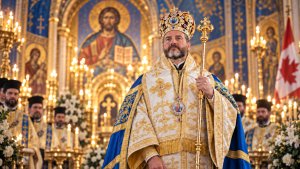
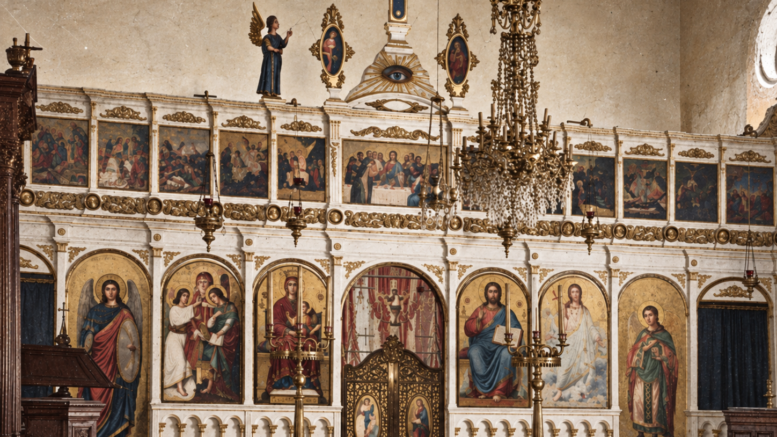
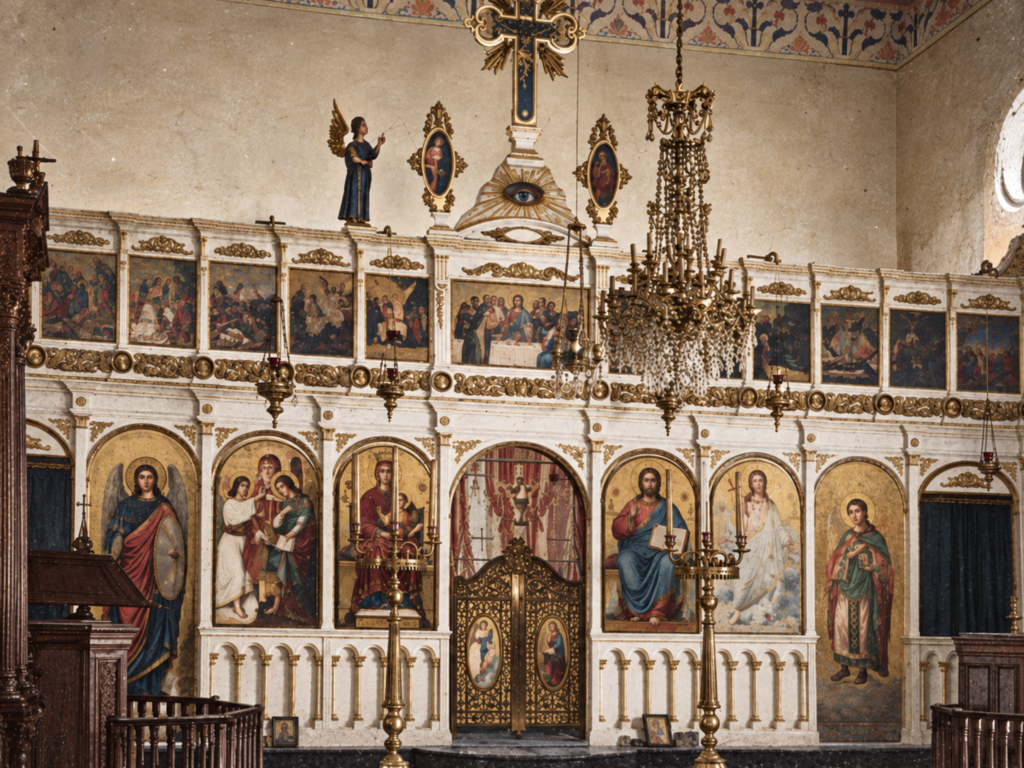
The building rose quickly once the ground was theirs. On May 5, 1910, the foundation stone was laid on the lot purchased at 753 Saint Lawrence Boulevard, and a little over seven months later, on Dec. 10, 1910, the church was consecrated as the Evangelismos tis Theotokou, the Annunciation of the Mother of God, with its first Divine Liturgy. It was the first Greek Orthodox church built in Canada. By the community’s own reckoning the land and the building together cost about $25,000, a considerable outlay for so small a colony, and the furnishing and adornment of the interior were completed gradually from the offerings of the faithful. The photograph that accompanies the original feature shows that interior as it stood in 1910, its sanctuary newly appointed, a record of what a people of modest means had built within a few years of organizing.
For the Greeks of Montreal the Evangelismos became the centre of religious and social life, the place where envoys of the Greek government and, during the war years that followed, members of the Greek royal family would stand at the door after the liturgy and greet the whole congregation by hand.
The community’s ambitions reached at once from the altar to the classroom. In the same year the church opened, the Greeks founded the Platon school, the first Greek school in Canada and in all of North America, housed at the start within the new church building on Saint Lawrence Boulevard between Prince Arthur and Milton streets. It began with about 30 pupils across four grades, taught in Greek, French and English and following the program of the city’s public schools, with John Didaskalou, of the province of Corinthia, remembered as its first teacher of Greek. This chapter of the series draws on the community’s own chroniclers, George D. Vlassis and Georgios Vasilakis, and on the journalistic references of Takis Petritis. In 1911 the community bought a three-storey house at 753 Clark Street, directly behind the church, and moved the school into its own quarters.
The next issue of Greek Times takes up the Platon school, its growth and its first teachers.