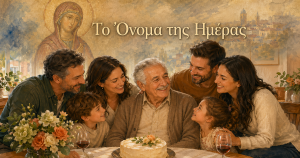
Today’s name day has a wider reach than it first appears. Alongside the Greek forms Gennadios, Hilda and Maximos, you can picture a Genadi, Gennady or Gena in a neighbouring community, or a Max and Hilda at work or school, all sharing in a tradition that Greek families have kept alive for generations.
Gennadius comes from the Greek name Γεννάδιος, built on the old Greek root gennaios, meaning noble, high-minded or well-born, a word with deep classical weight in Greek literature and moral thought. Hilda travels a different road, from Old Norse and Old Germanic roots related to battle, preserved in names such as Hildr and Brunhild before entering wider European use. Maximus is Latin rather than Greek in origin, from maximus, “greatest,” and passed easily into Greek as Μάξιμος, where it became fully at home.
In the Eastern Orthodox Christian tradition, a person’s name day is the feast day of the saint after whom they were named at baptism.
There is a certain dignity in Gennadius that suits the grandfather who never needs to raise his voice to hold a room, or the retired teacher whose advice still carries weight years later. Hilda has an older northern strength to it, the kind you feel in the across-the-street neighbour who is always first to shovel the walk after fresh snow. And Maximus, or the more everyday Max, fits the cousin with a big laugh, the coach who asks for one more effort, or the little boy already walking around as if the whole playground belongs to him.
So if you know a Gennadius, a Hilda, a Maximus, a Max, or one of the many related forms that travelled through other languages, today is a good day to reach out. Chronia Polla! to everyone celebrating, Greek and non-Greek alike, and especially to the friend who may be surprised to learn that today is their name day too.