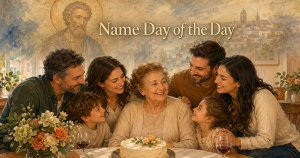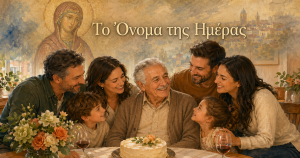
Today’s name day is a chance to celebrate one of those names that feels unmistakably Greek yet still travels well. If you know a Thecla, Tecla or Tekla, she shares today with Greek families, and the same goes for women named Myrsini, Myrto and Persephone, names that carry old layers of language, landscape and story into modern life.
Thecla comes from Greek Θέκλα, a later contracted form of the older Θεόκλεια, Theokleia. That older form is built from theos, “god,” and kleos, “glory” or “fame,” the same powerful kleos heard all through ancient Greek poetry. Myrsini comes from Greek μύρσινη, the myrtle plant, while Myrto is closely related to μύρτος, also “myrtle,” a word tied to beauty and ritual life in the ancient Greek world. Persephone is older still, a mythological name preserved from antiquity into English, French and Italian with remarkably little change.
In Eastern Orthodox Christianity, a person’s name day is the feast day of the saint after whom they were named at baptism.
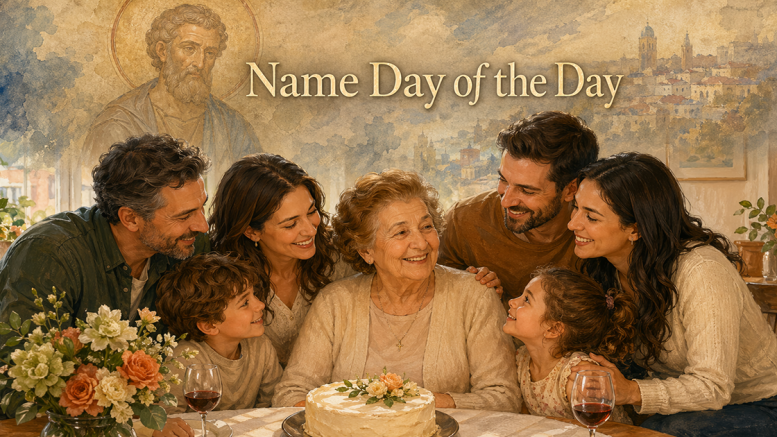
That gives today a lovely range of feeling. There may be a theia Thecla in the family whose quiet steadiness fills a room without any performance, a neighbour named Myrsini whose balcony is the greenest on the block, or a university friend named Myrto who always brings a little grace and freshness wherever she goes. And Persephone, with all the depth that name carries, suits the cousin who seems to move easily between seriousness and warmth, always returning with something new to say.
Some of today’s other forms are rarer and more local, including Mersa, Amersouda, Persis and Kopris, but that is part of the charm of the calendar. Name days preserve not only familiar names, but also older regional ones that keep Greek speech and memory textured and alive.
Chronia Polla! to everyone celebrating today, in Greek and non-Greek circles alike. If you know a Thecla, Tecla, Tekla, Myrto or Persephone, send the message along and tell them what a name day is. It is one of the easiest Greek traditions to share.