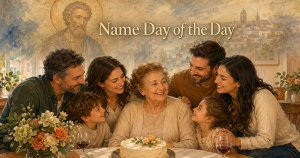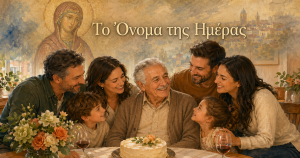
Today, every Martha you know shares a name day with the Greek tradition, and the circle is even wider than that. The name travels easily across languages, so a Marta at work, a Marthe at school or a Marfa in the neighbourhood can all be folded into the same warm wish. It is one of those names that makes Greek custom feel immediately shareable in everyday Canadian life.
Martha comes into Greek as Μάρθα, from the Aramaic word marta, meaning “lady” or “mistress of the house.” The name entered the Greek text of the New Testament and from there passed into Latin, then into English, French and many other European languages, which is why Martha and Marta feel both ancient and familiar at once. Its history is Semitic in origin, Greek in transmission and thoroughly international in modern use.
In Eastern Orthodox Christianity, a person’s name day is the feast day of the saint after whom they were named at baptism.
The name carries a steady domestic strength, the kind that suits the aunt who always has one more plate ready at the table before anyone asks, or the colleague who keeps the office running with quiet competence. It also fits the neighbour whose care shows up in practical ways, with soup at the door, a ride when needed or a houseplant revived on somebody else’s windowsill. Martha is a name with presence, warmth and capability, never flashy but never absent when something needs doing well.
So if there is a Martha in your family, a Marta among your friends or a Marthe in your contacts, today is a good day to send a note. Chronia Polla! to everyone celebrating, Greek and non-Greek alike, and especially to the friend who may never have heard of a name day until your message arrives.